

Sight Unseen
A blind expat's musings on life, death, and the Trump era
My name is Christopher Winner. I am an American citizen who has lived in Europe, predominantly Rome, for nearly half a century, and I founded The American | In Italia in 2004. I also began a column titled “Area 51,” which exists to this day. But, in 2015, I was diagnosed with glaucoma and have gradually lost my sight. The thoughts and comments you read below are snippets of my thinking in these challenging times and are dictated to co-managing editor Leigh Smith.

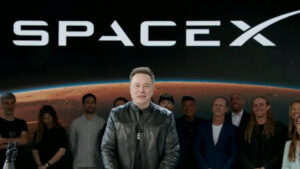 Han Musk: It’s all well and good for galactic impresario Elon Musk to announce that his multi-trillion dollar Space X project is on the cusp of opening the door to real-life Captain Kirks and Han Solos so that man can literally go where he has never gone before. But where, pray tell, will he go? Mars is the only planet in our solar system scientists believe might support human life. Trips to Venus (too hot) or to Jupiter (composed mostly of gases) might captivate sci-fi fans but have little consequence for human beings since they cannot be inhabited. Cutting to the space chase, it is interstellar travel that is most appealing and exciting, though it is just this kind of travel that is outside Han Musk’s reach. Distant exploration will demand either the arresting of mortality, cryonic sleep, or the creation of spacecraft capable of so-called warp speed. That or the invention of quantum physics machines that bypass time as we know it and put man in two places at once, much in the spirit of “Beam me up, Scotty.” Bottom line: the newer, bigger, faster, and more versatile rockets are impressive, but to reach the sci-fi galaxies the childish and churlish Musk boasts of exploring will require not improved rocket technology but a basic rethinking of human life, a frontier no one has yet to even approach.
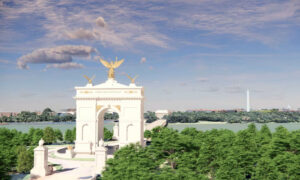
Defiling L’Enfant: The French architect L’Enfant devised an imposing but simple plan for the city that would be the American capital, Washington, D.C. — a city I would by good luck call home for nearly a decade. The two major seats of power, the White House and the immense Capitol building, would be connected by a wide boulevard, vaguely in sight of each other but not quite, like an intended flirtation. Memorials honoring Jefferson and Lincoln would sit slightly to the side, closer to the Potomac River. These four structures would all be neoclassical in nature, with domes and columns aplenty. At the center of it all there would be a 555-foot obelisk honoring George Washington and acting as a towering fulcrum. The cemetery where the war dead were buried was set into verdant, low-lying hills across the river, in Arlington, Virginia, gracefully low-keyed. Now this president proposes to ruin this perfect symmetry by building a triumphal arch that would lord over the cemetery and approach the Capitol dome in height. It would be his Parisian Arc de Triomphe. The idea comes as no surprise since his overweening vanity has already seen him add his name to the Kennedy Center, a squalid move thankfully undone by a local judge’s stern order. Yet the fact remains that, like a French poodle, this president must relieve himself wherever possible and thus mark his territory. If brought to fruition, the arch idea would mangle L’Enfant’s treasured blueprint. Many were the times when, by night, I would sit on the steps of the Capitol building, the Jefferson Memorial, or the Lincoln Memorial, before 9/11 made such youthful excursions impossible. Still, those lovely days in my lovely Washington remain etched powerfully onto my sense of American-ness. I can be singularly glad that my blindness will prevent me from seeing this gross real-estate developer’s imprint —and it is likely to be only one of many — on my beloved Washington.
 The Maradona dilemma: Only on the rarest of occasions does fan passion for a club player interfere with World Cup nationalism. But the dilemma unfolded before my very eyes and ears when host nation Italy was pitted against Argentina in the 1990 semifinal by chance set in Naples. At the time, Diego Armando Maradona was the Naples club team’s hero and savior. He had guided Napoli to an Italian league title and dwelled in the realm of the superstitious city’s saints. So when Italy took on interloper Argentina in a stadium that would later be named for Maradona, fans were muted, unable to decide whether to cheer their favored son or their favorite nation — an atmosphere unlike any I’ve ever witnessed. Argentina defeated Italy only to lose to West Germany in the title game played in Rome. And after the cup, Maradona returned to perform his magic for Napoli. What about this year? My intuition tells me Argentina will not repeat. Lionel Messi, who caught lightning in a bottle in 2022, won’t do it again. So who then? Look to Spain and France, classy sides both. Or to England, desperate to repeat 1966. Africa Cup finalists Senegal and Morocco are both tough, but lack seasoning. Croatia has been consistently fierce for a decade. Also in my mix are co-host Mexico, Germany, and Portugal, as well as upstarts Switzerland and Norway. Too many are the outliers to count, the group-stage scramble perhaps the cup’s most engaging phase. At least unlike 1990, there will be no Maradona dilemma. So let the madness begin.
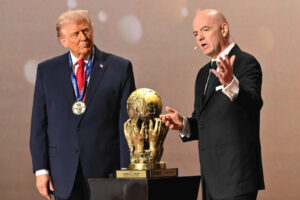 Foolish FIFA: FIFA has failed to do what it could and should have done a year ago, when both Israel and the United States were already on war footing in Iran — relocate Iran’s World Cup matches to Canada and Mexico. Instead, hoping to placate an American president’s belligerent prejudices, it awarded him its inaugural Peace Prize, a red-card error in judgment since his one and only goal was the Nobel Peace Prize. It should, therefore, surprise no one that Iran will have to fly from its provisional base in Mexico to play matches in Los Angeles and Seattle, to then be herded onto a same-day flight back to Mexico with ICE and police everywhere. A simple understanding of geopolitics could have prevented most of this, but FIFA preferred the illusion that old-school American fair play would prevail over reactionary politics. Would moving Iran’s games to Mexico or Canada have been inconvenient and caused some degree of havoc? Without doubt. But better inconvenience than the fiasco now afoot.
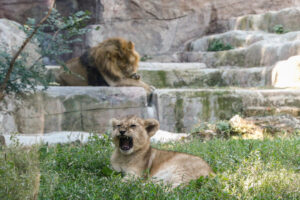 Imprisoned lions: For decades, I have lived only blocks from the Rome Zoo, here euphemistically referred to as the Bioparco. I strolled its grounds a few times when I could still see, usually in the company of visitors who wanted to take a peek at the animals. But those days are long gone and now the zoo’s existence comes to mind at hourly intervals when a booming recorded female voice announces in both Italian and English that it is forbidden to feed the animals. But after the zoo closes in early evening, the tone changes. This is when I hear the roar of Bengal tigers, Serengeti lions, Siberian bears, and Indian elephants, a raw but sincere music I once found quaint. What could these caged animals be thinking, week after week, year after year? Only now, as a blind man, have I begun to understand. Their sounds are not casual. Each night they tell the world that they are locked in, imprisoned, deprived as I am deprived of a vital aspect of life, their autonomy, to roam and see the world outside their furnished prison. Like me, they desperately want something back. Like me, they will never attain it, so that every day by twilight they express their mournful regret just as, next-door to them, I more quietly mull over my own shut-in sadness.
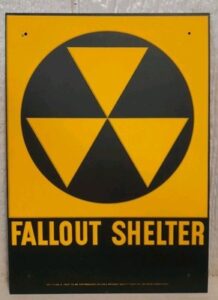 Mr. Pete: These are strange days for the men and women of NATO, their eyes trained east toward Russia while also aware they’ve essentially been orphaned by Uncle Sam, their longtime benefactor. They are like the Yankees come to play a game they know but suddenly confronted with a lack of bats, balls, bases, and, worst of all, umpires. Where then to turn for everything from scarce jet fuel to combat advice, since even the European Union emits confusing signals? NATO’s surreal situation reminds me of a neighbor of ours, Mr. Pete, who in 1960 had a giant hole dug in his backyard into which a submarine was lowered, or so we boys thought — I was seven. But it was in fact a fallout shelter with cots, canned food, and a water cooler. We were allowed to play in the sub and even got sugar cookie treats from Mrs. Pete. In exchange we had to listen to him tell us about the “Russkies” and that in the end there would be no alliances and we’d have to fend for ourselves. All his bluster took on urgency two years later when Moscow delivered nuclear-tipped missiles to Cuba. Cold War life going forward borrowed pages from the thick 1986 Tom Clancy novel, Red Storm Rising, in which Islamic extremists seize a vital Russian pipeline, thus forcing the Soviet Union to invade oil-rich Persian Gulf countries and triggering a massive conventional war in Europe. Though a very smart military writer with a superb mind for fiction, not even the likes of Clancy, were he still alive, could imagine Uncle Sam turning away from Europe. But he has, leaving NATO unsettled and, at times, directionless.
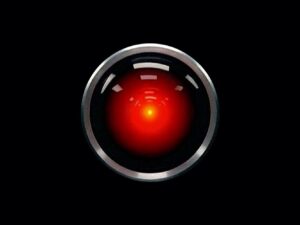 HAL revisited: I was among the few who watched the 1968 premiere of Stanley Kubrick’s “2001: A Space Odyssey” in Cinerama, a short-lived but mesmerizing technique that used three projectors operating simultaneously to display the entire canvas of the film on an amphitheatrically shaped screen measuring some fifty feet, floor to ceiling. Cinerama, for all its magnificence, took second place to the film’s star, an artificially intelligent supercomputer named HAL 9000, its voice dubbed by the Canadian actor Douglas Rain in flat, eerie tones. HAL is the soul of a vessel sent into distant space to investigate a Tower of Babel–like monolith on Earth’s moon (and, previously, in Africa at the dawn of humanity) that appears to take orders from its Jupiter counterpart. Though hundreds of postwar films and books touched on the inevitability of AI, HAL 9000 was unique, in essence a hyperintelligent supplementary human with a glowing red eye. At the time, some critics viewed HAL as a high-tech caricature, the brilliant machine made in man’s image, which, given human nature, would eventually turn against him. Ultimately undone by data it cannot fathom, HAL kills one of the two astronauts on board, forcing the second one to “disarm” it, to use Pope Leo’s word. My memory of HAL, a traumatic one for a boy, comes as the head of the American AI firm Anthropic has openly said that some new AI systems may soon have the menacing capacity to elude human control, HAL finally come true. He all but begs other AI firms to construct what he calls a brake pedal. I doubt he will succeed for the same reason HAL was made omnipotent, because superintelligence is thrilling, but as futurist Arthur C. Clarke — author of the 2001 series — knew, an AI door left too ajar can be symbolically and literally murderous, like a hormonally homicidal teen with an AK-47. The message is simple: Disarm now before HAL and its 21st-Century masters will not allow it.
Subtraction: “The Earth is hungry to subtract” was the opening line of a poem I wrote in the mid-1990s after a series of earthquakes in the Americas, Anatolia, and Eurasia. The poem’s speculation involved the opening of fissures that would come to swallow up the whole of humanity as an aging Earth grown tired of the burden of its surface dwellers. But the subtraction I failed to take into consideration is molecular, viral, the sickness not below but on the surface, between human beings. For fifty years now, new viral strains, most carried by birds, bats, rodents, and simians, have begun contaminating humanity’s vulnerable inner fluids. Imagine, please, a coronavirus-like epidemic of Ebola, whose latest strain is menacing several African nations. The result might be more like what was imagined in the postapocalyptic film “28 Days Later.” At a more existential level, consider as well that Earth is aging and by all accounts has already lived about half its projected lifespan, 5 billion years, a lifetime that will ultimately come to a quietly cold end after the sun becomes a white dwarf. Unless the inhabitants of Earth find and colonize a new home, they will vanish. In a time when many debate whether climate change is real — few choosing to study the fate of dinosaurs or to meditate on ancient ice ages — the reality that the planet itself is entirely mortal dawns only on astronomers. And yet the real tick-tock is not a social media platform, but the sound of actual time passing, in the end bringing my poem’s prophecy of subtraction to fruition.