

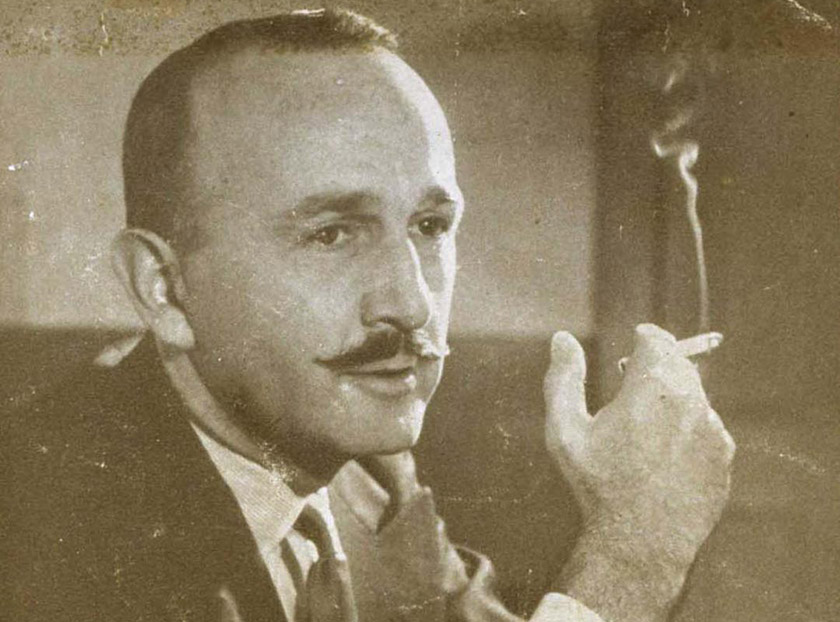
In the painful final days of his life, my father, usually the most private and discreet of men regarding his youth, broke into what could only be called song.
I have the most extraordinary dreams, he told me.
And they were, though some were not dreams at all.
He was in Brooklyn with his mother on a tram in the sunshine. This was the Brooklyn he never mentioned to anyone, having sought all his life to suppress his Jewish roots. He had changed his name from Frank Hyman Winner to Percival Horace Winner and, then, finally, to Percy Winner.
He was in Brooklyn with his mother on a tram in the sunshine. This was the Brooklyn he never mentioned to anyone, having sought all his life to suppress his Jewish roots.
Yet here he was on a sunlit tram in his Brooklyn.
It is such a beautiful day, and my mother looks festive, he said. Look at us together, under the “El”! The girders! The stairway!
Not down but up, since New York of that era had elevated subway trains. Only a few stretches of elevated track remain today.
Why is she letting go of my hand?
I never imagined she could walk like a ballet dancer, in leaps. Dream leaps.
She, his mother, was Rose, a sandy blonde.
In another landscape he was walking alone across the Brooklyn Bridge at twilight, headed for New York’s Greenwich Village.
There, he said, he would be rehearsing a play by . . . by . . .
Oh, what was the man’s name?
I waited.
Yes! Yes!
O’Neill.
Eugene O’Neill, I asked.
Yes, my friend.
Madness? Delusions?
Not at all. My father was a member of the Provincetown Players at the start of the last century and in fact acted in some of O’Neill’s early plays.
He wasn’t famous, said my father.
We drank together, and I was the child among them. In 1917, my father was 18, O’Neill barely 29.
An old man.
In another sharp flashback, my father recalled taking narcotics, heroin to be precise. It was, at the start, a drug prescribed to soothe nerves.
It did more than that, my father announced. He sang in the streets, went to a brothel, met a woman named Elsie, dreamed of their marriage, and woke in an alley when roused by police.
He had lost two days to heroin’s stupor.
Not a dream, said my father. Not that one. The truth. He could still imagine Elsie and would soon fake his birth certificate so he could marry a woman who looked like her, Helen. It was 1917.
My father imagined his father; “was he Dan, was he David?” He imagined his predecessor walking Brooklyn selling things. But what were these things? And had his father always been a salesman?
The dream did not answer.
My father died horribly, said my father. Of Hodgkin’s lymphoma, of every form of cancer.
My father imagined his father; “was he Dan, was he David?” He imagined his predecessor walking Brooklyn selling things. But what were these things? And had his father always been a salesman?
Precisely my father’s plight as he worked to remember and flesh truth from dreams.
“I was a colonel in the Sahara. I fought.”
Not quite. He was instead a “chicken,” or fake, colonel serving as an adviser to Dwight Eisenhower during Operation Torch, the Allied campaign against Erwin Rommel in North Africa.
Elsie was with me, and we walked amid dunes.
No, but a very pretty and sandy thought.
I am at a baseball game, he said.
It is Brooklyn against . . . California?
No, not California? Big-time baseball did not go west until after the war.
But there is a player all talk about . . . Rory? Ray? Richard?
Ruth, my father settles on.
A big man with a pug face. A fisherman’s son’s face.
I think he was Italian, my father said. But that was another man, I jump in.
DiMaggio.
Yes! That was his name!
In one of the last dream recitations, my father was in Paris, where he in fact spent a number of years in the early 1930s.
There is a place with omelets.
Marie is there.
I hear it!
The bells.
Yes.
We’re walking the streets.
We are cracking the eggs on the pavement.
I say nothing. The clock is winding down.
I feel her close to me. Marie.
And have I told you, perhaps not, that I have extraordinary dreams?
Have I told you that I am not afraid of death, but this . . . this dying . . . I loathe it.
On the last day, he said nothing.
He whispered air.
So much still to say.
And then he was dead.
