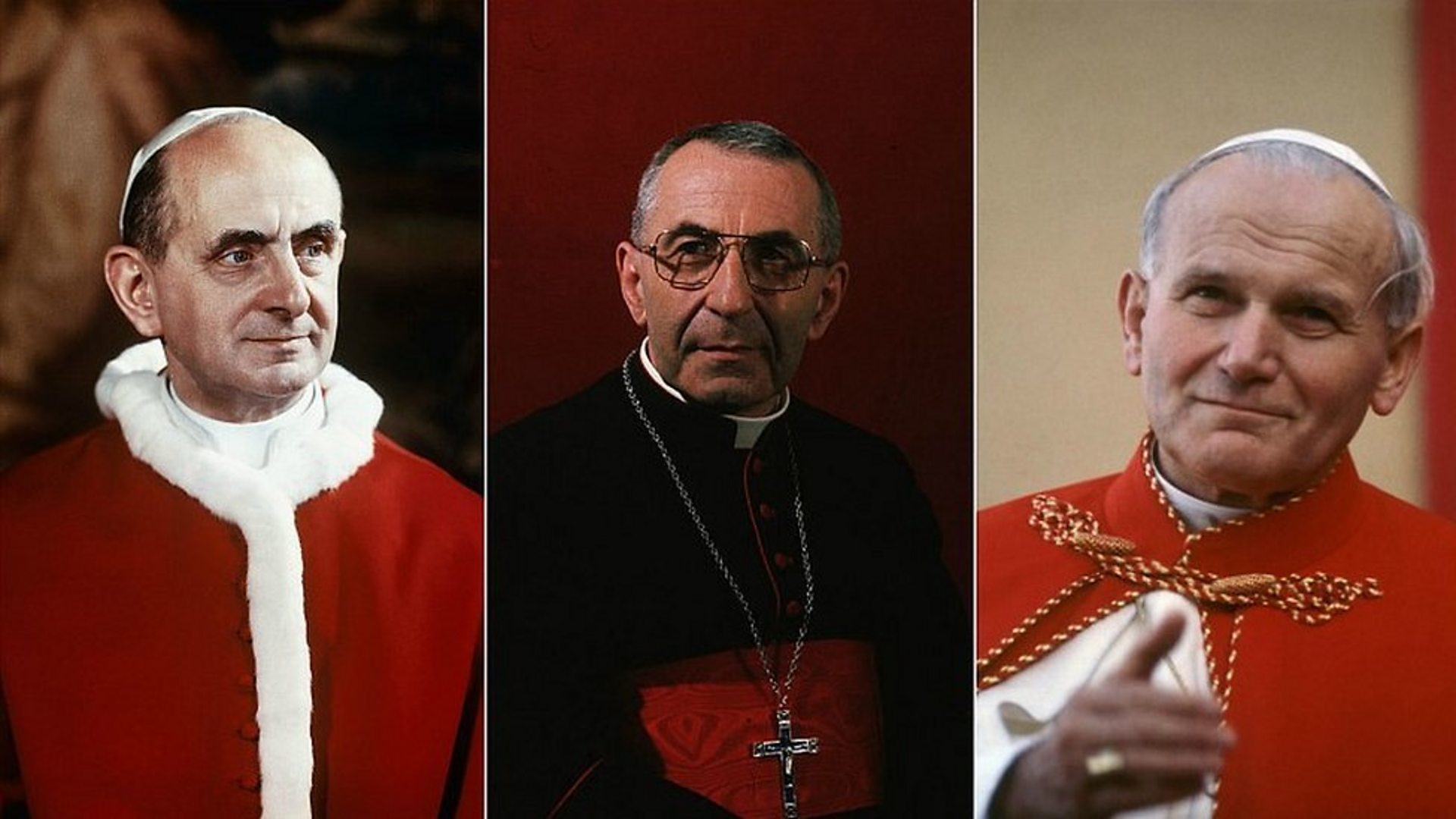
The year 1978 was the year of three popes, two papal funerals, two Conclaves, and two papal elections. This all happened because the successor of Paul VI, Cardinal Albino Luciani, who had been elected on 26 August, died after only 33 days in the seat of St. Peter.
On the morning of 28 September 1978, I was teaching a class of children of various ages in a small village school in the Piedmont region when the lady caretaker came in and announced, “The pope has died!”
To read the first part of this series, please visit this link.
“Well, yes, I know, a couple of months ago!”
“No, the new pope!” she cried.
Albino Luciani was born on 17 October 1912 in Forno di Canale (today’s Canale d’Agordo) in the province of Belluno, in the Italian region of Veneto. His father was a bricklayer. By the age of 10, he felt called to the priesthood. When he asked his father for permission to enter the seminary, his father, a socialist, replied, “I hope that when you become a priest you will be on the side of the workers, for Christ Himself would have been on their side.”
Luciani was ordained priest on 7 July 1935.
Though his simple appearance and poor health may have barred Luciani from becoming a member of the episcopate, Pope John XXIII was adamant. To the perplexed cardinals of the commission he said, “In this case, he will die as a Bishop.” From the very beginning, humility, solidarity, and simplicity of style were characteristic features of Luciani’s ecclesiastical career. At the 1971 Synod of Bishops, he suggested that dioceses in rich countries should devolve one percent of their income to developing countries “to compensate for the injustices that our consumer-oriented world is committing against the developing nations and in some way to make reparation for social sins.”
He received the cardinal biretta from the hands of Pope Paul VI, who made him Patriarch of Venice.
When Luciani became Pope, he chose the name of John Paul I, in deference to John XXIII and to Paul VI. In his book In God’s Name, David Yallop suggested that Pope John Paul I might have discovered corruption in the Vatican Bank, run by the notorious Archbishop Paul Marcinkus.
After his sudden death, several conspiracy theories sprung up. In his book In God’s Name, David Yallop suggested that Pope John Paul I might have discovered corruption in the Vatican Bank, run by the notorious Archbishop Paul Marcinkus. Archbishop Paul Marcinkus was suspected of laundering huge sums of Mafia money, and Roberto Calvi, the chairman of Banco Ambrosiano (a bank owned, in large part, by the Vatican Bank) was thought to be involved too. Recently, Charles Theodore Murr, in his latest book, Murder in the 33rd Degree: The Gagnon Investigation into the Vatican Freemasonry, stated that Cardinal Gagnon brought the new pope the results of his inquiry into the infiltration of Freemasonry in the Vatican’s upper levels. Pope John Paul I was shocked and decided to take immediate action.
According to Murr, John Paul I summoned Cardinal Sebastiano Baggio to demand an explanation. Cardinal Baggio presided over the Congregation for Bishops (now Dicastery for Bishops), the department that overlooks the selection of new bishops. It was against this cardinal that Gagnon had collected so much evidence.
The meeting took place on the evening of 27 September. The conversation was heated; raised voices were heard by the Swiss Guards standing outside the thick, heavy doors of the pope’s studio. Then the cardinal stormed out of the room in fury and left the palace. The next morning a nun found the pope dead in his bed.
Murr does not suggest that the pope was deliberately killed, but he reports Cardinal Gagnon’s opinion: “There are any number of ways a man might be killed. . . . I do not find unreasonable the possibility of a 66-year-old man being induced ― pushed, if you will, beyond his physical and emotional limits into cardiac arrest.” And it was not a mystery that the pope had a history of coronary problems and was taking prescribed heart medications.
No autopsy was ever performed on the body of John Paul I, and Cardinal Gagnon’s investigation was never published.
Karol Józef Wojtyła was born in Wadowice, Poland, on 18 May 1920, and he was the first non-Italian pope in centuries. The last “foreign” pope had been Adrian VI, a Dutchman, elected in 1522. As a boy, Wojtyła was a sports enthusiast and played football, often as a goalkeeper. He cultivated a passion for sports throughout his life, including during his papacy, enjoying mountain trips, skiing, and kayaking. While studying at the Jagiellonian University in Kraków, he developed an interest in theater and performed with various theatrical groups. His talent for languages emerged during that same period, and he learned as many as fifteen languages, such as Esperanto, many of which he used during his pontificate.
When the Nazis invaded Poland, young Wojtyła, like all able-bodied Polish males, was required to work, to avoid deportation to Germany, and was employed in a quarry. After meeting Jan Tyranowski in 1940, an ardent admirer of Discalced Carmelite charism, he joined the Carmelite spirituality and the “Living Rosary” groups of young men and women and was introduced to the writings of John of the Cross. He started to attend the clandestine underground seminary run by the Archbishop of Kraków, Adam Stefan Sapieha and, after the end of WWII, was ordained priest on 1 November 1946. In 1958, Wojtyła received Episcopal consecration, becoming the youngest bishop in Poland. Pope Paul VI made him cardinal in 1967. His election to papacy was the result of a compromise. When the Conclave started, it was clear that neither of the two strong candidates, the conservative Giuseppe Siri, Archbishop of Genoa, and the “liberal” Giovanni Benelli, Archbishop of Florence, had sufficient support to secure election. On 16 October 1978, Karol Józef Wojtyła became the 264th Roman Pontiff, choosing for himself the name of John Paul II as a homage to his predecessor.
Pope John Paul II was a globe-trotter of Catholicism. He made pastoral journeys to 129 countries, traveling for an estimated total of 680,000 miles, always attracting huge crowds. In Manila, during his travel in the Philippines, about four million people attended the World Youth Day in 1995. As a young priest, Wojtyła loved working with young people. The World Youth Days stemmed out of his constant concern for the spiritual health of youth. He presided over nine of them in various parts of the world.
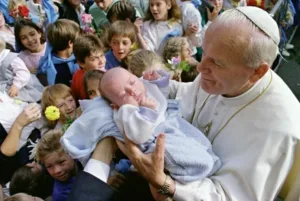
Globe-trotting Pope John Paul II visited well over 100 countries during his 27-year papacy. Here, he visits with French children in 1986.
Papa Wojtyła, as he was often called in Italy, took a middle course between conservatism and a more liberal vision of the church and its role in the world. And he was equally criticized by progressives for his opposition to the ordination of women and the use of contraception (even to prevent the spread of AIDS in the Third World) and by traditional Catholics for his implementation and support of the reform of liturgy following the Second Vatican Council. Many deemed even his action against child sexual abuse within the Catholic Church too feeble.
Notwithstanding his purported aversion to dictators, he openly supported military juntas in Central and South America, even reportedly funding the Contras guerrilla group in Nicaragua through Marcinkus’ Vatican Bank. His appearance beside Chilean criminal and dictator Augusto Pinochet on the balcony of the Presidential Palace in Santiago in 1987 shocked a large number of Catholics, who were still mourning the assassination of Archbishop Oscar Romero, who was believed to have been murdered by an assassin in the pay of the El Salvador military junta in 1980.
A fierce anti-communist, rumors are that John Paul II used the Vatican Bank to funnel money to the Polish Solidarność trade union. He also is considered a pivotal actor in the fall of the Communist regime in Poland, an event that started a domino effect, leading to the fall of the Berlin Wall and the demise of Communism in Eastern Europe.
He apparently did not take any action to counter the infiltration of Freemasonry in the church, and he confirmed the cardinals suspected of being Masons in their respective roles, disregarding for years the results of Cardinal Gagnon’s inquiry, at least until the first attempt on his life by the Turkish gunman Mehmet Ali Ağca on 13 May 1981. According to some well-informed sources, his first words after he was brought out of a coma, were “Call Gagnon.” However, he both left Archbishop Paul Marcinkus in charge of the Vatican Bank until 1989 and allowed a major cardinal in the odor of Masonry, who was responsible for a vital congregation of the church, to remain in office until 1984. An Italian judge issued an arrest warrant for Marcinkus in 1987, asking for his extradition to Italy, in connection with the financial crimes at Banco Ambrosiano and the mysterious death of banker Roberto Calvi, whose body was found hanging from scaffolding under Blackfriars Bridge in London on 18 June 1982. The request was met with a rebuff. John Paul II died on 2 April 2005.