I was eight years old when I learned that Pius XII, the first pope in my life, was ill. At school in the morning, and during Mass and evening services in the local church, we were all asked to pray for His Holiness but, as it turned out, to no avail. The pope died soon thereafter, on October 9, 1958, just a few days before my eighth birthday. I had a nebulous idea of where Rome was and of what pope really meant. At catechism classes, which I attended twice a week, I learned that the Holy Father was the head of the whole Roman Catholic Church, whatever that might be.
A seasoned Vatican diplomat and the scion of a noble Roman family, Pope Pius XII was born Eugenio Maria Giuseppe Giovanni Pacelli. He was elected to the papal throne on his sixty-third birthday, on March 2, 1939, when the world was already sliding into the chaos that led to World War II.
In the years following the war, he was criticized for maintaining political neutrality, and especially for not speaking more forcefully against the Nazis and the Holocaust. He was a staunch defender of Catholic dogmas such as papal infallibility and the assumption of the Virgin Mary.
However, as recently opened Vatican archives are showing, he was not completely politically neutral. The pope had previously been the legate nuncio to Germany, and he was fluent in German. The good relations he maintained with German high officials sometimes meant that the Nazi occupation of Rome was not quite as bad as it could have been. Keeping the diplomatic ties in place also helped some Jews and other would-be victims of German persecution escape with their lives instead of dying in extermination camps.
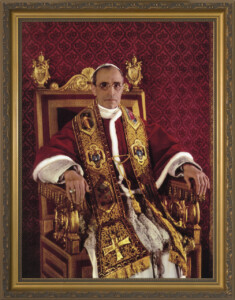
Pope Pius XII did not reign without controversy over his actions (or inaction) as the Holocaust transpired. Despite that, handcrafted art of the pontiff is still made, like this gold-framed piece.
A few years ago, a book called The Godmother, written by Charles Theodore Murr (which, incidentally, I translated into Italian), revealed details of Pius XII’s efforts to save Jews from certain death. The church hid thousands of Jews in Vatican palaces, in the Vatican’s extraterritorial residences in Rome, in convents, and in ordinary churches across Italy and other parts of Europe. Murr’s story is based on his conversations with his close friend Sister Pascalina (whose secular name was Josefine Lehnert), a German nun who served as Pius XII’s special assistant.
Pius XII’s successor was an altogether different personality. On November 25, 1881, Angelo Giuseppe Roncalli was born to a family of sharecroppers in Sotto il Monte, a village in the Lombard Alps. Before a surprise election by the Conclave as the 261st pope, Angelo Giuseppe Roncalli had been the Patriarch of Venice. Upon becoming pope, he took the name John.
As Pope John XXIII was 76 years old when he ascended to the Throne of St. Peter, several of his fellow cardinals imagined that his role would be merely that of caretaker, keeping the seat warm as it were, for a younger, more papable candidate. They could not have been more mistaken.
It was John XXIII who called the Second Vatican Council, which would in time reshape the life of the faithful. The Second Vatican Council marked a profound shift in Catholic doctrine. There was a change in the liturgy; there was a change in the way the church understood doctrines such as ‘no salvation outside the Church.’ After the Second Vatican Council, the Catholic Church became more open to dialogue with other Christian traditions and also with other faiths.
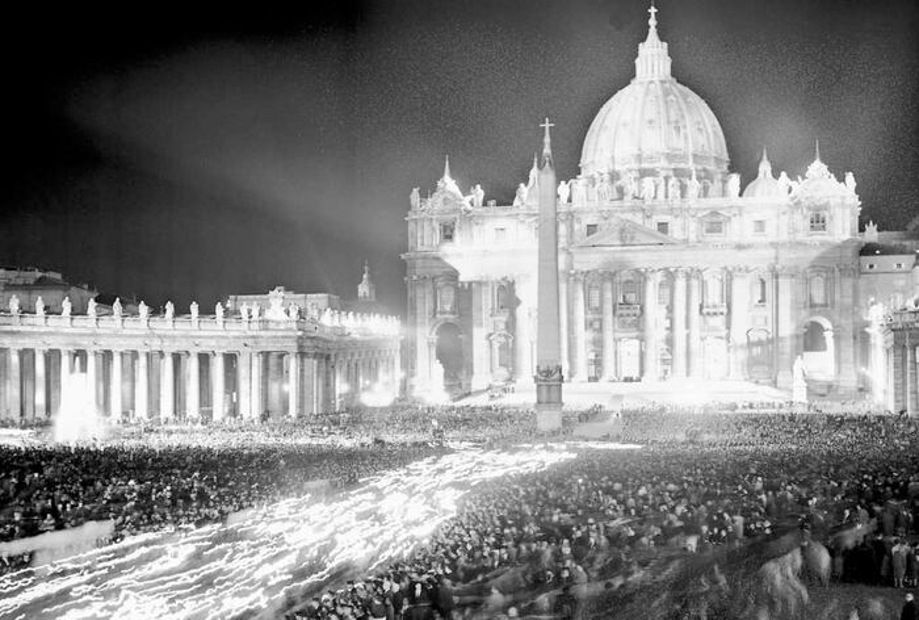
One of my fondest memories of him is his “moonlight speech,” delivered from the windows of his study to the crowd assembled in St. Peter’s Square on October 11, 1962, on the evening of the opening of the Council. I saw it at home, in my little Apulian village, on a nebulous black and white TV screen. “I hear your voices. Mine is only a single voice. But what resounds here,” he announced, “is the voice of the whole world; here all the world is represented. One might even say that the moon rushed here this evening. . . . to behold this spectacle.” Then he added, “When you go back home, you will find your children. Give them a hug and say: This is a hug from the pope.”
Though it was John XXIII who called the Council, he did not live long enough to see it through to the end. He died on June 3, 1963, at the age of 81.
John XXIII‘s “moonlight speech” is one of my fondest memories of him. In it, he said, “When you go back home, you will find your children. Give them a hug and say: This is a hug from the pope.”
And so it was that the task of bringing the Second Vatican Council to a close and implementing the changes it called for fell on the shoulders of the next pope, Cardinal Giovanni Battista Enrico Antonio Maria Montini, or Pope Paul VI. Paul VI, who came from a Lombard bourgeois family, never had aspirations to be anything other than a simple priest. Fate did not go according to his desires, though. He was soon called to attend the Pontificia Accademia Ecclesiastica, where he was initiated into a diplomatic career in the church. His only experience of diplomacy before that had been a short stint at the Apostolic Nunciature in Warsaw. A few years later, owing to his skills as an organizer, he was appointed Papal Chamberlain and started work at the Curia Romana, the civil service of the church. He carried out several assignments at the Curia, became Substitute for Ordinary Affairs, where he closely collaborated with Cardinal Eugenio Pacelli, who was secretary of state at the time. When Pacelli became pope in 1939, he confirmed Montini as a Substitute for Ordinary Affairs for the Secretary of State.
During the war years, Montini was instrumental in carrying out Pius XII’s provisions in favor of war prisoners and to save Jews from deportation. He was later Archbishop of Milan and received the Cardinal biretta from his good friend Pope John XXIII. When John XXIII called Vatican II, Montini was so amazed that he is reported to have said, “The old boy does not know what a hornet‘s nest he is stirring up,” foreseeing the strong resistance to reform by the most conservative part of the Catholic Church and the Roman Curia. Paul VI was the first pope to travel extensively in Europe and to Australia, the Middle East, and the Far East, as the first pontiff ever to use a plane. During an apostolic visit to the Philippines in 1970, he was the target of an assassination attempt by painter Benjamin Mendoza y Amor Flores, who tried to stab him. Several of the pope’s entourage helped foil the attempt, including his personal secretary, Monsignor Pasquale Macchi, who reportedly pushed the assassin to the ground and the man was arrested.
Paul VI’s post–Vatican II warning that “Through some fissure, the smoke of Satan has entered the Temple of God,” was clearly a sign of things to come.
In 1974, after the conclusion of the Council, two cardinals visited the pope and brought him evidence that Masonry had infiltrated the church and that top cardinals and high-ranking prelates leading vital congregations of the church were actually Freemasons. The pope then asked the Canadian Cardinal Édouard Gagnon to conduct a full inquiry inside the church, but when Gagnon brought him the results of his investigation, in three volumes, with evidence against notable archbishops and cardinals, Paul VI was already too ill to take any action and preferred to leave the task to his successor. He died a few weeks later, on August 6, 1978.
—This is the first in a two-part series.