When I finished my dissertation last summer, surreptitiously becoming a doctor of philosophy, I reposted the Facebook announcement sent out by my department. I had thought 15-20 people might have liked it — mostly my fellow cohort members and a handful of other people who were privy to my rather private academic journey.
Instead, I got nearly 200 likes, about the same number I received on the post announcing my pregnancy. Interestingly, the two are related: I jokingly dubbed myself “Dr. Mama,” because my dissertation dealt with a motherhood topic. But I was surprised and delighted to see so many people, from various chapters of my life, crawl out of the woodwork to acknowledge my intellectual achievement.
Getting a doctorate was honestly never one of my goals in life; even when I started my degree, I did so largely for practical reasons — the salary and benefits were good — enough to keep me financially independent and free. But the whole idea of going into academia went against the grain of my deeper convictions about finally, midlife, being able to turn to more creative pursuits. But I also knew that I needed to support those pursuits somehow (and also my daughter and myself as a semi-single mother), so I soldiered on, finding a topic that was publicly relevant and understudied, and tailoring my project to suit my ultimate goal of writing about it for the public.
This [moving after a divorce] puts mothers in dire situations (one scholar compared the dilemma to Sophie’s Choice) and gives fathers the upper hand in controlling women’s lives even after separation.
My initial research confirmed this. For a small pilot study, I spoke with mothers from across the country who were trying to move on with their lives at the behest of their ex. A Harvard Ph.D. who could not go on the job market said she felt like Rapunzel trapped in the tower. She also compared the issue of women struggling to relocate to a “second #MeToo movement” because women are afraid to speak up publicly about their struggles. Mainstream media has covered relocation sporadically over the decades, to their credit, usually emphasizing that it burdens mothers.
But in the absence of more regular coverage, I dove into social media discussions, as a litmus test of the issue’s contemporary relevance. The ubiquity of relocation matched what family law attorneys had said about the frequency with which it comes up in their practice. My research found that mothers wanted to move to be near family support networks, new jobs, or new relationships (in that order); they felt trapped and, because of that, disenabled as mothers. But even worse were the mothers who had internalized the notion that they shouldn’t even try to relocate because the odds were stacked against them.
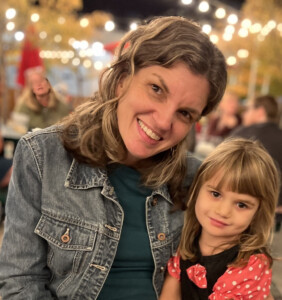
Kristine Crane and her daughter from a few years ago.
This scenario sadly echoed a debate from five decades ago, over joint custody, the outcome of which set the stage for the first relocation statutes. Fathers’ rights’ activists touted their need for more parental “rights” in pushing for joint custody; some feminists championed the practical utility of having fathers share, at least on paper, childcare labor; but others cautioned that joint custody would undermine maternal autonomy — especially if mothers were shouldering most of the responsibility for actually taking care of children. The pandemic proved that mothers are still, in fact, the country’s default caregivers, as mothers quit jobs in droves to care for kids. In my research, I likewise found that men spoke largely in terms of “rights” around child custody, while women spoke of “responsibilities” over children, including facilitating the father’s relationship to his own children.
This situation smacks of the second-class citizenry that women often experience when they become mothers — which is ironic, since motherhood ought to be an empowering position. Unfortunately, many feminists during the era when joint custody was being debated, the “second wavers,” neglected motherhood altogether. Since their main impulse was to put housewives in the workplace, they worried that advocating for mothers would mean confining women exclusively to a motherhood role. This has also been true in academia; in certain circles, talking about my research felt akin to walking down the runway in mom jeans. I once got into a heated, albeit helpful debate with a woman who accused me of being a “vintage mother.”
This actually made me smile, if for the wrong reasons, since I love vintage clothes and furniture; and my mothering style is arguably more like that of my indulgent grandmother than my anxious mother. But there’s nothing old-fashioned about my support of women as mothers. In fact, advocating for mothers ought to be a timeless pursuit, not one that’s regularly shelved for being politically incorrect. Andrea O’Reilly, a feminist scholar in Canada who established a whole field of studies called “matricentric feminism,” says mothers are “feminism’s unfinished business,” who despite forty years of feminism, remain disempowered. That should be a paradox, and if it’s not — especially given the current political climate in the U.S. — mothers should be included, without hesitation, in overall efforts to empower women.