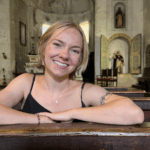
It was never-ending: Just when I thought Romano Romanini had showed me all he could of his sixteenth-century abode, he opened another door or led me up another set of stairs. When Romano had referred to his wife’s ancestral home as a palazzo, he was not exaggerating. This place was a palace, and Romano and his wife, Tilde, were its rulers.
Romano has lived in Cagli since 1964; three years after arriving, he married Tilde. Tilde, on the other hand, has been in Cagli since she was born, joining the long line of the Bonclerici family. The Bonclericis are descended from a fourteenth-century cleric, Guido de’Rossi, who later became the bishop of Cagli.
Guido proved himself to be a trustworthy secretary to the Duke of Urbino, Federico da Montefeltro. He was quickly dubbed a member of the “bon clerici,” meaning “good clergy” by the duke himself. Two centuries later, the surname de’Rossi was abandoned in favor of Bonclerici, and the family home was constructed.
Today, the Bonclerici home is a museum, a family home, and a trove of memories—all rolled into one.
At 88, Romano jokes that he must be the oldest professional geologist in the center of Italy who is still working.
Walking over the threshold into Romano’s office, I soon saw evidence of a lifelong dedication to his work as a geologist. Maps of terrain and books on rock formations lined the shelves. Piles of notes on landslide projects covered his desk. I asked Romano how he kept this all organized, and he tapped the side of his head, assuring me that he has it all organized in his mind.
Romano reaches up to grab a metal container; he doesn’t say the name but instead explains that it is a type of foot warmer.
Among the piles, Romano fished out a heavy iron key, placing it into my hand. The key opens the front door to the Torrione Martiniano, the iconic fifteenth-century tower that was part of the original city walls of Cagli. With his freer schedule, Romano volunteers at the tower, as the literal gatekeeper.
Leading me through yet another set of large doors, Romano motions for me to follow him up the stairs into what looks like a medieval kitchen. My mouth hangs open at the preservation, knowing that this could not possibly still be a functioning kitchen. Pots and pans adorn the wall. The black, stone fireplace with the crest of a wolf carved in the center is covered in utensils that I had never even seen before.
Romano reaches up to grab a metal container; he doesn’t say the name but instead explains that it is a type of foot warmer. Opening the lid, he points to where one would put hot coals, and then sits down to demonstrate how one would place their foot atop the closed lid.
There may not be labels on any of the artifacts, but just looking at them, you know they’re old. The type of old where you fear you will break it if you touch it in the wrong place. Regardless of what they are, they have a history of meaning something to someone. They still mean something to Romano and his family, hundreds of years later.
Up yet another set of stairs, French doors open up to the entry room and the living room. The entry room alone is forty meters long. But each room is filled to the brim with antiques. I am surrounded by crystal, silver, and marble—and feeling far too underdressed even to stand in the room that shines.
Romano explains that although some of these antiques came with the house, he and his wife have done their fair share of antique-hunting over the decades. Not wanting to put modern furniture in their home, they “preferred to get the ancient stuff,” Romano says.
Leading me down a hallway, Romano stops to show me the chapel-turned-kitchen that they use as a kitchen. He also stops to show me pictures of himself and his wife when they were younger, as well as baby pictures of their sons, Simone and Guido, who still live at home.
Out of all the rooms in this four-story palazzo, I didn’t think that Romano and Tilde’s bedroom would be one of them. Equally as elegant as the rest of the house, their bedroom is adorned with multiple gold mirrors and paintings. The room’s centerpiece is the antique bed, with a gold-colored bedspread that glows in the early afternoon sun.
Taking a closer look at the iron headboard, I see little specks of blue and red mixed with the metal, and Romano tells me that it is meant to resemble a peacock’s feathers. However, that is not the piece of bedroom furniture Romano wants to show me. Giving me a mischievous smile, he says, “I have something really beautiful to show you.”
He motions me toward a little blue and gold chair, il cassettone, in the corner. The colors are less vibrant due to its old age, since it belonged to his great-grandmother. Kneeling down, Romano takes the cushion off the chair, revealing a wooden base and the hole in the middle. It is a commode chair, a hidden chamber pot.
Hearing her husband and I laugh, Tilde comes into the bedroom. She is immediately horrified by the sight of her husband explaining the mechanics of the chair and proceeds to scold him in very fast Italian. All Romano does is laugh.
Joinin g us for the tour of her own house, Tilde then leads me into the main study. As amazing as the antiques in the room, those are not what Tilde wants me to look at. It’s the ceiling—which is covered by a fresco. The detail is exquisite, a painting that one would expect to see in the opulent palace of Versailles rather than a small Italian town. In the corner of the mural, written in French, are the words “Je suis tout à vous,” which means “I am all yours.”
Just being in the home, I can feel the love and romance radiating within the walls, but seeing a statement of love written on the ceiling is truly beautiful.
Romano asks me if I could live in a house like this, and I immediately say yes. Not just because I’m a history nerd, but because this is a home that is loved. Generations of people were born and raised here. The house is itself a physical love letter to Romano and his family.
The last room that Tilde wants to show me is across the main hall, and she must unlock it with a key. She describes the room as a salon that was her mother’s domain, and they themselves do not like to use it.
The salon is equally full of antiques, and pink and gold accents like the other rooms, but it has a layer of simplicity that the other rooms do not. Walking in, I am hit with a musky smell—like one that I would get from a grandparent’s house or an antique store. It is a memory preserved.
I look at Tilde, thinking that maybe this room is how she honors her mother’s memory. By leaving it untouched today, her mother’s imprint on the room remains, ensuring that Tilde still has a piece of her.
Before I know it, almost two hours have passed since I have entered their house. Walking out of its front doors is like jumping back into the twenty-first century. I thank Romano again for letting me into his home, knowing that a “thank you” would still not convey my gratitude at being privy to this amazing home and the family in it.
Editor’s Note: This essay marks the third in a series initiated by American Associate Editor Kristine Crane, who spent the summer teaching in the immersive Cagli Project.