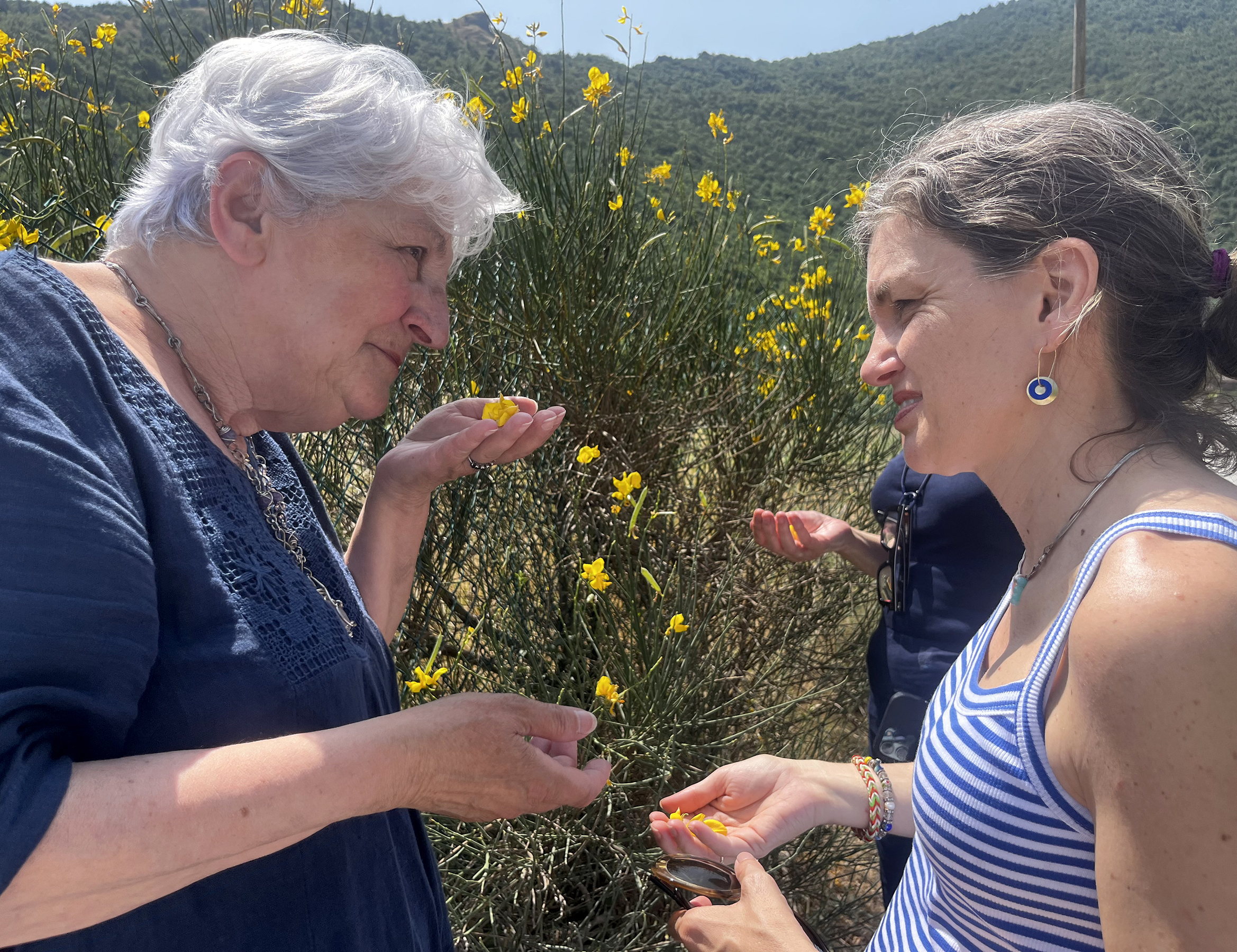
A friend of mine, a seasoned journalist in Rome, recently wrote about la dolce vita, and how travelers to Italy have various versions of it, all of which have strayed from the original meaning embodied in the Fellini film by the same name. I’m entirely guilty of co-opting my own “sweet life” in Italy, at least for one month out of the year. In June, I teach in a study abroad program in an Apennine Mountain village called Cagli, a hidden gem of a place. Our program is more like an apprenticeship program for students set on storytelling, and our motto is “if there are 8,000 people in Cagli, there are 8,000 stories to tell.” We’re connecting to people through their stories, which, for me, is the best way to connect to people.
This year, I gave my students an exercise I’d inherited from the poet Ellen Bass, who herself had inherited it from the poet Linda Gregg. The assignment was for students to keep a journal in which they record, briefly, six things they have seen each day — “not beautiful or remarkable things, just things,” Gregg says. I augmented this to include things noted via other senses, too, not just sight.
Our program is more like an apprenticeship program for students set on storytelling, and our motto is “if there are 8,000 people in Cagli, there are 8,000 stories to tell.”
My own first-day’s list started with the line, at London Heathrow, for the Bologna flight: It was unmistakably Italian. Meaning, amorphous. I’ve written previously about how Italian lines — coincidentally those in Bologna during my student days — taught me to assert myself. But on that day, I was so sleepy from jet lag that I was the second-to-last person to board, following sheepishly behind the herd.
My second thing was the sandwich I spotted at the Bologna airport. It was just a prosciutto sandwich on focaccia bread, but the kicker was what was squeezing out of it: soft, pillowy mozzarella di bufala. I resisted the temptation, however, for a much humbler affair: my leftover cheddar and tomato sandwich from Heathrow.
The third thing was the inkblot-sized espresso that emitted from the espresso maker in my hotel room. Oops, I guess I pushed the wrong button, I thought, incredulous at the tiny amount of coffee. But pushing the other button didn’t procure much more coffee. Is it broken? I was getting frustrated, when suddenly it hit me: I’d become Americanized, even in my taste for Italy — a tendency that, alas, would fortunately be corrected over the next month.
The fourth thing was the Sant’Orsola Hospital’s pronto soccorso ostetrico-ginecologico that I noticed on a gelato-hunting walk. An ER just for pregnant women? (And gynecology patients.) I’d never heard of such a thing, and I was immediately curious.
The fifth and sixth things occurred on our drive to Cagli the next day. About an hour into our three-hour drive, we stopped for coffee. Since I’d already had three coffees (if the two in my hotel room count), I couldn’t bring myself to get a fourth, but I was nonetheless glad to be back in the land of frequent coffee breaks.
Back on the road, the song “Strada Facendo” came on the radio. The students were mostly dozing, so I didn’t dare ask the driver to turn the music up, but it was playing loudly in my mind. It’s a feel-good song about going along life’s journey and the importance of persevering and solidarity. I remember listening to it with my ex-boyfriend in Italy, when we went on road trips. I rediscovered it several years ago, when I was teaching Italian. I played it for my students to teach them the future tense, which the song is mostly written in, but, secretly, I needed to hear it myself for its refrain: vedrai / che tu non sei più da solo. “You will see that you are no longer alone.” At the time, I felt entirely alone. I was a new mom, semi-single, in a strange place — and substitute-teaching a language I hadn’t been born into but had fallen in love with, not least for the sense of rebirth it had given me. The song, and the memories of Italy it triggered, had made me feel less alone. As I listened to it again en route to Cagli, I realized that Italy’s renewed presence in my life continues to remind me that I’m not alone.
After that first day, my “six things” entries waxed and waned. But here’s one more, a post-script of sorts:
Red lipstick
I have a middle-aged confession to make: I’ve never actually worn red lipstick. Like the rest of me, my lips are petite. My personality is also quiet, albeit mostly confident. I thought about my lips unexpectedly in Cagli, when I received a lip mask as a freebie insert to Amica magazine. One day, in search of blush, I went to the profumeria, and walked right into a vast, hard-to-ignore display of lipstick. I couldn’t resist trying on some neutral colors. The saleslady was nice and helpful, so I blurted out, “What do you think about red? Can I wear it?”
“Of course you can,” she said, then proceeded to give me three shades of red to try on.
“Ci penserò,” I said, wiping off the lipstick. I’ll think about it. When I checked out with my blush, she stuffed some free samples in my bag, including lipstick. When I got home, I fished out the lipstick. It was red. Ferrari red.
I smiled. I figure if Italy is where I donned my first heels, short skirt, halter top, and bikini, at age nineteen, perhaps it shouldn’t come as a surprise that it gifts me, at nearly fifty, my first red lipstick.
Editor’s Note: Work by Kristine Crane’s students in Cagli will appear in the coming months.