

This is a love story that could easily slip through the cracks if you let it. I won’t and can’t, not in the twilight of a fully lived life whose fullness has savored details above all else.
It is also a short and uncommon ode to a father who, beginning at age 12, raised me alone after my mother’s decision to leave, making a party of three into one of two. There were reasons. There always are. But they are not for today.
***
November 25, 1968, fell on a Monday, the Monday before Thanksgiving to be precise.
My father and I shared a smallish apartment in a green-brick apartment building on Connecticut Avenue in Washington, D.C. I was in my first year of high school, and he had turned 69, two years less than my age now, a month before that November Monday.
Though I loved my father very much, I struggled to keep pace with his intense political concerns. It had been an admittedly tumultuous year: Martin Luther King Jr. had been assassinated, Bobby Kennedy also, the Soviet Union had invaded Czechoslovakia, and the Democratic political convention in Chicago had seen an orgy of violence triggered by both racial tensions and opposition to the Vietnam War.
Washington itself had turned into a battlefield after King’s murder. I walked empty and charred streets in the Black heart of the city, in some cases less than a mile from the White House.
I failed in this, my epochal teenaged pursuit, to be among the first to own and play the latest the Beatles had to offer — and, as it turned out, the greatest.
The tumult had led us to sit and watch Election Night returns on television, my armchair inches beside my father’s. Richard Nixon had won thanks in part to the third-party candidacy of racist former Alabama Governor George Wallace, and my father was glum. He was also sick with cancer. In that way he is as I am now.
***
Yet my love at the time was not politics but music. I had a small stereo player in my room, and I lived for my small collection of LPs, a hodgepodge of rock records led by every Beatles song and album recorded in those years. I listened for new songs on my 9-transistor Sony radio that I tried but usually failed to sneak into my classes.
That November I knew one thing and only one thing for certain, and it had nothing to do with Nixon or my father’s intense meanderings touching on the transformational changes occurring in France as a result of its own wave of summer protests that would a year later cause a man my father knew, Charles de Gaulle, to abandon the French presidency.
That single thing was knowing that the Beatles’ new album, a double record, would be made available to the American public on November 25. Already, early into the month, I also knew that the album would be stocked for sale at the city’s most popular record shop located near Dupont Circle, a hub for what was then called the counterculture. I prepared assiduously to make a before-school trek to the store to mark a place in a line all expected to be long and winding, much in the spirit of a later Beatles song.
So all was secretly set, since to explain this mission to my tone-deaf father seemed futile. I would rise early on the pretext of needing to prepare 8-millimeter movie projectors for that day’s classes, part of my usually after-school duties.
No one would know.
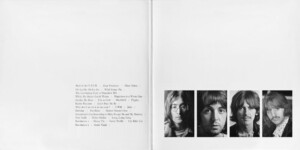
Richard Hamilton’s inter-sleeve design for The Beatles’ so-called “White Album.”
***
But fate intervened. Wickedly so.
The Friday before the anointed Monday I came down with severe flu symptoms.
I was seriously ill all weekend but also in tears, a symptom my nurse-father could not understand, though he cared for me day and night.
Sunday night my fever held high at 102°F, and my cough was orchestral. I would be going nowhere on Monday, and my heart was broken. I failed in this, my epochal teenaged pursuit, to be among the first to own and play the latest the Beatles had to offer — and, as it turned out, the greatest. Throughout the day I grieved. My aging male nurse remained by my side or close, absent only in the morning, when I slept the sleep of the sick.
***
My condition improved on Tuesday, but my regret was deep, all the more so when I was finally well enough to turn on the radio and hear such songs as “Back in the USSR,” “Blackbird,” and “While My Guitar Gently Weeps.”
I wept, and this is how my father found me when he returned from work on Tuesday afternoon. I was set to return to school the next day. Yet, well into the evening my radio continued to play these lovely “lost” sounds, or so they seemed to me.
This is when it happened, the magical moment, after he had boiled broth and invited me out of bed.
I went, my radio in one hand, spoon in the other.
“Julia,” sang John Lennon. And elsewhere on the album, as if to presage the spirit of the moment, “She’s not a girl who misses much.”
And at that moment, overlapping that line as a conjurer might, my father commanded me to turn the radio off. Too much for him, I thought.
Then, “Why are you listening to all this on the radio? I have a better idea. . . .”
From a place hidden by the French daily “Le Monde,” which he got at work, he pulled out the white jacket of the record.
I understood immediately and dropped my spoon.
“You think I don’t listen. I do. But such a long, long line! Longer than for tickets to see Maria Callas.”
Not a man to miss much, my father. Even today I imagine my father alone in that snaking line, and in the autumn drizzle no less, while my memory’s own guitar gently weeps.
Still.
