

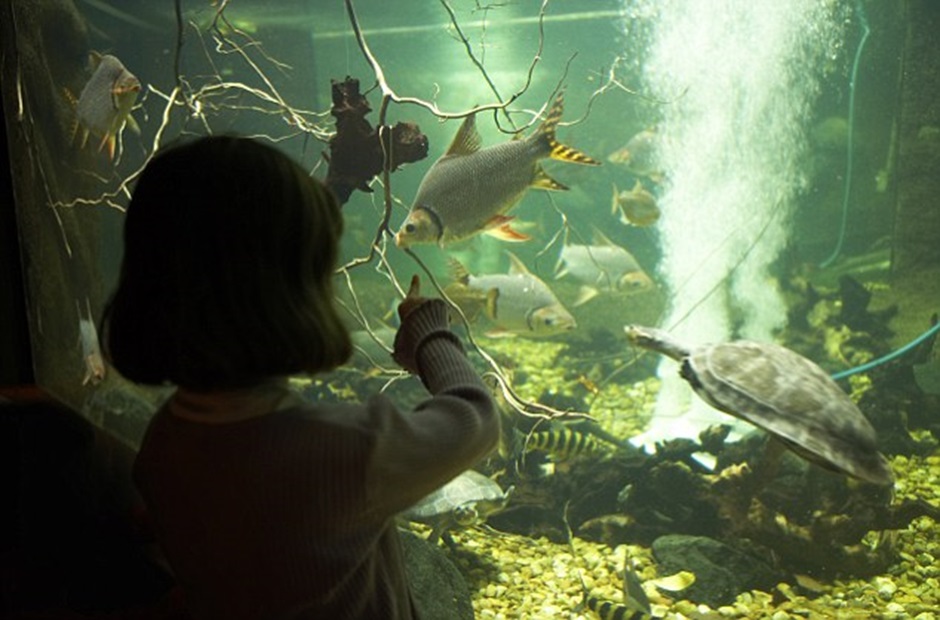
Smaller than small, I once set out on a a great adventure at the Washington aquarium, another way of saying I became lost. I was six, a fact surer than sure because the immense calendar on the wall read 1959 — and I was then and always a lover of dates.
What happened was simple, and typical, at least of me. I was staring intently at some giant, blue fish, thin as paper, when my father excused himself to go to the men’s room. I should stay just where I was, enthralled with the emaciated blue fish, until he returned. Alas, I was very bad at following instructions even at a young age and after a few moments was pulled away from the blue fish by a school of glistening yellow ones in a tank across the room. And the yellow ones soon led to a gigantic green thing in another room.
And so it was that I was lost. “Losted” in today’s parlance, because is it not a father’s duty to know the whimsical whereabouts of his child?
I of course had no notion that I was lost. Not at first. I was too busy listening to a guide explain that in the deepest depths of the ocean, near some strange land called Indonesia, there were whole tribes of fish so deep down in the blackness they had no need for eyes. These blind fish navigated using a form of radar, sending signals into the pitch black and having that same pitch black respond with instructions, or so I understood it then. I wondered to myself what I would say to a blind fish. Surely not the inner “Wow!” I had addressed to the wafer-thin blue fish.
It was about this time that I decided it was time to direct this newly amassed knowledge to my father, who was, I realized suddenly, nowhere to be found.
I attracted the attention of a girl with long pigtails and asked her where my father was, to which she merely shrugged and walked away. How was it possible that not only did everyone there not know of my father but they also could not pinpoint his location?
How was it possible that not only did everyone there not know of my father but they also could not pinpoint his location?
At first I tarried, pretending nothing had happened. I entered yet another big room, this one with charts and graphs of the ocean bed and a large tank with fish called minnows, which looked to me like sliced bits of a dog’s tail in constant golden and reddish motion. These were called Barrow Minnows, as if they’d been found in a wheelbarrow and then dumped in the tank for no other reason than the fact that all fish found in wheelbarrows should be returned to their rightful place.
But what, then, about my rightful place? What about my father?
This is when I started sobbing, though the minnows paid me no mind.
An older man did, likely a father himself, and took me to a guard, who took me to a small room near a tank with fish shaped like swollen fists.
From the swollen-fist room he made a call, took me to a second room, where a man in a green suit picked up a fat metal device and spoke of a lost child named Christopher, as I had, in the midst of my sobbing, forgotten my last name.
Could the owner of a lost Christopher with brown eyes and black hair, age about five (how dare they!), please come to office Q or R and fetch this wayward creature?
My father appeared in a few minutes, and I clutched his trousers, overjoyed. He asked if he hadn’t asked me to stand still in front of the wafer fish? Had he not been specific?
He had been specific but after drying my sniffles said nothing.
But then I began asking him if he knew that near a place called Prindonesia there were blind fish, like blind mice, and that they scurried over the ocean floor.
Indonesia, he said. A place where all boys stand still until their fathers return.
That fact I was determined to look up in the “encyclook” when I got home.
With my one and only father.
