

Mortality and death were not acceptable topics of discussion in the household of my elementary-school years. Had Bosch or Bruegel dared to set up shop in our dank basement, mice would have nibbled on their toes or devoured their easels. Their ghouls and skeletons would literally have been eaten alive. No “Triumph of Death” in our barracks.
My father addressed death obliquely. Seeing our cat with a robin in its maw, strutting before us, he’d remark, “That one won’t be flying anymore,” which to me made it hard to distinguish between bird and cat, since the latter scampered up our apple tree as if in flight. To say I was naïve understates my state. I was closer to a boy-as-fairy–tale creature, in impermanence’s thrall. The cat might have the robin, but to me there was no earthly reason it would not detach itself and return to flight. And my father’s vagueness only reinforced this belief.
One day, seeing a dead squirrel flattened by a passing car, I stood by the maple on the sidewalk and developed humming sounds and guttural chants I knew would revive it, returning all life to the animal as it had been before. My croaked hymns never helped on the spot, but I insisted to myself that they would in time. Sure enough, a few days later the squirrel was gone. I did not consider clean-up crews, or wish to: They punctured the myth of Robin Hood, as I dubbed the cat-nabbed robin.
If my father was oblique, my mother resided in a place that might as well have been never-never land, at least in her verbal affirmations. When I explained to her how I had brought a squirrel back from the dead and would continue these exorcisms, she simply said, as if reciting an immutable formula, “Death is part of life.”
I pondered this at length and finally decided what my mother really meant was that death was the same as life and cat and car were merely players in a grand game of catch and release.
This flummoxed me because if death was indeed part of life, all my robin and squirrel efforts were for naught. The cat’s maw and the car had merely extended life, though in a form and in a way I could not recognize.
I pondered this at length and finally decided what my mother really meant was that death was the same as life and cat and car were merely players in a grand game of catch and release. This was of course hard to accept fully since it meant cutting back on my crushed-squirrel incantations. To soothe my sadness, I told myself the incantations couldn’t hurt and might even speed up the “death is part of life” death by encouraging both death and life to return to their mother-mandated collaboration.
If I worked diligently enough, I might, I thought, succeed in getting death and life to coexist, as in one of my beloved cartoons, in which life and death were unmoored, best friends who traded places on colorful command.
When my friend Andy told me his grandfather had died and his family was grieving, I offered to intervene if given the chance. I needed only to get close, in squirrel range, and I could make all be as it was before. Andy let out something of a choked gasp, and our friendship, to me inexplicably, went silent. I assumed this was because his grandfather had made his own from-the-dead comeback and my services were therefore no longer needed.
Toward the end of this school phase — by then my mother had fled our family nest — my father told me a story that began a new and less appetizing confrontation with my loathed rival, reality.
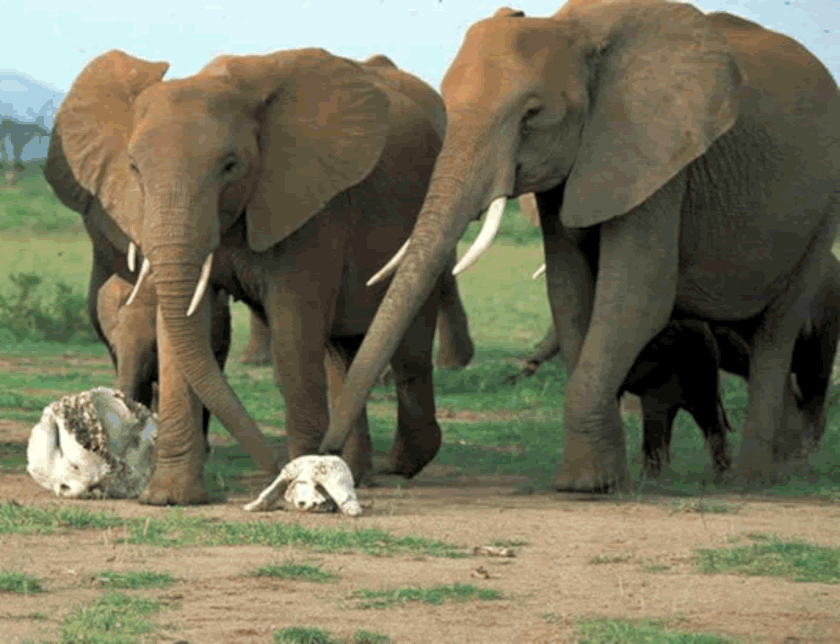
You know, he said in grave tones, as if initiating some Gregorian chant, when elephants grow old and weary and aware their time has come, they go to where other elephants have gone, to die there with their kin, creating fields of bones. These death fields, he said, were often piled hill-high.
It began striking me that no amount of incantatory noisemaking would likely be able to reclothe that many bones. I might need many lifetimes. And then the meaning of the word came to me, “lifetime,” a word that, try as I might, I could not wash away with comic books.
We had a lifetime, which meant a time limit.
I remember all this now as I near my elephant place, walking around it though aware at some point I will have no choice but to commune with bones.
At the same time I begin humming to myself, growling and hissing, wishing back the time of the squirrel. The mad boy in me persists, and to quote a God in which I do not believe, bless him.
