

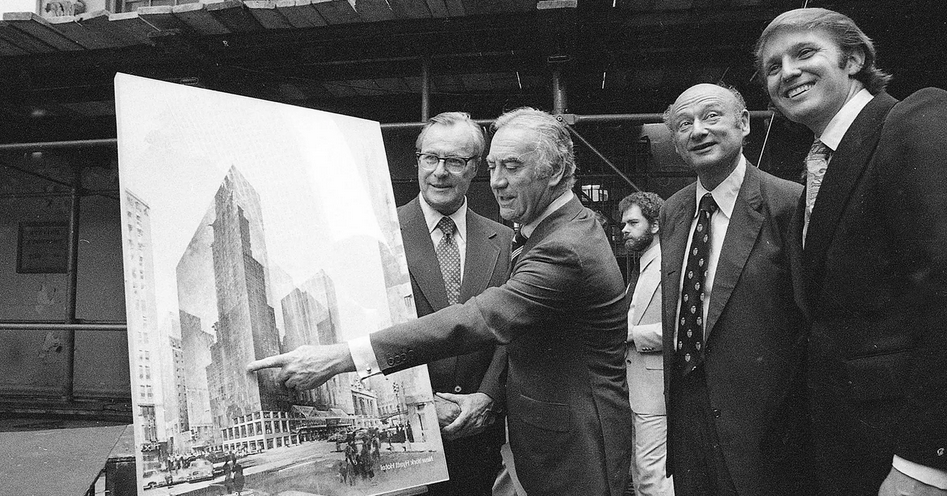
It was coming. It was always coming for those who chose to see it. In New York City was a massively arrogant real estate developer with gold-gilded ambitions as determined as they were ostentatious. He could be president, he confided to friends. Why not? But he would no more say this in public than he would share his views on the future of Cuba, better, he thought, as an island without Cubans and a dead Fidel. He imagined a Gold Coast of his making all around Havana. A bit like his dreams for Gaza now.
This developer, Donald Trump, a son of money, dreamed of and in money. His money. And a kingdom built around it in which all would do his bidding. Not a casual reverie, his. No. As serious as serious could be.
He’d floundered on several occasions, his businesses failing, but this he blamed on local, state, and federal authorities whose laws and regulations were nothing short of monstrous, and, in an ideal world (his), these hindrances would be cut down to size. If not eliminated.
He loathed the likes of FDR, who had expanded a federal bureaucracy to a size now larger than life, a state within a government. Never mind the New Deal. Never mind extending a lifeline, however precarious, to those without hope. Giving hope did not make money but spent it. Money that could be his. Had he lived in that time, he would have heckled FDR and befriended the country’s many isolationists. What good business could come out of opposing Nazi Germany? Why not make friends, and, failing that, impose tariffs and levies. Always and again, show me the money.
This man, this Trump, he envied nations that had made it by hook or by crook, like China. Ah, would it not be nice to cut the new and prosperous China down to size? Japan too, never mind its status as a postwar ally and never mind as well that Americans bought Japanese cars not to spite Detroit but because they were better.
Why not also humble Europe, the continent freed by U.S. troops, since, after all, an alliance failed to produce what was sought after: money.
Never mind extending a lifeline, however precarious, to those without hope. Giving hope did not make money but spent it.
In his mind circled a dream: an America, ruled by him, outside the constricting international rule of law, a concept that in his thinking was the true authoritarianism. He could and would if possible rid the planet of those awful rules and regulations he recalled as enemies from his New York days.
So yes, it was coming.
Extremists do not invent themselves from one day to the next. They are usually figures who feel they were wronged by the very society they now seek fully to control. They are passionately convinced of their own vision and legitimacy. There are no other nations because they sit atop America, the country that has always harped on its own exceptionalism. They do not know, refuse to know, that in spite of all their power, they are both parochial and provincial, unable to comprehend any form of internationalism, and therefore disdainful of it. In domestic and foreign policy, they are bullies by default since to bully is the easiest and least thoughtful form of governance and miles from the loathed intellectual — a word extremists have forever considered dirty.
And finally, of course, the bully is sometimes a thug, which means he can shake others down at will.
Show me the money.
Trump explains his policies as a boon for all Americans when in fact they represent his youthful dream of shattering the established order and thereby proving he is like a Borgia pope, demanding a tithe.
Common people will be hurt, say critics. Goods will skyrocket in price. No friendly nation will ever again believe in the honor forged by the United States through the years since 1945. The sturdy rhetorical idea of a nation that leads the free world will vanish, making America not an ideal but a business entity. If only any of this mattered to a papal felon who claims his country has been raped and pillaged when, unlike Europe or Asia, it has never had its soil sullied by true warfare since the Civil War.
To which the pope of course replies, “I have bigger concerns.” So the cornerstone of the America Tower is laid, shaped as a pyramid with an all-seeing eye at its peak, so all are reminded of Independence Day.
Now then, let someone please cast the first stone.
