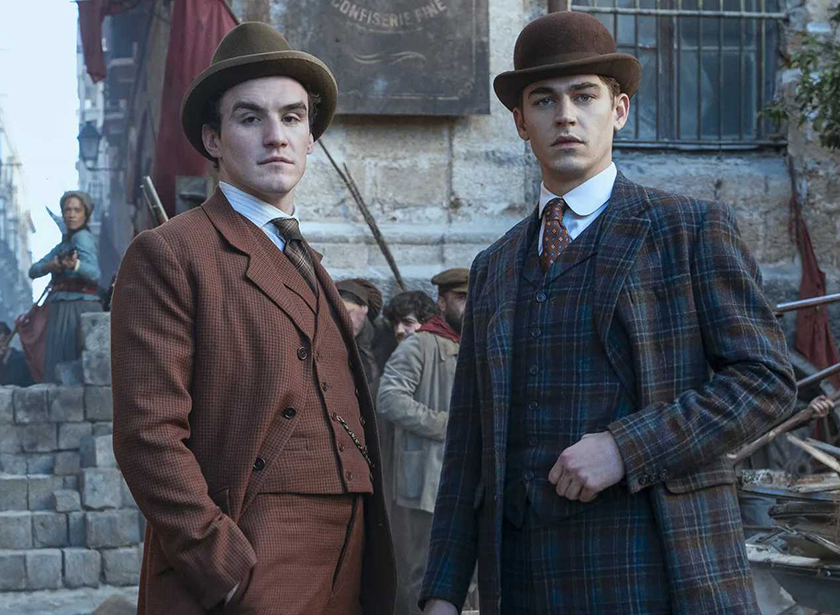
I recently finished watching the new(ish) adaptation of the Sherlock Holmes story, “Young Sherlock.” Hero Fiennes Tiffin plays young Sherlock and Dónal Finn is James Moriarty. The two are portayed as having been partners in crime before their canon rivalry, which is what the eight-episode mini-series builds towards. Finn’s acting is marvelous; he has an air of Irish charm and dry humor that modulates the dark themes of the story.
Still, I recall the original books British children are made to read at one point or another in primary school, and ask, “Isn’t Mycroft Holmes (played here by Max Irons) supposed to be smarter than Sherlock?” Despite the story pacing being comfortable but with enough twist to keep you hooked, I fear we missed out on some of the characters that are necessary to counteract Sherlock’s wild sense of intellectual superiority. Sherlock’s family and friends at sometimes seem downplayed, with Moriarty getting only a few moments of solo screen time to show off his potential as Sherlock’s intellectual equal and Mycroft performing practically as teenage Sherlock’s probation officer for most of the series.
It is sometimes hard to understand who takes the lead in revealing the “who dun it?” aspect of the story, which follows a murderous revenge plot against an academic scientific society developing and testing a bioweapon in a small village in rural China. Nevertheless, there is a good balance of personal triumph and teamwork woven throughout the series and we are brought repeatedly into Sherlock’s mind palace, an ode to his skills in deduction.
Set in the late 1880s, we are transported to the University of Oxford’s dark libraries, hidden safe houses, and the oaken grandeur of the old campus buildings. It was filmed on Oxford campuses, with scenes from Paris and Istanbul shot in Andalusia, Spain. I really like how a lot of the British crime history has been preserved, with some scenes featuring England’s oldest prisons in Somerset, operational from 1625, as well as the court buildings being Shire Hall in Monmouth, South Wales, which date back to 1724.
Arthur Conan Doyle’s Sherlock Holmes books are considered a primary source on the ideas of physical profiling and of what type of people are given to criminality. These are notions that are tactfully included in “The Young Sherlock,” but disproved. Sherlock himself is shown to have engaged in all manner of mischief prior to his redemption arc, and he belongs to a wealthy family, not the working class, who were thought, at Arthur Conan Doyle’s time, to be more liable to be villainous.
The series does a really good job of not giving us all the clues at once. We are not sitting there, shouting at the characters through the screen to realize something we noticed three episodes ago. As viewers we are given the knowledge of who, what, where, or why something has happened at the same time as the characters, making us as inquisitive as Sherlock himself. Despite Sherlock’s canonical egotism, the show takes different spins on his allies, placing them as necessary additions to the process of crime solving. Tensions between characters like disguised Chinese Princess Shou’an (played by Taiwanese actress Zine Tseng) and frenemy Moriarty are welcome as they facilitate Sherlock’s realization that he cannot succeed alone, as much as he’d like to take all the credit.
Tseng’s acting is top notch as we get a lot of her own backstory of seeking revenge for her family, who were victims of an experiment conducted by British scholars. She systematically targets four Oxford professors, Thompson, Roberts, Enright, and Malik, who were involved in developing the weapon that killed her family, with Professor Malik being the primary target responsible for the atrocity. She appears as one of the few characters with a strong moral compass in the series, a refreshing take on political and social ethics in contrast to Sherlock who, more often than not, has yet to figure out who exactly he is trying to save, whether it be those at risk of a future war, his mother, or his own future as a teenager with little to no direction in life.
The little pieces of forensic history sprinkled in create what is a must watch for any Sherlock Holmes fan, both TV and literary. The principles of crime scene preservation, natural selection, and trace analysis make you feel in tune with the world of crime scene investigation, even though not all of us have the powers of deduction that Sherlock possesses. The balance of scientific explanation with morality is also a nice touch as the show does take on some dark themes in terms of global war, the exploitation of rural communities, and the use of bioweapons. I wouldn’t say it’s done in a way that adds to the ever-growing desensitization to violence we experience in a lot of media and literature today. The series could be seen as quite a valuable addition to the repository of sources that keep these issues historically relevant even if it is packaged as a crime drama recognizable under the family friendly household name of just another Sherlock Holmes spinoff. The potential of a season two, as was indicated by the cliff hanger and expected development of Moriarty as Sherlock’s rival, is exciting and I think the plot would benefit from having some of the loose ends tied up.