
Last week, I sat curled on my couch, reading Ilan Pappé’s The Ethnic Cleansing of Palestine. My daughter was asleep beside me, her tiny fingers still sticky from the banana, one fist curled around a crayon. I could hear the soft hum of life outside my apartment window: kids playing, neighbors chatting, someone laughing loudly down the street. And yet, inside me, there was only stillness — that stunned, airless silence you feel when truth knocks the wind out of you.
I had just turned the page to a short, grim passage about 1948, the year Palestinians call Nakba, the catastrophe. In that section, the book described a planned, covert campaign of biological warfare, code-named Operation Cast Thy Bread. In several Palestinian villages like Beit Surik (or Beit Suriq), Bayt Mahsir, and Artuf, Zionist militias, with the approval of future Israeli Prime Minister David Ben-Gurion, deliberately introduced typhus- and dysentery-causing bacteria into water wells. The intent was not mass poisoning, but a more insidious goal: to prevent Palestinian refugees from ever returning to their homes.
Operating in secrecy, Zionist forces deliberately introduced harmful bacteria into the water supplies of Palestinian towns and villages, acts that blatantly violated the 1925 Geneva Protocol prohibiting the use of biological agents in warfare. They also go against another international agreement that was signed fifty years later: The Convention on the Prohibition of the Development, Production, and Stockpiling of Bacteriological (Biological) and Toxin Weapons and on their Destruction (commonly referred to as the Biological Weapons Convention).
The historian — and anti-Zionist Iraqi Jew — Naeim Giladi, in Ben-Gurion’s Scandals: How the Haganah and the Mossad Eliminated Jews, writes, “To make sure the Arabs couldn’t return to make a fresh life for themselves in these villages, the Israelis put typhus and dysentery bacteria into the water wells.”
Israel resorted to implementing the same plan in Gaza a week later. On May 1948, Egyptian forces arrested two Jewish operatives red-handed as they attempted to contaminate Gaza’s water supply. Seized from them was a water bottle ingeniously divided by a hidden barrier: The upper compartment contained ordinary drinking water, while the lower section held a concentrated bacterial solution. The operatives confessed they were part of a twenty-member team dispatched from Rehovot (formerly the Palestinian village of Zarnuqa) for this mission. The Red Cross, which operated in Palestine at the time, had documented a sudden, unexplained spike in typhoid cases across Gaza and the Jerusalem corridor in the spring of 1948.
Operating in secrecy, Zionist forces deliberately introduced harmful bacteria into the water supplies of Palestinian towns and villages, acts that blatantly violated the 1925 Geneva Protocol prohibiting the use of biological agents in warfare.
A 2003 academic study, conducted by researcher Salman Abu Sitta, revealed the facts. The campaign was real. It was coordinated. It was hidden by design. Two decades later, Israeli historian Benny Morris confirmed the scandal in his article “‘Cast Thy Bread’: Israeli Biological Warfare during the 1948 War,” which was published against the wishes of the Israeli security establishment, which has tried for years to block any incriminating documents. For decades, the truth was buried deep in archives, and the phrase “Cast thy Bread” mistaken for a benign biblical phrase.
In a documented report dated May 16, 1948, Haganah, the Zionist paramilitary forces that today comprise the core of the IDF, roamed a besieged city proclaiming over loudspeakers, “You have either to surrender or commit suicide. We will exterminate you to the last man.” When the city surrendered, women and children were left homeless. Civilians were arrested en masse. Looters ran rampant. The Red Cross investigated reports that a young girl was raped in front of her family by Haganah soldiers.
Even within the operation, plans spun out of control. In one instance, a commander was handed glass tubes of typhoid-causing bacteria to deliver to his subordinates near Jericho and Jerusalem. But one tube broke in his home, and his three-year-old child became infected, bedridden for days.
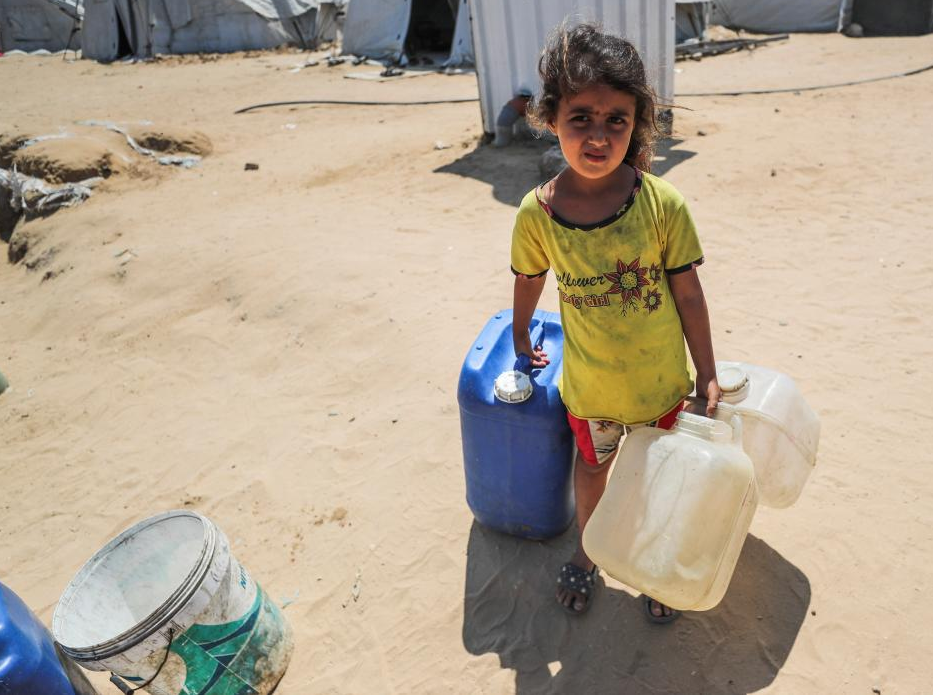
Fast-forward to 2021, when the Euro-Mediterranean Human Rights Monitor reported that 97% of Gaza’s water is undrinkable. Today, the situation is even worse; since October 2023, Israeli attacks have cut off 70% of Gaza’s water supply infrastructure per ReliefWeb reports. Children sip from puddles, and mothers desperately boil what little they can find. The thirst continues — not just for water, but for justice.
As I read, I thought again of my daughter, asleep and safe, her world wrapped in softness. I imagined a mother in 1948 crouched by a dry well, her hands shaking, her children moaning from fever, her voice hoarse from begging for help that would never come. I thought of how no one came then, and how even now no one comes. The legacy of using water as a tool of war continues — not by poisoning it, maybe, but through siege, infrastructure destruction, and restrictions on fuel and parts needed for water purification. In both cases, the objective has remained consistent: to make life untenable, to block the return of refugees, and to control a population by controlling access to its most basic needs.
Estimates tell us that there are more than seven million Palestinian refugees living in exile around the world. Many still teach their children the names of the villages they came from. Some still carry land deeds, rusted keys, or photographs of homes that no longer exist. What happened in 1948 set a pattern of displacement without redress and survival without security that defines Palestinian life to this day.
My daughter stirred beside me, still wrapped in sleep. I looked at her small hands and wondered what kind of history my toddlers will grow up to learn — and what kind of world will be left for them to understand.
