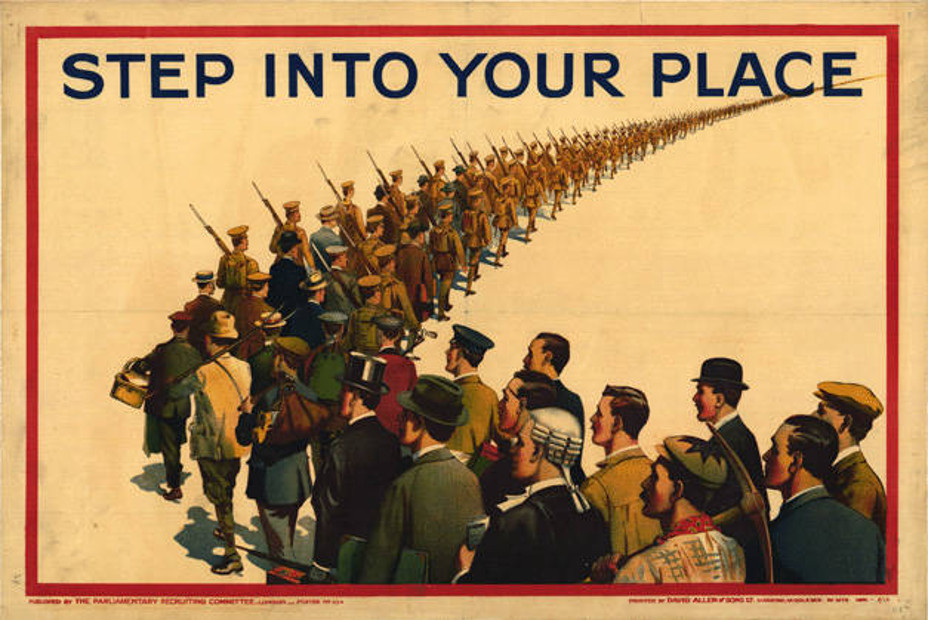
Michael Paris, a historian at the University of Lancashire, whom I met during my high school history class, has been popping up in my mind, prompting me to consider how popular culture influences our actions and our view of the world. In the first chapter of his book, Warrior Nation, he focuses on how World War I exhibits a social attitude endemic to British imperialism, the desperation to be seen as winners — with godly faith part of the mix. And this is a perception of ourselves that we Brits have lorded over other nations, allowing us to disassociate ourselves from the reality of humanitarian crises, a perception that allows us to maintain the veneer of civility while being aggressive through and through.
Before 1914 and since, making military service look attractive to young men has meant using psychology. Our education, media, and literature still greatly consist of normalizing violence, glamorizing sacrifice, and promoting victory by any means. Evidence of this can be traced as far back as 1880, with author and ex–military General George Alfred Henty’s action novels, such as his In Times of Peril, a story set during the Indian mutiny, valorizing the ideal British warrior. Henty and many other novelists taking inspiration at the time were not only dedicated to teaching patriotism, but they also proclaimed themselves leaders of the nation’s men.
In History Today, Paris the historian relates a story from September 1914, where nineteen-year-old Roland Leighton wrote to his close friend Vera Brittain:
I feel . . . I am meant to take some active part in this war. It is to me a very fascinating thing — something, if often horrible, yet very ennobling and very beautiful, something whose elemental reality raises it above the reach of cold theorising. You will call me a militarist. You may be right.
There is relevance in these ideas still, and in Roland’s account, as we see the idea of something “horrible” or scary as being less of an issue than it is risk-worthy or valuable to our jingoistic nature. Our perhaps human penchant for risk — and, moreover, showing our comrades that we’ve taken that Risk (risk writ large) in a conspicuous way — prevails.
Today people film themselves jumping out of planes, not because it’s scary, but for the sake of others seeing them do so. People film themselves cleaning their houses, not to open themselves up to vulnerability or to share the intimacy of their private spaces with strangers online, but because it is ‘noble’ and victorious to have reached the seeming universal standard of a ‘good wife’ or ‘good mother.’ Is it noble if no one will thank you for it? Is it beautiful if you didn’t share it with others? Making connections between the popular culture of World War I and that of the twenty-first century might be in poor taste. But I feel there are similarities in the way we are encouraged to be in a state of performance, only reading the parts of the script deemed entertaining enough by our wider nation or community.
Some, if not many, of our soldiers, now lying beneath the poppies, believed they were destined to be part of a divine mission to protect our nation. Many if not all our soldiers were subjected to militaristic comics and literature in their youth. At the beginning of the second World War, Captain America, who famously punched Hitler, sprung forth from the pens of Joe Simon and Jack Kirby, both Jewish, in 1940. This comic icon is still a symbol of liberty and democracy. Characteristics that we consider lost in our Western reality live on between the pages and speech bubbles of a more colorful world of coercion.
Many men here reading might recall the characters that embodied masculinity in all its glory. Fictional war stories published, especially after the age of conflict, were extremely popular. Being approved by parents, teachers, and school governors, these stories continued to shape us, especially the men and boys, who were called on to be brave and chivalrous and honorable and to do their duty to the nation. British perceptions of masculinity, warfare, and domesticity have for decades tugged on the pubescent heartstrings of young males and girls alike. This is not just a British phenomenon, but a Western sickness. A sickness that romanticizes the crisis. In the case of World War I, a quote from Paris’s book, Over the Top: The Great War and Juvenile Literature in Britain, that encapsulates this pleasure culture of war is as follows:
In August 1914 . . . Their most often expressed anxiety was not of being maimed or killed, but rather that the war would end before they got to France and that they would miss the Great Adventure.
It is no question these socialization methods have changed. Many men today do not identify with typical masculine labels. Many English youth thus did not flinch when the queen died, and some outright celebrated, seeing a symbol of colonialism and not a monarch to be revered. Our aim instead should be to deconstruct the image of greatness within an age of “incessant imperial warfare” (Paris, Over the Top), which requires deconstructing our notions of what entertainment is. After all, we have already seen the lengths to which our leaders will go to embolden or even espouse romanticism before they protect the impressionable.