
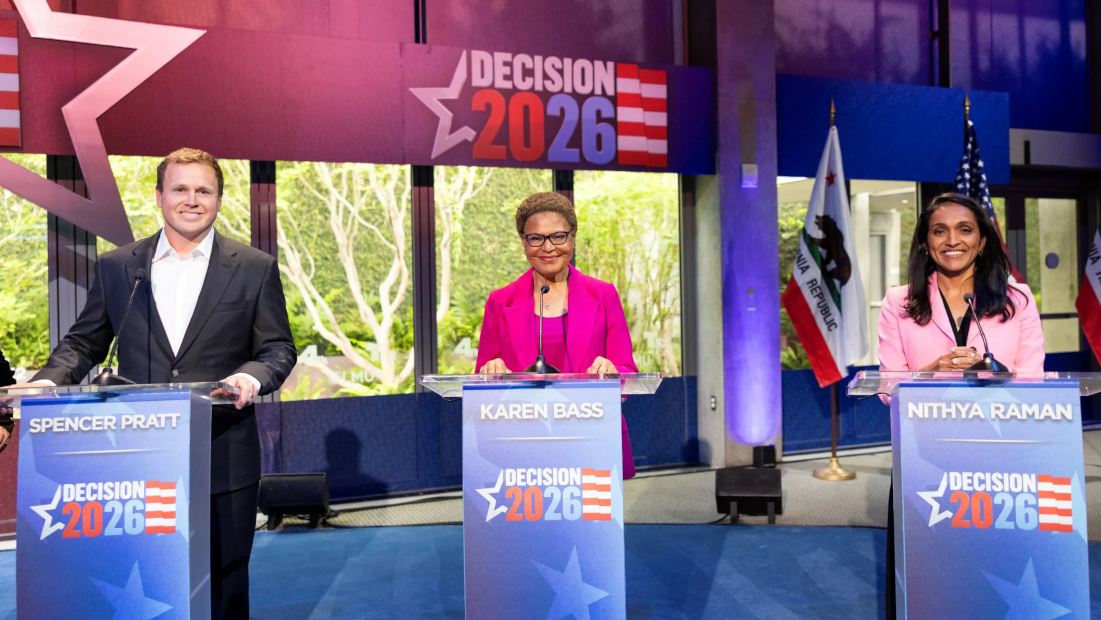
Democratic socialist Nithya Raman was supposed to be the “next” Zohran Mamdani, laying siege to the Democratic establishment of Los Angeles and giving Mayor Karen Bass a run for her money in this year’s election. But it hasn’t turned out that way. Instead, former reality TV star Spencer Pratt (of “The Hills” fame) has surged into contention in the Los Angeles mayor’s race, occupying second place in the latest polling, with less than two weeks left before the final voting concludes. Like Mamdani, Pratt is a populist firebrand running on widespread dissatisfaction with the status quo and voter contempt for the time-worn policy solutions offered by the Democratic establishment. But he’s a staunch conservative, too, so the challenge is coming from the right, not the left. Still, there are real parallels here. Just as New York officialdom struggled to find a message that could compete with Mamdani’s emphasis on the city’s crippling affordability crisis, Los Angeles officialdom, led by sitting mayor, Karen Bass, has yet to find an effective way to fend off Pratt’s laser-like focus on the devastating wildfires that wreaked havoc on LA in early 2025 as well as his attacks on Bass’ failure to address the rampant crime, homelessness, and urban decay that have engulfed the city in recent years. Also like Mamdani, Pratt is calling for change at a time of perceived social emergency and has been stoking and channeling a quiet rage that has been brewing in LA outside official channels, defying the mainstream parties.
Pratt exudes grit and spontaneity and brings indefatigable energy to his campaign, in contrast to the staid and wooden styles of Bass and Raman. He’s the angry Everyman, demanding accountability not just for him and his beleaguered family, but for the entire city. His opponents seem to sputter and flail, when they deign to appear in public at all.
The Pratt surge began after a three-day televised debate two weeks ago in which the 42-year-old actor quite literally stole the show, racking up points on virtually every issue. Pratt gave definitive answers to questions about policy while the others were continually qualifying their responses, seemingly oblivious to the urgency of the issues facing the city. Pratt openly derided Raman’s understanding of the homelessness issue and savaged both candidates for continuing to hand out needles to drug users. When asked if he would continue that policy — deemed “humane” by the city — Pratt replied flatly: “No needles and no crack pipes for addicts.” The others equivocated. It was one of many sharply defining contrasts in the debate, and it clearly impressed the Angelinos who were watching. In a post-debate poll, a whopping 89% declared Pratt the winner.
But in fact, the immediate debate aftermath was just the start of a tidal wave of public opinion that threatens to hand the election to Pratt. He’s released a blistering series of video attack ads on Bass’ record and the record of Raman, that have spread virally online, capturing in some cases tens of millions of viewers. The ads typically cast him as the victim of Bass’ inept handling of the devastating LA wildfires, which resulted in the burning down of his own home. Meanwhile, a friendly freelance consultant, moviemaker Charles Curran, has created AI-inspired video ads that cast Pratt in cinematic, hero-style scenarios using motifs from Batman and Star Wars. In one ad, Pratt squares off against Bass in a lightsaber duel while California Gov. Gavin Newsom and former Vice President Kamala Harris are seen cynically scheming behind the scenes. In another ad, Pratt is depicted as Batman opposite a figure of Bass that closely resembles the Joker. The action in these remarkable ads is fast, furious, and utterly captivating.
Bass and Raman appear to have no answer to this viral visual assault, other than to call into question Pratt’s political independence — Raman has even called him a “MAGA fascist” — and his temperament — Bass has criticized the Pratt ads as “violent.” But the AI ads, a novelty in election campaigning, are spawning copycat efforts and are even more popular than Pratt’s own. Pratt calls these outside efforts “fan-made” and disavows any role in authorizing let alone directing their production. A new AI ad is emerging virtually every day, generating continuous fascination and a sense of momentum behind Pratt’s campaign.
But can Pratt really win in a blue city that identifies overwhelmingly with the Democrats? The latest poll places Bass in the lead with 30% of the vote, followed by Pratt at 22%, and Raman at 19%, with 16% undecided. That’s only a slight change from a poll in March, which saw Bass at 20% and Pratt at 10%, with a whopping 51% undecided. But Bass’ lead has dropped to single digits. Pratt has also overtaken Raman to reach second place, and his ad campaign is only now moving into high gear. There is also the strong possibility of “social desirability bias,” the phenomenon whereby nominally loyal voters under-report their intention to support the opposing candidate out of fear or embarrassment at revealing their defection publicly. This phenomenon has played a role in previous California elections and is also known to have occurred in the case of Donald Trump’s two runs for the White House.
It helps in NY and LA that Mamdani and Pratt have been running against manifestly corrupt and even inept city leaders deeply implicated in the social decay and disarray of their cities, but this new brand of populism, fueled by an aggressive and innovative use of social media, is bound to spread elsewhere.
By all appearances, support among Democrats for Pratt’s upstart bid for the mayor’s office is exceedingly strong, with a growing number of Hollywood personalities , including Paris Hilton and singer Katherine McPhee, publicly embracing Pratt, and holding fundraisers. Plus, campaign funding from some of the state’s most prominent billionaires is pouring into the Pratt campaign, dwarfing the amounts raised by Bass and Raman. If current trends hold, it’s hard to see how Bass and Raman recover lost ground. Right now, they’re barely keeping their footing.
The upshot? Pratt may already be in the lead — or close to it. The remaining undecideds in the race very likely tilt toward Pratt, so it’s basically neck and neck at this point. If no one gets more than 50% of the vote on June 2, a runoff will occur between the two top candidates, which are likely to be Bass and Pratt. In theory, Raman’s supporters will back Bass in a runoff, so unless Pratt wins big in the first round of balloting, he could still lose in a two-person race.
The Pratt insurgency, like Mamdani’s, is notable because it’s occurring in one of America’s largest metropolises, where voting Blue has become virtually axiomatic. But it’s important to realize that similar upstart efforts have occurred in recent years in Chicago and Seattle and even more strikingly, in the current race for the U.S. Senate in Maine. Something dramatic is starting to happen in the nation’s political landscape, and the two parties are struggling to catch up. Populist rage at the “establishment,” first glimpsed in Bernie Sanders’ two presidential campaigns, has spread to all levels of politics. The public appears ready to embrace these charismatic outside-the-box candidates preaching a return to “common sense” and their lack of political experience, while attacked by their establishment opponents, is viewed by many voters as an asset, a sign that they haven’t been compromised by the “system.” It helps in NY and LA that Mamdani and Pratt have been running against manifestly corrupt and even inept city leaders deeply implicated in the social decay and disarray of their cities, but this new brand of populism, fueled by an aggressive and innovative use of social media, is bound to spread elsewhere. New political technology is changing the rules of the game, as it has previously. But with the introduction of AI, future political campaigns may be entering a Brave New World.
Politics, like life, is beginning to imitate art: a rather cartoonish and gimmicky art, to be sure, but one that holds immense popular appeal, especially with younger audiences, while raising questions about the boundary line between fantasy and reality. No one is fact-checking these ads or raising questions about the way the political targets are rather absurdly depicted — often unfairly. They’re too busy marveling at their ingenuity and joining in the fun. Eventually, though, election campaigns end, and the hard work of governing unmanageable cities will begin. Will AI shield surging candidates like Pratt from serious scrutiny should he pull off a still-improbable victory? It looks like we’re about to find out.
