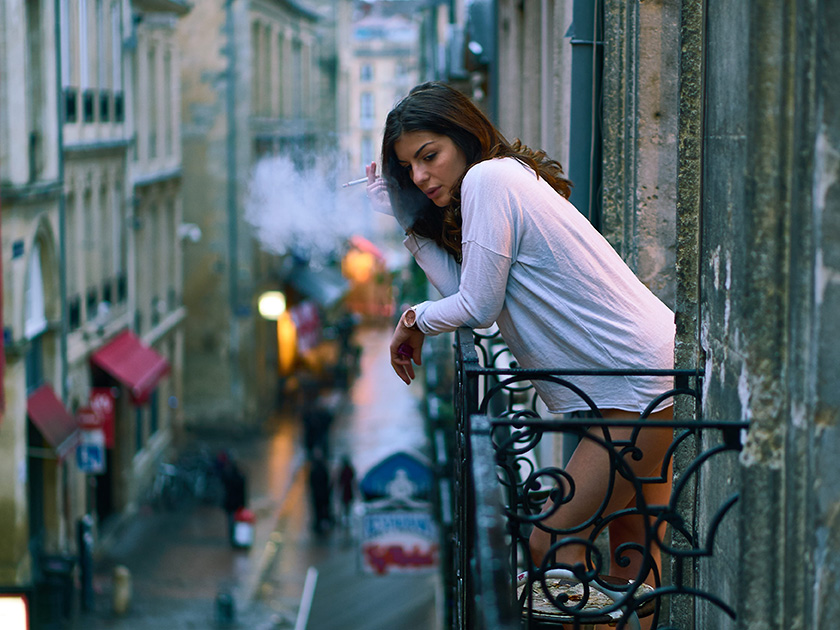
Every time I go to the doctor and have to fill out my medical history, one question gives me pause: Have you ever been a smoker? I usually look around the waiting room, furtively, as if making sure that no one will catch me in the lie that I am about to tell: No.
In reality, I smoked so little, and it was so long ago, that my little white lie probably has no real bearing on any of my current medical assessments. But the question always takes me back to my novice smoking days in Italy.
I was not a rebellious teenager, at least not in any of the traditional ways: I didn’t drink, or do drugs. My health anxieties inoculated me against most forms of adolescent self-destructiveness. When I went to Italy at nineteen, though, I threw off some of my self-made shackles. I drank a little wine. I wore high heels, short skirts, and midriff tops. I even bought a bikini. Smoking was the next rite of passage.
I was teaching them English, and they were teaching me about life. After class, we’d hang out at one of the nearby cafés and do what everyone else was doing: talk and smoke.
Refugees taught me to smoke. I was teaching them English, and they were teaching me about life. After class, we’d hang out at one of the nearby cafés and do what everyone else was doing: talk and smoke. Often, it was just them talking and smoking, and me listening and writing down their dramatic stories of survival. As much as I liked the quick hit of smoking, what I was really after was the sustained thrill of storytelling.
Smoking was also an extension of my efforts to recreate myself in Italy. I’d always been a “good” girl, and a shy one, though certainly not one without angst. Smoking helped me air out my inner edge. If I’d had a bad day, I could just puff it out. It also helped me be more social. All of my Italian roommates smoked, while gabbing at the kitchen table, activities that seemed essential to socialization. Since they smoked the cheap “Diana” brand, I did, too.
When I moved back to Italy after college, I upgraded to Marlboro Lights. My roommate smoked, and our after-lunch cigarette was a ritual. But after two years, I quit, almost cold. I couldn’t stand the smell of smoke — on my hair, my clothes, my hands. I was two years into a romantic relationship, incredulous that my boyfriend had never asked me about smoking. I had never smoked in front of him, but surely he must’ve smelled it on me. I figured he was just being discreet, and non-judgement, since he had once smoked so much that walking up a flight of stairs left him breathless.
Although I don’t smoke, I sometimes feel a longing for what it gave me, which was maybe just a little freedom to break out of myself, or the strictures of my world.
He had since pivoted to another addiction: long distance running, which he was teaching me, too. Since smoking and running felt incompatible, I chose running, and never looked back. When I moved back to the U.S., I was not tempted to smoke. If smoking was a stylish activity in Italy, it was a slovenly one in the U.S. Successful people who smoked often hid it — like my partner, who for years, smoked one cigarette a day. But I only saw him smoke once, on his back patio. He had donned a faux leather jacket, and a clear shower cap, to prevent odor. I was sympathetic but aghast. “If you’re going to do it, at least look the part!” I teased him, recalling my fashionable smoking days in Italy.
Although I don’t smoke, I sometimes feel a longing for what it gave me, which was maybe just a little freedom to break out of myself, or the strictures of my world. I wonder if smoking was also like this for my mother. She started smoking in her teens, during the 1950s, the heydays for smoking. When her aunt, a nurse nun, stopped talking to my mother for smoking during nursing school, her argument was not that smoking was unhealthy, but impure.
After my mother had children, she limited herself to one cigarette a day. She kept her soft box of Menthol cigarettes in the top drawer of an antique kitchen cabinet from her Italian grandmother. In the evening after dinner, she’d slip out to the back steps, and sit for about ten or fifteen minutes. She wore a sky-blue negligee, and stared into the distance, perhaps imagining a life without kids, or her life before having kids. I knew, instinctively, not to disturb her. That eventually she would return safely from her travels, having bridged a distance that was light years away.