
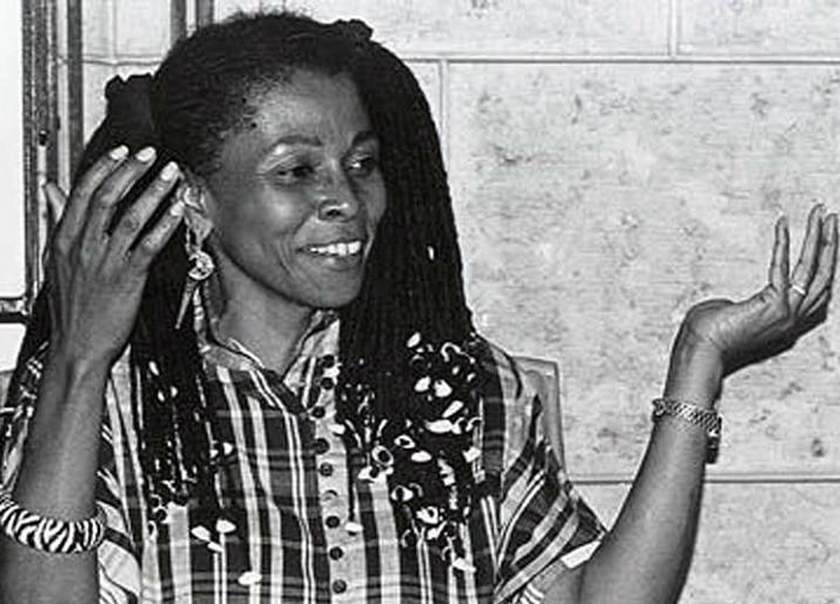
Some weeks ago, I stumbled upon a story that hasn’t left me since. It was late. I was half scrolling, half thinking, trying to shake off the static of the day, when I came across an old photograph. A young black woman, her gaze steady and unflinching, eyes full of something between exhaustion and defiance. The caption read: Assata Shakur, 1979 — escaped from a U.S. prison.
I knew the name vaguely, but not the story. Not the full, devastating truth of it.
The more I read, the heavier it became — the weight of everything that was done to her, and everything she refused to let destroy her.
Assata Shakur was born JoAnne Deborah Byron in Jamaica, Queens, in 1947. She was raised in New York and North Carolina, where the violence of segregation shaped her early sense of the world. By the time she was in college, the United States was burning — Vietnam, civil rights, Black liberation — and she became part of a generation that refused to suffer quietly.
She joined the Black Panther Party in the late 1960s, working in community programs, teaching political education, and organizing free breakfast initiatives for children. But the Panthers were never just a movement; to the U.S. government, they were a threat — an organized, armed, and unapologetic demand for dignity.
By the time Assata Shajur was in college, the United States was burning — Vietnam, civil rights, Black liberation — and she became part of a generation that refused to suffer quietly.
FBI Director J. Edgar Hoover once called them “the greatest threat to the internal security of the United States.” What followed was one of the most sustained campaigns of political repression in modern U.S. history.
Under COINTELPRO, the FBI’s Counterintelligence Program, black activists were harassed, infiltrated, framed, and assassinated. By 1971, more than 25 Panthers had been killed by police. Hundreds were in prison. The government didn’t dismantle the movement in debate — it buried it.
Assata was among those targeted. Between 1971 and 1973, she was charged in a series of cases — everything from bank robbery to kidnapping — most of which collapsed due to lack of evidence. But the damage was done. Her name was etched into the FBI’s files as a “militant extremist.” Her image was on wanted posters across the country.
Then came the night that would define her life.
After leaving the Black Panther Party, with which she had disagreements, Assata joined the Black Liberation Army.
On May 2, 1973, Assata was traveling with two members of the Black Liberation Army, Zayd Malik Shakur and Sundiata Acoli, on the New Jersey Turnpike when state troopers stopped their car, allegedly for a broken taillight. Minutes later, gunfire erupted. When it ended, Trooper Werner Foerster and Zayd Malik Shakur were dead. Assata was bleeding from two bullet wounds — one through her arm, another through her shoulder.

Assata Shakur’s mug shot.
The state accused her of shooting the officer. But the evidence didn’t hold. Ballistics experts testified that her injuries made it physically impossible for her to have fired a weapon. There were no fingerprints, no gunpowder residue. Witnesses contradicted each other. Still, the outcome was predetermined.
In 1977, an all-white jury convicted her of first-degree murder. She was sentenced to life in prison — not because the facts demanded it, but because the system did. Because a Black woman who refused to bow was more dangerous than any gun.
She was placed in solitary confinement around the clock, held in a “hot, dank, bug-infested room.” Her defense team filed a civil suit against the state, calling the conditions cruel and inhuman. She was denied proper medical attention for her gunshot wounds and her pregnancy. She was shackled to her hospital bed, bright lights burning over her 24 hours a day. Even meetings with her lawyers weren’t safe — there were hidden listening devices in the room. “The guards would come around and say, ‘We know what you’re saying,’” she later recalled. “It was their way of saying, ‘We’ve got it on tape anyway. So what?’”
They wanted her broken. But she wrote. She organized. She learned. She endured.
Two years later, she escaped.
On November 2, 1979, six years to the day after her arrest, members of the Black Liberation Army broke her out of Clinton Correctional Facility for Women in New Jersey. It was a meticulously planned Operation. Three armed individuals overpowered the guards, took control of the facility’s visiting room, and fled with Assata in a getaway van. She disappeared.
For years, her whereabouts were unknown — until 1984, when she resurfaced in Cuba, where the government granted her political asylum. She lived there for more than four decades, under constant surveillance, wanted by the U.S., and even added to the FBI’s “Most Wanted Terrorist” list, the first woman ever to appear on it.
The reward for her capture was raised to $2 million.
But she never returned. She died in Havana on September 25, 2025, at the age of 78. Cuba’s Ministry of Foreign Affairs announced her death “due to health conditions and advanced age.” She left this world the same way she lived in it — unbroken.
When I read her story, I couldn’t stop thinking about that word — escape.
Because what does it mean, really, to escape? Is it freedom, or is it defiance? Is it running away, or refusing to stay trapped in a system built to destroy you?
Assata didn’t flee justice. She fled the desecration of justice. She fled a country that called itself free while waging war on Black liberation. A country that built prisons for its revolutionaries and monuments for its oppressors.
She lived there for more than four decades, under constant surveillance, wanted by the U.S., and even added to the FBI’s “Most Wanted Terrorist” list, the first woman ever to appear on it.
The reward for her capture was raised to $2 million.
But she never returned.
Her story is about every person who has ever looked at the institutions of power and realized that justice, as written by the powerful, was never meant for them. It is a mirror held up to a country that still fears the people it claims to liberate. The same system that caged her continues to fill its prisons with the poor, the Black, the unwanted. The same state that called her a terrorist still funds wars abroad under the same logic — that violence is legitimate when it serves power.
And that’s why her words still echo: “Nobody in the world, nobody in history, has ever gotten their freedom by appealing to the moral sense of the people who were oppressing them.”
Assata didn’t wait for permission to live. She didn’t wait for a fair trial from an unfair system. She refused to let her dignity be something others could grant or deny.
In the years after her escape, she wrote, she taught, and she kept speaking — not about vengeance, but about survival, about love, about the need to build something new in the ruins of what had tried to destroy her.
When I think of her, I think of a kind of courage that doesn’t look like victory — it looks like endurance. The quiet kind. The kind that knows the system will never love you, but refuses to let that be the end of the story.
Assata didn’t escape from justice. She escaped from her country’s false idea of justice. She fled from a sham justice, a smoke and mirrors trick. And that may be the most radical thing any oppressed person can ever do.
