Over the millennia, humans have used written language to communicate, to pass information, to narrate a story, an experience, to leave a mark of their passage on this planet, or simply for amusement. The generation that came into the world after WWII, the “boomers,” are probably the last to have used writing tools that, with some improvements and modifications, people have employed over the last three thousand years. It is also the generation that witnessed the most dramatic changes and innovations in the instruments used for writing.
According to Steven Roger Fischer (“A History of Writing”, 2019) a calamus, a sharpened bamboo stalk was probably already used three thousand years ago in Ancient Egypt, during the First Dynasty. Quills, sharpened goose pinions, supplanted bamboo stalks in the Middle Ages, but it wasn’t until the nineteenth century that metallic nibs were applied to a quill or simply to a wooden stick. The instrument so obtained was still called pen, from the Latin term “pinna” (feather), though a feather it was no longer. This last innovation was the one with which my generation was also familiar. We all became acquainted with the art of writing by dipping a steel nib into an inkpot and laboriously penning the alphabet letters on a white lined page, and the numbers on a white squared page. It took some time before we learned to drain some ink from the nib, running it on the edge of the inkpot, in order to avoid, or at least reduce, unsightly black blots on the page. To be honest, before using pen and ink, we underwent a long training using a more page-friendly rubber tipped pencil.
A calamus, a sharpened bamboo stalk was probably already used three thousand years ago in Ancient Egypt, during the First Dynasty.
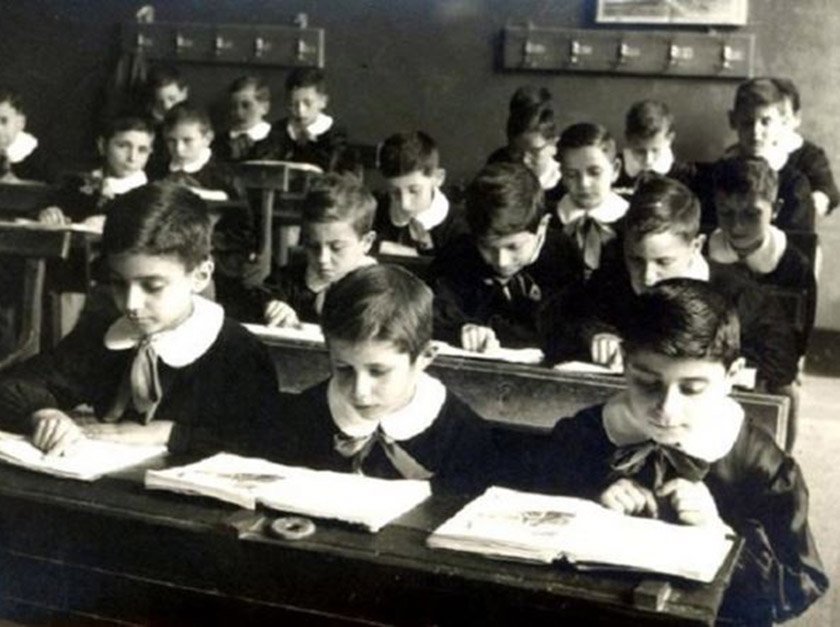
During my five years at Elementary School, from 1956 to 1961, two or three times a week, a ceremony would take place: a janitor would appear in the classroom, bearing a small zinc container, a sort of watering can, full of ink. He would pass among the rows of wooden desks and fill the small inkpots inserted at the corner of the writing slabs. The ink was apparently black, but when it dried on the page, the color was actually dark brown. A few pupils, scions of wealthier families, would bring their own ink in a small screw-capped glass inkpot filled with sparkling dark blue India ink. They kept the small bottles precariously resting at the edge of the narrow writing slab, just behind the head of the pupil sitting in front on them, since the desks were lined up in thick rows in the overcrowded room. A sharp movement was sometimes enough to knock over the inkpot, its liquid spilling, flooding the exercise book pages and dripping on the black smock that all pupils, luckily, had to wear at the time.
A fountain pen was what I dreamed to use one day, like the one the teacher used to keep his register and fill in our marks. My father also had a beautiful fountain pen, a vintage object already at the time, coated with mother-of-pearl and with a built-in piston and vacuum filling system. Fountain pens were expensive and delicate, so you normally had to wait until you started Scuola Media (Junior High), when you were about 12 years old, to be entrusted with one. I remember I could not wait and I bought a very cheap one with my pocket money during the last year at Elementary. It was not a good deal. It was made of plastic of the worst quality. It smelled foul and ink soon started to leak, with deplorable effects on my books, exercise books, satchel and clothes.
To avoid further damage, my father decided to jump a stage and bought me a dependable fountain pen. It was a Reform 1745, a resin, German-made pen, that was extremely common among Italian students, due to its cheaper price compared to more famous brands. Its design, green body, black cap with golden clip and rings, was reminiscent of the classic Pelikan 150, which I would buy later and use for years.

The author, standing to the teacher’s right.
I loved handling a fountain pen, the delicate scratching of the nib on the paper, the act of refilling it, or just the unscrewing of the cap before starting to write.
I had just mastered the use of my beloved Reform when I started Scuola Media and discovered that apparently biro pens were much more practical. The amount of writing we had to do had increased so much that I had to refill my fountain pen two or three times every morning. Carrying a glass inkpot every day to school, in addition to an armload of books and exercise books, and more often than not a Latin dictionary, was out of question. The product of the Hungarian inventor Lásló Bíró’s ingenuity (he first registered his ballpoint pen in Hungary and Great Britain in 1938), in the globetrotting revised and improved version produced by Baron Marcel Bich, was certainly handier, inexpensive, and would last for weeks. The “Bic (without the ‘h’) Cristal” became popular in the 1950s. My lovely Reform and my precious Pelikan were relegated to homework use in the afternoon. My passion for fountain pens, however, did not fade. Over the years, I kept collecting them.
The typewriter (the first models were launched at the beginning of the nineteenth century), was another fascinating writing instrument that never ceased to arouse my curiosity. My father worked in one of the offices of the local Town Hall. Whenever I went to see him at work, his swift fingers deftly pushing the keys of his Olivetti 80 Lexikon Wide Carriage, the typebars furiously ticking like a machine gun on the sheet of paper inserted in the platen, the margin bell ringing, mesmerized me. Sometimes, while he was busy with something else, I would sit at the typewriter and type a few lines of a song or a poem. I received my own typewriter, an Olivetti 32, for my sixteenth birthday and I quickly learned to type as deftly and fast as my father. I used it throughout all my university years and well into my professional career as a teacher and as an occasional contributor to local newspapers. I was still using it when I started translating books in 1991, until I bought my first computer, an Olivetti 260.
There appear to be a distinct neural pathway to success in learning that is only activated when we physically draw out the letters.
Today writing means sitting at a computer and producing a Word file, which is just like working on a typewriter, only with a million more options and functions, but the act of writing has become disembodied, impersonal. When you receive a letter, if someone still writes letters, it is usually a printed copy, hopefully hand signed. Gone are the times when your heart leapt with joy when you recognized your sweetheart’s calligraphy.
One of the negative side effects in using a word processing program is the danger of losing one’s handwriting skills. I have gradually noticed a difficulty in finding the correct position for my hand, in keeping the pen at the right angle on the paper, in penning a letter in clear and smooth cursive.
To try to counteract this regress, I recently took out my collection of fountain pens, filled my Reform 1745 and my Pelikan 150, and started doing exercises in handwriting. A few minutes every day. I also use one or another of the various ballpoints I received as gifts during my teaching years, and Bic pens, of course. I am not writing for posterity, once I get to the last page of the notepad I will throw it away. I only want to recover the handwriting ability I had so painstakingly acquired more than sixty-five years ago.
Handwriting might be a good exercise for the brain (at whatever age). In fact, several researches in the field of neuropsychiatry have shown that handwriting stimulates cerebral areas that are much wider and deeper than those involved by the simple keying of a text in a computer. According to these studies, manual writing, cursive writing in particular, greatly enhances learning abilities and the development of other skills, like language, logic, reading, and critical thinking. There appear to be a distinct neural pathway to success in learning that is only activated when we physically draw out the letters. That is why many schools are now encouraging pupils to put aside their tablets and, for at least part of the day, use paper and pens.
Researchers say that it also helps improve and preserve memory. And at my age, this is not a minor fringe benefit at all.