
The British Council, in spite of its fame in certain parts of the world, is an organization that here in America most people have never heard of, and so it merits an introduction. Its stated mission is to “support peace and prosperity by building connections, understanding and trust between people in the UK and countries worldwide.” A public corporation with a Royal Charter, and a registered charity maintained by the Foreign Office, but for all practical purposes it is a sort of cultural wing of the UK government. It charitably provides all sorts of interesting cultural events and opportunities all over the former colonies and elsewhere, and — a little less charitably perhaps — it teaches English and allows people to take British examinations. Thousands of people all over the world flock to the nearest British Council to learn English or to take an International English Language Testing System (IELTS) exam to prove their proficiency in English. School children in Mauritius, Malaysia, Brunei, Bangladesh, Pakistan, or Zimbabwe can take a slightly different version of the exams that schoolchildren in the UK take. And so it seems that after all, the sun really hasn’t quite set on that vast empire. (According to an Irishman, the reason the sun never sets on the British Empire is because even God couldn’t trust the English in the dark.)
What is a cat? Beauty. Elegance. Serene self-composure.
But my story has little to do with English lessons or exams and more to do with cats, who are far more interesting. Some lovely Egyptian cats apparently feel that they, too, are citizens of the erstwhile empire and thus have decided, in that independent way that marks cats out as a special tribe, that the British Council in Agouza, Cairo, is their home.
Before getting to the meat of the story, a few words about British Council staff. The teachers themselves are a quirky jumble: young Brits disillusioned with Brexit and the high cost of living, Australian backpackers who thought it would be fun to live in Asia a while, the odd Jamaican woman who has elected to make a life in the Indian subcontinent, English folks who have married Malays and adopted the spouse’s homeland, a Canadian yoga teacher on a never-ending search for the meaning of life, an occasional African-American woman looking for the homeland of her heart. In the beginning, all the teachers were Brits, of course, but gradually they let Aussies, Kiwis, and Canadians teach too, and eventually even a few Americans (who of course can’t speak the Queen’s English). Then, having come down that low, they realized that perhaps it was time to change the model. Paying shipping and relocation costs for all those teachers was fabulously expensive, so why not hire locally? As luck would have it, there was a ready cohort of perfectly fluent and well- educated local teachers who’d be quite pleased to work at the British Council. Instead of the Council paying for their luggage, they pay the Council for a course to certify them in teaching English to adults and then they get a job, a win-win situation. In some countries now, the British Council teaching staff is almost entirely made up of local teachers, and the admin staff, of course, has always been local folks anyway.
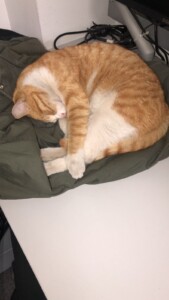
Taking a well-deserved siesta.
Onward with my tale. A dozen cats (give or take) currently live on the British Council premises in Agouza. They are outdoor-indoor cats who come and go as they please. They are not new lodgers; they’ve been there as long as anyone can remember. Local staff say that the cats preceded them, that when they first came to work in the British Council, they found the cats already there. No one is quite sure when they first arrived, but no one can quite remember a time when there weren’t any cats. So this generation of cats may be the great-grand kittens of the cat colony who first settled in that building. They have rights. Squatters’ rights, if you will, but rights.
These are not feral cats, but just like hundreds of well-loved housecats around the world . . . Only these cats belong to no man. Like domestic cats everywhere, they like to nap in chairs unoccupied by big, lumbering human beings. They nap in the morning, in the afternoon, in the evening. They like meals. Above all, they like comfort. They like to laze in the grass on sunny mornings. They like to go to the restaurant next door to see if maybe somebody might give them something. They belong to the place itself.
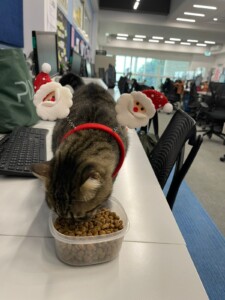
These Egyptian cats are cared for by the British Council local staff, who pay for kibble, vaccines, vet fees for spaying and neutering, all out of their own pockets. As far as anyone knows, no one has ever resented caring for them, nor have the cats caused any trouble. Students, exam-takers, and people wanting to know about UK scholarships come in and out all day and see the cats, and there has never been the slightest fuss about them. And in fact, other prestigious foreign institutions in the city also shelter cats on their premises, including, I’m told, even the British High Commission itself.
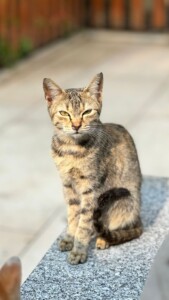
An Egyptian tabby.
But very recently a surprising announcement was made to British Council staff in Cairo that the cats would be removed from the premises by the end of the month and never allowed to return. Staff were further warned that continuing to feed the cats would be considered an offense meriting disciplinary action. Of course, everyone was assured that the cat removal would be done humanely and “no cats will be harmed in the process,” but my Egyptian friends tell me that commercial cat and dog removal services are unregulated and notorious for simply dumping the unwanted animals somewhere in the desert.
And of course getting rid of one bunch of cats will not stop another bunch of cats from moving in.
The rationale for this unilateral decision was declared, but neither the cats nor the cat-lovers were convinced. First, cats pose a risk to pregnant women because of the parasite Toxoplasma gondii, sometimes found in cat feces, which is why these women are advised by their doctors to let someone else clean the kitty litter for nine months. But, in truth, we are as likely to get toxoplasmosis from gardening — and no one tells you to quit that — or from eating raw or undercooked meat. And these BC cats do their business outside, so pregnant women are hardly at risk.
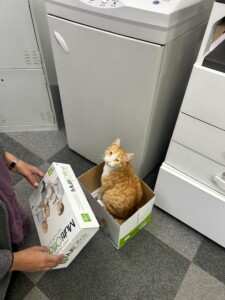
Cats and their boxes . . .
A second stated reason is that cats cause allergies, and sometimes allergic reactions can be very severe. But half the growing green things of springtime and autumn make us sneeze and wheeze, and yet how foolish it would be to uproot them all and send them to outer space to take root somewhere, telling ourselves that “no plants were harmed in the process.” True, for people with allergies to cat dander, this is inconvenient, but in the long run, creating a sterile, animal-free environment would do greater harm than leaving the cats alone and having a few people sneeze. As biologists learn more about the microorganisms with which our planet is teeming, and the countless bacteria that make their home in our guts, on our skin, in our mucous membranes, in our lungs, it is becoming apparent that human health is not achieved by living in artificial environments isolated from the outside world (sometimes called the ‘hygiene hypothesis’). Children brought up on farms are much less likely to have hay fever or allergies because of their early exposure to a greater variety of microorganisms — farm dust, clouds of cattle breath, beds of hay where mama cats gave birth to their kittens. Emerging research about the benefits of pet ownership suggests that early exposure to animals may mean fewer allergies as adults, less obesity, and many other diseases. Illness seems to be something that happens when our ecosystems (and thus our inner ecosystems, or microbiomes) are out of balance or not diverse enough. If the health of staff and customers is the concern, let the cats be.
Thirdly, it is understood that some people have a phobia of cats as others have a fear of dogs. But in Egypt, stray cats and dogs are everywhere, so there is no avoiding them. People with phobias have to manage their fear in a way that does not require changing the landscape utterly.
This communal way of caring for cats is nothing strange. I observed something like it in Greece, in an island of the Northern Sporades, where old ladies regularly feed the village cats scraps of fish, rice, eggplant. Whatever was left over became a meal for the neighborhood cats. I never saw anyone offering them kibble, though. The cats regularly hung out at all the restaurants, and — this I did see — ate everything you tossed to them, from eggplant to zucchini to onions. (The only things they never touched were white bread and salad.) In Turkey, too, it has historically been a matter of pride to give shelter to cats and dogs, and at least one Turkish university offers their campus as a sanctuary for dogs and provides food on a daily basis. In parts of Malaysia, cats may not belong to anyone in particular, but people stop to pet them or feed them, and they always lurk round the back doors of cafes, waiting for handouts.
What is baffling is that an organization whose mission is to build connections and trust among different countries and cultures can occasionally be so lacking in cultural sensitivity and awareness.
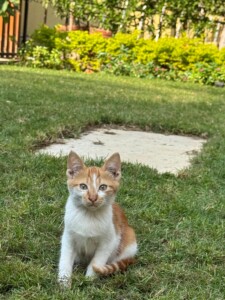
A baby in the garden.
Muslims aren’t a monolith, of course, and feelings about cats vary from person to person, but cats occupy a special place in the storyland in which Muslim children are reared. The Prophet Muhammad loved cats, and one of his beloved companions, Abu Hurayrah, was such a lover of cats that when he went to pray in the masjid, or mosque, people would observe kittens peeping out of his pockets or nestled in his robes.
There is a well-known story of a pious woman who’d never done anything wrong except that once she starved a cat to death, and for that one act of inhumanity, God threw her into Hell. The rest of her life counted for nothing. There is also the opposite story. Another woman, a prostitute who had never done anything good in her life, gave water to a thirsty dog, and again, next to that one act of charity, the rest of her life counted for nothing. The prostitute went to Heaven.
Finally, the one part of this whole business that is especially troubling is that the local staff are afraid to speak up. They are employees of the British Council, certainly, but they are neither British nor ‘white’, and whether intentional or not, the old dynamic of colonizers and natives can still be felt. Local staff in Egypt, as in many other Commonwealth countries, rarely feel that they are on equal footing with their British colleagues. The decision about the cats seems to have been made without any consultation with local staff. It came down like a bolt of lightning. Staff were told the matter was decided, it was final, and not open for further discussion.
I wish my story had a happy ending, as all good stories should. But unless something is done very, very soon, I am afraid that the story will end sadly, for the cats, for the people who love and care for them, and for our sad old world, in which it seems that for every stride we take toward harmony and understanding, we take two big steps backward.
