
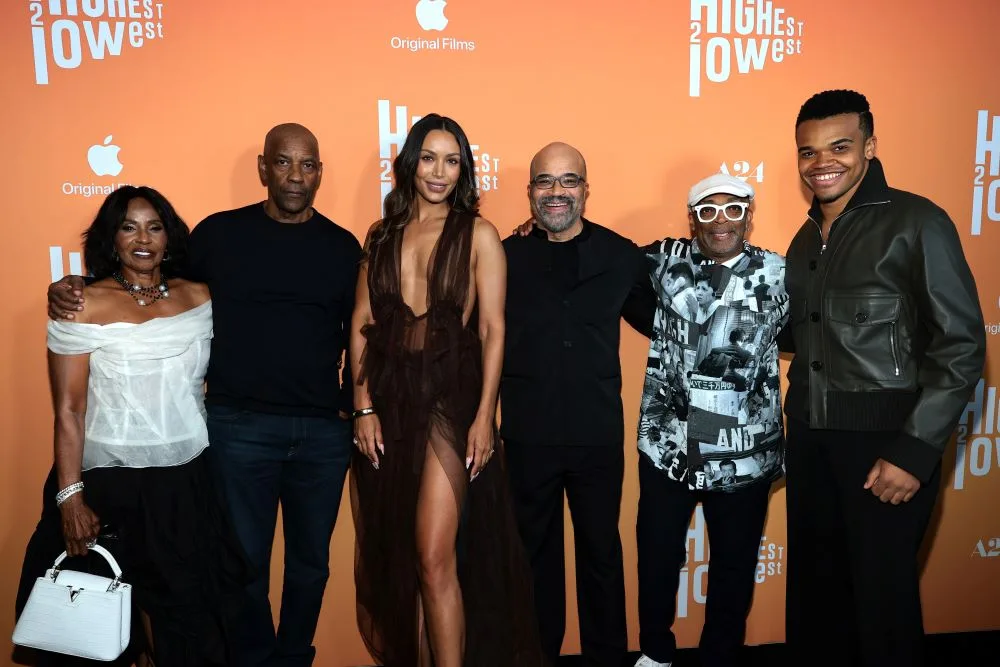
Imitation is the sincerest form of flattery. But imitation doesn’t always live up to the standard set by the original — sometimes with disastrous results.
Over the years, the legendary Japanese film director Akira Kurosawa, known best for his samurai warrior films “Rashomon” and “Seven Samurai,” has inspired his own set of imitators and admirers, most notably Italian-born filmmaker Sergio Leone. Indeed, Leone’s entire “spaghetti Western” genre owes its inspiration to Kurosawa, who was himself a fond admirer of early Westerns directed by John Ford.
So, perhaps it’s not surprising that noted American film director Spike Lee would try to catch lightning in a bottle once again — this time with a 21st century updating of Kurosawa’s classic police procedural, “High and Low.” The setting in Kurosawa’s original film, released in 1963, was the bustling Tokyo metropolis. An affluent and well-known corporate titan played by Toshiro Mifune is suddenly faced with a painful financial and moral dilemma: whether to pay an enormous ransom to retrieve the kidnapped son of his chauffeur. The sum is enormous and could cripple the titan’s plans for a corporate takeover. Further complicating the issue is the fact that his own son was the intended target of the kidnapping, but the confused kidnappers grabbed his chauffeur’s son instead. Should he refuse the kidnappers’ demands and walk away, protecting his own family, and his ambitious financial plans, knowing full well that his chauffeur’s son might perish, leaving his own reputation with the Japanese public forever tarnished? Over the years, the legendary Japanese film director Akira Kurosawa, known best for his samurai warrior films “Rashomon” and “Seven Samurai,” has inspired his own set of imitators and admirers, most notably Italian-born filmmaker Sergio Leone.
Even before the kidnapping, King is seen deciding whether to sell his entire empire to larger commercial interests in exchange for a life of permanent luxury in retirement, knowing that it will deprive aspiring young artists of the kind of sponsorship his company once provided. His personal conflict is somewhat different from the Japanese CEO’s in “High and Low,” but the moral dilemma — naked greed over loyalty to deeper personal values — is broadly the same. The kidnapping further complicates the issue, because the ransom demands are so excessive and because the kidnapper turns out to be an aspiring rap artist who feels King never paid him the attention he deserved. This would-be star also wants revenge, demanding recognition and a creative partnership with King, even from prison, once he agrees to surrender or is captured.
I won’t spoil the ending. The film’s riff on Kurosawa’s 1963 film is certainly highly original. And it’s clear that Lee wants his film to be as instructive and uplifting as Kurosawa intended his own to be. The problem — and it’s a big one — lies mainly in the execution, including the cast, plot, pace of the narrative, and even the low-key soundtrack, which is bizarrely out of place tonally. The first part of “Highest 2 Lowest” is remarkably similar to “High and Low.” The action is confined to the corporate bigwig’s luxury Manhattan suite, and the unfolding drama, which features the company’s board of directors squabbling over their future direction, is subdued, almost cerebral, until the kidnapping, which occurs off–screen.
From the very start, Lee’s film stumbles — and nearly stalls. Kurosawa depicts his board in a state of frenzy as Mifune’s character, Gondo, defies their wishes for a new marketing campaign for a modern shoe that is poorly produced but could earn the faltering firm an immense sales bonanza. The in-fighting is intense and ends with threats and an angry walk-out by the board. Gondo, defiant and arrogant, insists the firm produce a durable old-fashioned shoe, regardless of the profit margins. Mifune strikes a commanding pose, much as he does in his samurai films: Only here, it’s the sheer force of his personality, with his quiet skulking in the presence of his rivals, that carries the day.
In “Highest 2 Lowest,” Washington portrays a man exhausted by his creative vision. Unlike Mifune’s character, he’s an aging mogul who seems eager to bail out — and even sell-out — if it means less strife and more luxury for himself and his family. His chief obstacles are those in his midst who want to preserve the firm’s founding vision, but King’s desperate for new financing to make his acquisition deal viable. Apparently, he’s not a man of principle, and he makes no bones about it. He wants out and begs his board members, one by one, to go along with his plan.
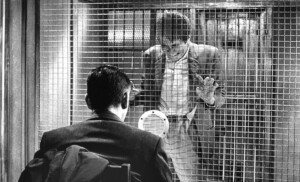
A key scene in the tense thriller “High and Low” by Akira Kurosawa (1963), featuring actors Toshiro Mifune and Tsutomu Yamazaki (facing camera).
Maybe it’s this slow, inauspicious, and decidedly un-heroic beginning that all but dooms “Highest 2 Lowest” from the outset. Washington is traditionally portrayed in a more favorable light, usually with uplighting, but here he is sluggish, even slovenly. King’s life is one of ostentatious luxury, and symbols of that wealth as well as Black power are ever-present in his penthouse, in contrast to the stark black-and-white interiors in “High and Low.” Kurosawa was also a master of blocking shorts; the cinematography is superbly crafted, the composition exquisite. In “Highest 2 Lowest,” the viewer is distracted instead by eye candy of various kinds: the extravagant, out-sized art work and sculptures as well as King’s wife, played by Ilfenesh Hadera, who’s a wonder to gaze upon but virtually inert in her role. She possesses a high-flying career of her own, clad in fashion-forward elegance, but, in the end, her presence never really registers. By contrast, Gondo’s wife, meek to the point of being obsequious and almost geisha-like, emerges as a quiet but compelling force, and, indeed, carries much of the film’s moral gravitas.
When “Highest 2 Lowest” shifts to the kidnapping and its aftermath, with the arrival of the detectives and the precarious negotiations with the kidnapper, one hopes that something like real drama will ensue. In “High and Low,” Mifune’s character resists capitulation, but is slowly worn down by the anxious supplications of nearly every one around him, especially his wife and young son, who feel the human weight of a beloved child’s life at stake. The dramatic high point arrives when the chauffeur, apprised of the precarious financial position of his boss and loyal beyond belief, apologizes for asking Gondo to pay the ransom, even to spare his own son’s life. It’s a heart-breaking gesture, one that strikes Gondo hard, breaking down his resistance and ensuring his capitulation.
Here, too, the moral contrast in the two films is profound, as King continues to resist paying the ransom. While his aide, played by Jeffrey Wright, pleads with his boss for understanding — absurdly asking for a “loan” for the multimillion dollar ransom he could never afford to pay — King remains unmoved and bitterly recounts all the people he’s been forced to take care of during his rise to the top. In the end, he concedes when the detectives assure him that they can recover the ransom when they catch the kidnapper. It’s an emotional letdown, to say the least, that Washington’s character seems so gripped by his fear and greed; this character’s failing seems to undermine the entire premise of the film — at least until the end, when a strong hint of the protagonist’s ultimate “conversion,” and re-embrace of his long-held personal values, finally becomes apparent.
Some viewers may enjoy the shift in tone in the second half of “Highest 2 Lowest,” when the film becomes more of an action movie and urban gangsta flick than a strict crime drama. Washington’s character, frustrated by the manipulations of the kidnapper, and the incompetence of the detectives, goes rogue and decides to pursue his nemesis, portrayed by rapper A$AP Rocky, on his own. At this point, the plot takes several highly improbable turns: For example, when King, brandishing a handgun and filled with quiet rage, confronts Rocky alone in the bowels of a South Bronx ghetto in the dead of night, seemingly oblivious to the dangers. It’s actually the kind of blighted neighborhood where King grew up, and in pursuing Rocky, he’s arguably chasing his own past — and even his own soul — as the police have already captured the hidden ransom money and the kidnapped boy is safe.
But somehow, even here, Lee can’t seem to sustain the suspense and emotional drama one might expect from the film’s denouement.
It’s actually an intriguing premise, and some may find the final showdown between A$AP and King compelling. But somehow, even here, Lee can’t seem to sustain the suspense and emotional drama one might expect from the film’s denouement. Despite the uptick in tempo, the pace of Lee’s film remains almost unbearably slow; the dialogue often feels stilted and the performances of nearly every character strained. The kidnapping itself never seems to register as the catastrophic personal event it would surely be for any real family. Indeed, for much of the film, even in the latter action sequences, the cast seems to be going through the motions, as if they’re still in rehearsal. Yes, it’s actually this bad: In the early going, avid moviegoers may well find themselves staring at their watch, hoping for relief.
There are other scenes in Lee’s film that seem gratuitous at best. For example, the police team’s failed pursuit of the kidnapper takes place in the heart of the city, amid its annual Puerto Rican Day parade, where Latin jazz icon Eddie Palmieri is shown playing with his band amid a throng of festival-goers. Lee has long showcased his affection for New York’s Afro-Latin culture, often featuring Puerto Ricans, such as Rosie Perez in “Do the Right Thing,” prominently in his cast. But Lee here seems to go way overboard with elaborate showcasing of other prominent — and, for him, beloved — New York locations (for example, Yankee Stadium). But his worst excess may be a scene where King and A$AP Rocky try to outwit each other on a subway train, a scene that is lifted rather crassly from the classic 1971 film “The French Connection,” another New York–based crime drama with a harrowing and precedent-setting car chase through lower Manhattan. In Lee’s film, the kidnappers outmaneuver the hapless police on motor scooters and their fruitless pursuit comes off as comical, rather than gripping. It’s symptomatic of just how uneventful and disappointing so much of the cinematic drama in “Highest 2 Lowest” turns out to be.
One could go on about other subpar elements of the film, including its bizarre score, which runs like a barely audible whisper throughout much of the film. Lee seems intent on defying movie convention here, refusing to let his score accent key moments in the film’s narrative. Palmieri’s Latin jazz sequence, which goes on far too long, may seem to highlight the frenzy of the police pursuit, but the music and the dancing is far more animated than the actual chase scene. The film, for all intents and purposes, simply lacks a compelling score, further undermining its emotional impact.
Lee is entitled to his own film, of course. He’s collaborated with this same cinematographer, Matthew Libatique, previously, but not on his best, most notable Oscar-worthy films. And, arguably, “Highest 2 Lowest” is meant to be as much a reinterpretation of “High and Low” as a faithful homage. On paper, Lee does take his plot in some interesting, perhaps even darker directions than Kurosawa did. With a better cast, better pacing, and a tighter script, “Highest 2 Lowest” might have turned out to be a more compelling and watchable film. Washington’s sheer presence in one of the weakest performances of his career does raise the level of the film, but only slightly. This is Lee’s first major production in over a decade, and, sadly, one of the movie industry’s most acclaimed auteurs seems a bit rusty — and even self-indulgent to the point of laziness — in “Highest 2 Lowest.” It takes real hubris to try to measure up to a legend like Kurosawa, and Lee largely fails here. Homage, by its very nature, is a risky proposition. On its own, without a clear predecessor, “Highest 2 Lowest” might have commanded more respect. It’s not a disaster, and thanks to the hype and his own reputation, Lee will survive this disappointing effort, which, in the end, is somehow both overwrought and completely underwhelming.
