Paul and I needed a break. The noise, the smog, and the endless traffic jams felt like Los Angeles was closing in on us, so we couldn’t wait to jump in the car and hit the freeway headed for Palm Springs. The desert hotspot was just a couple of hours away but a world apart from where we had started.
We were ready for our weekend escape, and even more excited to crash at Twin Palms, Frank Sinatra’s first of many homes in Southern California’s Coachella Valley. Architect E. Stewart Williams designed the memorable mid-century manse in 1947 back when the Movie Colony location — where Jack Benny, Cary Grant, and Marilyn Monroe eventually took up residence — was mostly dust and dreams.
With our homemade Sinatra concert blasting through the Saab’s speakers, we belted out “I’ve Got the World on a String” and “Come Fly With Me,” all the while pretending we had pipes.
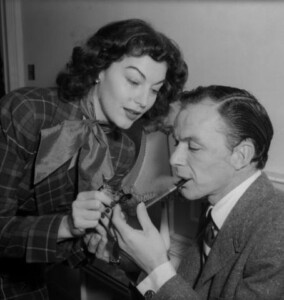
Actress Ava Gardner and Frank Sinatra. After Sinatra’s divorce from his first wife, the turbulent couple shared the Twin Palms estate for a time.
Freeway after freeway, the city slipped away until we passed the last gas station and fast food joint. Suddenly, we were surrounded by open land: dry, sun-seared earth with an occasional cactus popping up as if by magic.
Just as the scenery started to blur, we hit a rise — and then, boom: windmills. Hundreds of them, slowly turning as if enacting some sort of obscure meditative practice. The army of propellers felt like a surreal welcome party to Palm Springs, its lifeline shimmering in the distance.
Coachella Valley became a latter-day tourist mecca, but, always one beat ahead of his time, Sinatra called the desert area his true home starting in the late 1940s and for most of his adult life.
After making his first million, Sinatra had fled Hollywood for reasons very different from our own. Frank liked being able to escape the star trappings other celebrities craved, and he enjoyed the quiet of the desert without sacrificing certain social gatherings.
In fact, this Rat Pack-er’s Twin Palms parties were done his way. He could handily dodge the paparazzi and autograph-seekers, yet still host the kind of functions that had the locals talking. Regularly, as the sun started to set, Sinatra would hoist his Jack Daniel’s flag up a pole near the pool, signaling that happy hour was officially in session at Frank’s house.
But there were rules.
For instance, guests at his soirées were expected to dress up, even while poolside. The women donned curve-clinging cocktail dresses and kitten heels while the men turned out wearing cuff links and polished shoes. Nobody dared show up in flip-flops unless their name was Sammy Davis Jr., and, even then, he’d probably hear about it. Meanwhile, Frank often hosted in a tuxedo.
Conversely, our crowd took a more relaxed approach. One by one, they arrived, immediately making a beeline for the pool: barefoot, laughing, drinks already in hand. Some dropped bags; others dropped their towels.
Jeff “Beachbum” Berry was among the first to show. A revered tiki expert and our longtime poker pal, the Hawaiian shirt–clad author/mixologist was eager to spend time in the house where Sinatra once held court. It didn’t take him long to set up a fully stocked bar near the two cabana-style changing rooms at the far end of the pool, ready to offer concoctions sure to quench even the most hard-to-please thirst.
That pool, by the way? Why, shaped like a grand piano, of course.
Our initial afternoon at Twin Palms swiftly melted into a swirl of plunging, floating, splashing — and more than a few cannonballs. Sinatra favorites like “The Lady Is A Tramp” and “Summer Wind” serenaded through underwater speakers while drinks became more necessity than distraction. As the day wore on, stories grew longer, voices grew louder, and laughter grew more unhinged.
Eventually, someone asked for a tour, causing a few of us to drift inside. The house, while comfortable, still had that clean-lined glamour of mid-century cool, including stone and glass in all the right places. We walked through the living room, with its wooden ceiling designed for better acoustics, and then past the dining space, decked out these days with a rare Paul Frankl table.
After making his first million, Sinatra fled Hollywood for reasons very different from our own. Frank liked being able to escape the star trappings other celebrities craved, and he enjoyed the quiet of the desert without sacrificing certain social gatherings.
Finally, we hit up the pink master bathroom which still held a famous remnant from when Sinatra lived there: a cracked bathroom sink. Legend has it Frank smashed the hardy porcelain with a full Champagne bottle during a fight with Ava Gardner in which he allegedly threw the bubbly at her head, and apparently missed. The sink stayed and the story stuck harder, especially because it bore a scar that — truth or fiction — served as a reminder.
By dusk, our friends mellowed as the lights around the pool came on, casting that warm glow only Palm Springs can conjure. Some of us slipped into the hot tub, hanging tight to exotic cocktails as we let the water work its magic.
Inside, someone cued up Frank’s 1955 album, “In the Wee Small Hours,” while a bottle of something good was passed around. Through the floor-to-ceiling windows, the stars started showing up: late, but as glamorous as ever.
We repeated that day all the next: more sun, more floating, more stories about Sinatra. Oh, and more Manhattans to give us that feeling one gets when time stops keeping track.
Alas, all too soon, it was time to return to Hollywood. The following morning as Paul and I headed out, I mentioned that there was one more ritual Frank would have wanted us to pursue while in the vicinity.
And so, with a quick flick of the blinker, we were able to follow a nearby off-ramp. Within minutes we were inside a big casino, casing the joint like bona fide members of the “Oceans 11” crew.
Paul set off for the card tables while I detoured to the restrooms, then wandered down two steps. There, I nearly ran into what looked like a low-rent slot machine and so, just for kicks, I slid in $20 and hit max bet.
When the reels stopped, a bell started ringing — loud, insistent — as numbers began to climb. People turned. I stared. The machine flashed a rainbow of colors.
After surrendering my Social Security card and driver’s license to a casino staffer (no ID, no payout), I went to find Paul. He spotted me first.
“Hey, I won $200,” he said, clearly pleased with himself.
“That’s great,” I said. “I won $19,200.”
He laughed. I didn’t. I was still in shock.
At last, the cash was delivered into my hot little hands and we left the casino, humming Sinatra’s “Luck Be a Lady” all the way to the bank.