
Once again, “Shark Week” is upon us.
It’s a good time to remember how we became so obsessed with these fearsome predators. Was it “Jaws,” the blockbuster 1975 summer hit, starring Richard Dreyfuss and Roy Scheider?
That movie was such a colossal disaster in production that it nearly didn’t make it to the screen. Filming on Martha’s Vineyard was plagued by constant delays and mishaps. Even the mechanical Great White shark became irreparably damaged, forcing the director to alter the script. But the show went on. And after “Jaws,” going to the beach was never quite the same.
Some maintain that “Jaws” permanently dented the summer tourism business up and down the New England coast. Perhaps, but the movie exerted an even greater — if more insidious — impact on popular culture, similar to the effect that Alfred Hitchcock’s “Psycho” once had. Before “Jaws,” the ocean and the surf inspired carefree spontaneity; after “Jaws,” they could just as easily prompt a sense of foreboding and fear.
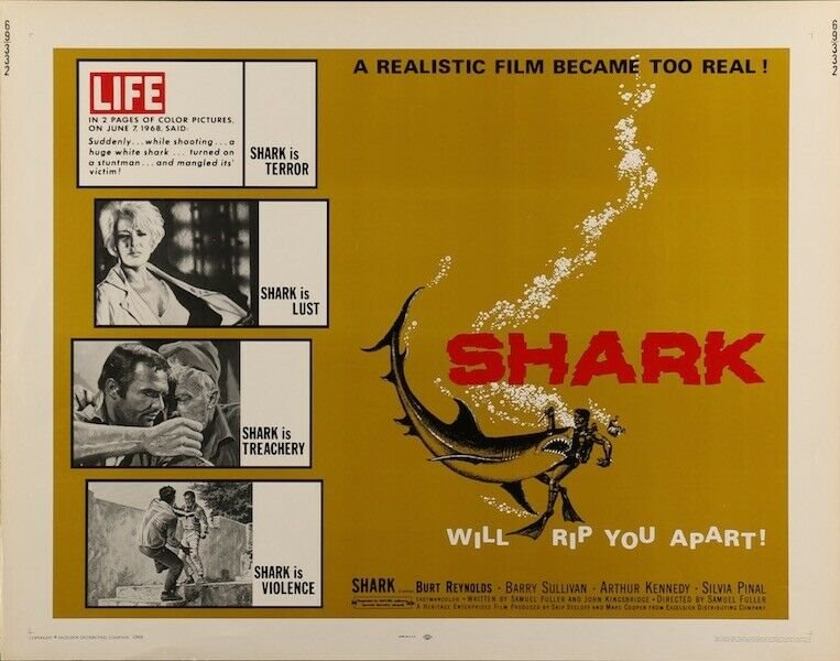
Ironically, Hollywood’s emerging shark genre — including three rather unimpressive sequels to the original film — didn’t actually begin with “Jaws.” It started with another film, titled simply “Shark,” which appeared six years earlier. That movie featured an emerging Hollywood leading man and sex symbol, Burt Reynolds, and, so, might have seemed destined for greatness, too.
It had sharks, and shark attacks, including one during the actual filming that allegedly claimed the life of stuntman Jose Marco. In fact, the producers of “Shark” were so anxious for publicity that they crassly hyped Marco’s alleged death as part of their promotional materials, creating howls of protest.

Despite writing and directing “Shark” (later renamed “Man-eater”), Samuel Fuller disavowed the film owing to its editing.
Commercially, though, the film bombed. Even its legendary director, Sam Fuller, disowned the final cut. But an extensive review published in the respected film magazine Bright Lights still found a few things to praise in “Shark.” Reviewer John Belton said the film “contains some magnificent moments, some brilliantly shot and edited purple passages,” especially its underwater fight scenes.
But what really set the film apart from “Jaws” was its use of the shark not as a metaphor for an unpredictable external enemy or an inner psychological fear — two characteristics of the horror genre — but as a symbol of human venality.
The sharks in “Shark” are largely human-sized. And the humans, cold and shark-like, swim among them as equals. In the end, the film is really a disturbing commentary on the selfish and predatory nature of humans under conditions of unbridled greed.
Not surprisingly, the two films also end on different notes. In “Jaws,” Brody (Scheider) and Hooper (Dreyfuss) snag some barrels and kick their way back to shore together, spent but having vanquished the terrifying evil that nearly consumed them both. But in “Shark,” the protagonists, still competing over underwater treasure, end up on deck literally at each other’s throats. Meanwhile, sharks continue to swim and circle, eagerly awaiting another body thrown overboard.
Who knows how the entire Hollywood shark genre might have evolved if “Shark” had garnered more attention? In the late 1960s and 1970s, the “Jaws” celebration of human cooperation and survival may have been more reflective of popular culture.
But, looking back, perhaps “Shark” contained more insight into the blood-thirsty human world we still live in.
