

Deborah Levy put down into three books many of the same thoughts I dwell with during sleepless nights or mindful cleaning and cooking. She calls them her living autobiography, the last of which is titled Real Estate. The other two, in order of publication: Things I Don’t Want to Know and The Cost of Living.
The books (particularly the third, for me) really get your mind going. The experience was one of the rare occasions where, upon completion, I don’t simply reflect on how much it resonates with me, but it actually feels as though she’s captured what I write in my mind on a daily basis. The way she expresses the unadulterated happiness found in a busy kitchen filled with her daughters and their friends reminds me exactly of the joy I felt when my daughter and her friends would pour into our ‘real estate.’
In our loft apartment, bilingual bursts of laughter and awe filled the rooms, piles of shoes crowded at the entrance, one friend perched on a counter making her way through tarallini con anice, another knitted while sitting cross-legged on the floor; all the while, others stepped around them boiling the water for pasta, grating cheese, and opening bottles.
There is a living throughline out there among female creatives if you just bend your ear to them. They are in journals, on Instagram, singing to “The Moth,” telling their stories.
Levy also roams from living space to living space — be they writer’s rooms or apartments, in London or in Paris — borrowing a plant from one, a window from another, a pomegranate tree from a third, until she creates the perfect imaginary set-up, which she calls her Unreal Estate. This I find inspiring. There is a living throughline out there among female creatives if you just bend your ear to them. They are in journals, on Instagram, singing to “The Moth,” telling their stories. They are telling us, “yes, you got deterred for decades by obligations and impositions thrust on you by the patriarchy; yes, you may be wrinkled and bent by burden and sadness, but it is never too late.” Never too late.
It is not a new concept, the one of the grown woman who balances the pragmatism of work and family with the creative burn to put something out there, the wandering woman in search of “a room of one’s own,” as it were. But it is worth noticing and recognizing, for as many manuscripts and works of art there are in the world belonging to such women, there are many, many more that go unfinished, unread, unseen.
Rereading Levy this year brought me to consider my own unreal estate. For the past three years or so, I, too, have drifted from one writing corner to the next. Inhabiting living spaces, each with its own charm. I make mental note of what I’d keep of each, what I’d change.

You can’t always see it, but there is a steady tension between one’s real and unreal estate.
Right now, I sit on a terrace above Savonarola’s square in Florence. It’s breezy but warm enough to sit sleeveless and barefoot while the finches chirp around me from rooftop tegola, or tiles, to antenna. Soon, it will be too hot to step out onto the terracotta even in early morning. In front of me, the Duomo hides behind an umbrella pine, the Campanile behind a cell tower.
I remember when I went off to write in a room of my own in the Norfolk countryside with a few belongings: my favorite Stoneware mug with the blueberry motif and a three-cup Moka, MacBook, necklaces and earrings, a journal, a few family photographs, and a Bose portable speaker (through which BBC Radio 4 keeps me company and John Prine sings “Hello In There”). I was taking revenge on the lockdown months of Italy and began a peregrination that has yet to finish.
I
Shortly before leaving to commence my midlife Master’s degree, I fell into an arrangement with an extremely well-to-do farming family. I would live in the gatehouse at the end of their kilometer-long drive, beyond the ostentatious gate, and atop one of the rare hills of the flattest region of the UK. Norfolk skies are a thing of beauty. Sheep and muntjac deer, pheasant, and hare were my neighbors. Along with, of course, the Range Rover–driving, Balfour-wearing landlords and their hunting friends.
Here I went on long walks and mentally dialogued with my father, whose Alzheimer’s had taken him away from the writing table before he’d had the chance to share with the world the depth of his compassion and understanding of the human condition. He had so much worth saying. So I would take him with me on my hikes, as I wrote and explored life on campus again as a 55-year-old woman. I don’t deny that on some of those windswept crests, amid pig sties and village churchyards, fields of wildflowers, or knee-deep bogs, I spoke aloud with him as if he were by my side. He loved long walks, a college campus, chats with veritable strangers.
I learned the inestimable value of light through short winter days and unending summer ones, plus the poetic timing of snowdrops, bluebells, and daffodils. The apartment itself in the gatehouse was far too large. I created a nook in the vast living room, ignoring three-quarters of the space, confining myself in evenings to a cozier corner. My studies and writing took place in the warmth of the kitchen. I initially settled in the smaller of the two bedrooms, slowly emboldening to the point of taking over the larger one. I felt as much at home those black and silent nights as I ever had rambling through woods on the mountain of my childhood.
II

View from the cottage: A horse grazes, out to pasture in the idyllic countryside.
From my gatehouse in Ringland, North Norfolk, I moved just south of Norwich to look after a “cottage” for a new friend. The home was bordered by horse paddocks in the back and a country lane in front. It was idyllic, full of family love and warmth, worn to just the perfect point of comfort. I was working on my thesis by now and sat at the desk in the study looking out onto the horses; I had my dinner outside as they came and munched on an olive tree. The kindness of new friends and the way they opened their home and arms to me propelled my writing and filled me with hope and faith in the future. The daily company of majestic horses fills my heart to this day.
III
In a bungalow outside of London and audibly close to Heathrow, my dear friends from Rome have created their home. This is where I started and finished my year away. Some of my belongings still occupy part of their garage. The level of support and friendship in that house full of dogs and cats, food, fun, and laughter pushed me into my pursuit of truth and writing.
IV
The view from the kitchen table into the barn fueled the Sicilian tale I wove.
From London I went to New England. I would complete my thesis at my brother and sister-in-law’s house in Vermont, not far from where I grew up. The view from the kitchen table into the barn fueled the Sicilian tale I wove. I was alone for much of the time, alternating my productive time in their peaceful house with spurts at my mother’s, not two hours away, where writing was the last thing I could do. There it was about cooking, cleaning, changing sheets, doing laundry, keeping Mom engaged. I’d been away a long time, and it seemed fitting to dedicate time to both.
Time in Vermont extended. Repeatedly. Life had been suspended for much of my sabbatical, but upon pushing that submission button, it came back with blow after blow. My first bout with COVID coincided with thesis completion; my mother was hospitalized with a lung infection they refused to call COVID.
And then my imaginary writing companion, the presence that had accompanied me constantly for my whole year off, faltered. My father was in a rural nursing home nestled between the White and Green mountains outside a nameless village where a diner buzzed with upbeat chatter and staggering BLTs on homemade bread. The adage about Vermont towns goes, “sneeze and you’ll miss it,” and this was such a town. A road where you instinctively know to watch for bear and deer after dusk dipped and curved east, passing not one but two gun shops before coming to a worn storefront with a hand-printed sign, The Curt’n’Rod. I drove that road until the night of October 8, 2022.
VI
Like Levy in Real Estate, I don’t own a home. Although I do make myself at home — usually — wherever I am. This is particularly true of my apartment in Rome, where I have lived for ten years. If I had my unreal estate dreams met, this flat would provide the footprint for a small house in a country setting with horse paddocks to the back. I’d keep the same beautiful wooden floors and overhead beams, its loft and open-plan kitchen. I’d add a breezeway off the entrance and put an en suite guest room at the other end, just like my dear friend Helen did to her Umbrian home.
VII
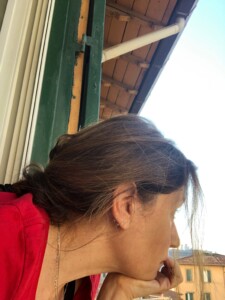
The author contemplates her peregrinations past and future.
Seven months ago, I rejoined the real-world workforce again. My extended sabbatical and regular writing practices came to an end as I took on a role of responsibility full of daily tasks and forcing me back into dialogue with productivity and KPIs. As part of the arrangement, I had to agree to live in Florence, the place I left twenty-four years ago. Even though it’s been over a year, I still say I’m here for work. Still hold on to my Rome lease. My general rule since I left my marriage in 2000 had always been to be on the top floor of wherever I lived, with light streaming in and no one above me. Figuratively or literally. The sixty-square-meter loft apartment in Florence was created by an architect who designed it as a boat. The floors are reminiscent of decks of teak. The galley kitchen is efficient if not grand. Every surface serves a purpose: Pantry shelves disappear under stairs, while a mezzanine-level wall doubles as a long desk under which bucket drawers hold linens and clothing, ending in a platform bed. The top floor — or deck — holds the master bed and bath and the observation deck where I sit now as I write this. As much as it is designed to be efficient and sleek, it is also warm and comfortable.
I can’t know when my peregrination will end, when I might decide I am where I belong, where I will stay. Nor do I know if I’ll ever reach that point. I do know that what Levy calls “unreal estate,” what Virginia Woolf conceived as “a room of one’s own,” cannot be dark and closed-in. I have to see out, observe the world around me. Whether standalone in the country or on a top floor in the city, I have to have air and light, wooden floors, functional kitchens built for food-lovers, and big sofas to sink into. Creativity soars with horses and wildflowers or, in their absence, the laughter of children in the piazza intermingled with voices outside a local wine bar.
