
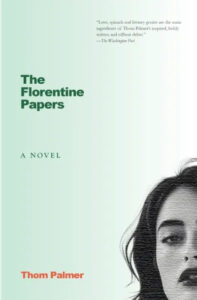
If you are a fan of lean, hard-boiled prose, you won’t find it in The Florentine Papers: A Novel, by Thom Palmer. In this, his first novel, the author is a maximalist, filling the pages with obscure and colorful adjectives that may send some readers to their dictionaries.
For instance, the second paragraph from the 2025 reissue by Tivoli Books:
The dedication, “To Popeye, mon ami,” is not just another tongue-in-cheek element of this jeu d’esprit, though admittedly her work is full of arcanum and recondite asides that the nescient gourmand-belletrist would pooh-pooh as so much excelsior. . . .Yet, despite the unstinting investment of my time, sanity, fully equipped kitchen, and circulatory system, I am not one whit better off than I was four years ago. Contrarily, my midsection is greater and my emotional state, always a tad delicate, is more friable than ever.
Despite that, I found the prose engaging. The rhythm is seductive, while not altogether sublime.
The story takes place in San Francisco in 1978, which was a year of profound transformation, marked by some of the most tragic and pivotal events in the city’s postmodern history. We often refer this to as “Year Zero,” a time when the city’s political and cultural scene was shaken to its foundation by internal violence and global disruption. The defining moment occurred with the horror of the Jonestown Massacre in Guyana. The mass murder–suicide of more than 900 people involved many San Francisco residents who had followed cult leader Jim Jones from his headquarters in our city. Just nine days later, San Francisco suffered a second shock when Mayor George Moscone and Supervisor Harvey Milk were assassinated inside City Hall.
 While The Florentine Papers makes no mention of these events, an undercurrent of dread and anxiety is present throughout the story.
Our unreliable narrator opening the passage above, who forever remains nameless, is at work on an epic poem about Vietnam. And while America’s war there ended three years earlier than the setting, we don’t know if he may have been a veteran of that conflict . . . or if he’d acquired an appetite for hashish elsewhere.
His fondness for bordellos may also be a clue, as he has cultivated a relationship with Yvette, a club-footed prostitute working in Madame Nerval’s salon. This place of ill repute is tucked away above the downtown shop of a tobacconist. Many such places were opened up in San Francisco after the war for military men passing through our city from Southeast Asia.
Meanwhile, he becomes mesmerized by an 18-year-old vixen with supernatural culinary talents: Maria Perpetua.
He is more than simply smitten or enchanted. He adores her. For my money, though, [this novel] bears a great resemblance to the Italian masterpiece Zeno’s Conscience (La coscienza di Zeno) by Italo Svevo.
Maria was a fugitive, fleeing San Francisco with her mother as a young girl, only to return at the age of 18. There’s a brief fling with a lesbian lover before she shacks up with our poet.
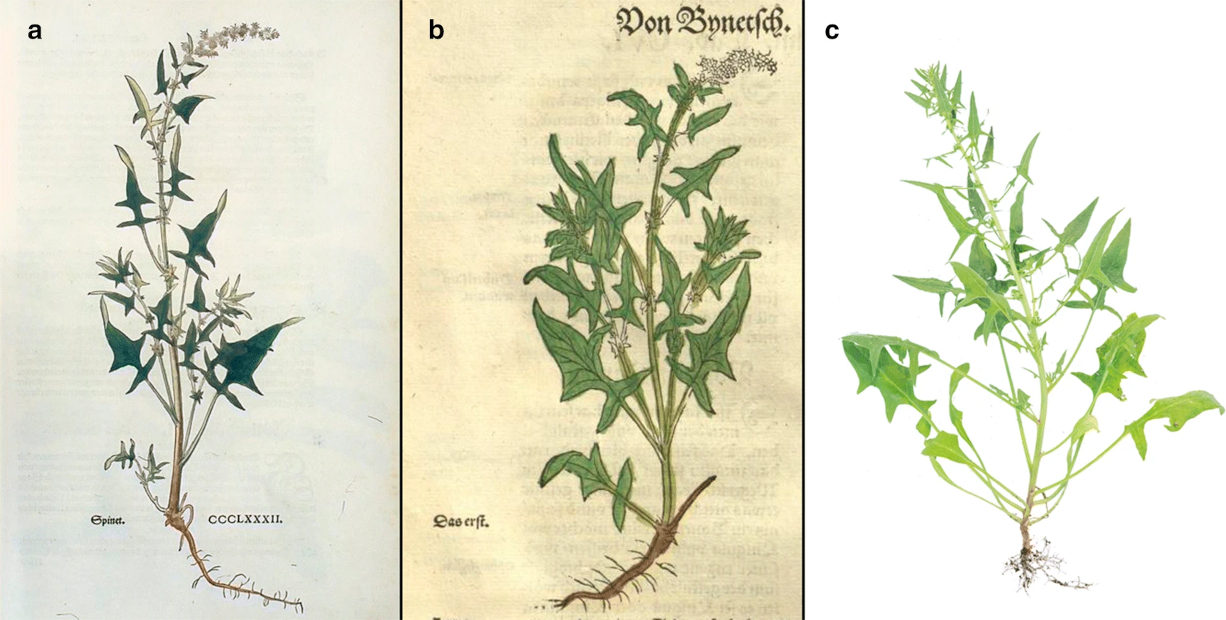
A woman now in full bloom, her one goal is to author the definitive tome on spinach — Spinacca oleracea — dictating her impressions and recipes to this narrator who tirelessly bangs out her musings on his Underwood typewriter.
Is she impressed? Hardly. Maria advises him to invest in an electric model, or even a word processor, to keep pace with her rapid dictation.
Thom Palmer’s complex gastronomical book has been widely praised by prominent critics who compare his style to that of Julian Barnes, Anthony Burgess, and even Nabokov.
For my money, though, it bears a great resemblance to the Italian masterpiece Zeno’s Conscience (La coscienza di Zeno) by Italo Svevo.
Our antihero here, however, is not a slender chain-smoker, but a “paranoid, poltroonish poet,” filled with similar rationalizations and self-deception.
His introspective reflections make it a powerful (and often humorous) work of psychological realism that takes place when all of San Francisco is going through a rough patch, indeed.
