On the morning of February 11, 2013, the World Day of the Sick, I was sitting in front of my computer translating a news flash for a Roman agency when an announcement was made on Italian Radio 3, to whose classical music program I was listening. At the end of a consistory held on that day to discuss three possible canonizations, Pope Benedict XVI had taken a sheet of paper out of his pocket and read, in the perfect Latin of the Roman Curia, a declaration of resignation. Soon after, a flash with the news I had just heard on the radio appeared on the screen. Giovanna Chirri, the only one who understood Latin among the journalists covering the event, was the first to break the news to the world. In his “declaratio,” Benedict XVI cited his advanced age and failing health, adding that he no longer felt the strength “ad navem Sancti Petri gubernandam” (“to govern the barque of St. Peter”). Pope Benedict’s resignation, effective from the night of February 28, 2013 meant that from that moment the office of St. Peter was vacant.
It was a shock for the Catholic world. Pope Benedict was the first pope in seven centuries to resign freely, without being compelled by external pressures. The only precedent was the resignation of Pope Celestine V in 1294.
Pope Benedict XVI had taken a sheet of paper out of his pocket and read, in the perfect Latin of the Roman Curia, a declaration of resignation.
Though Benedict XVI’s decision was unexpected, he was 85 when he announced his intention to leave and it was well known that his health was poor. According to well-informed sources, the pope had expressed his intention to retire well before his election to the papacy, but Pope Paul John II had asked him to remain at his office as Prefect of the Congregation for the Doctrine of the Faith.
Joseph Alois Ratzinger, who was to become Pope Benedict XVI, was born on April 16, 1927 in Marktl, in Bavaria, Germany. He and his brother Georg were both ordained priests on June 19, 1951.
Georg Ratzinger was the organist and the director of the Regensburg Cathedral children choir, the celebrated Regensburger Domspatzen (“the Sparrows of the Regensburg Cathedral”).
From the very start of his ecclesiastical career, Joseph Ratzinger had a reputation as a first rate theologian. At 31, he was appointed as full professor of Theology and taught at several German universities, before becoming Archbishop of Munich and Freising in 1977. In that same year, Pope Paul VI made him Cardinal.
Joseph Ratzinger became pope on April 19, 2005, choosing to be called Benedict in honor of Benedict XV, the promulgator of the first comprehensive Canon Law of the Church, and St. Benedict of Nursia, the monk who founded several monastic communities including the Abbey of Monte Cassino, in Latium.
Benedict XVI was traditional in many ways. He allowed a wider use of the Tridentine Mass, which had become neglected since the promulgation of the Novus Ordo. He strongly opposed the growing secularization of the Church and relativism, which he considered incompatible with the principle of truth. Many, however, thought him too conservative. For not being more diligent in prosecuting members of the clergy accused of sexual abuse and for his opposition to the use of condoms, even in AIDS stricken countries, he received much criticism.
After his resignation, he chose for himself the title of “Pope Emeritus” and he retired to the Papal residence of Castel Gandolfo to continue serving the Church with a “vita orationi dedicata Sanctae Ecclesiae Dei” (a life of prayer dedicated to the Holy Church of God). Benedict XVI died on December 31, 2022, at the Mater Ecclesiae Monastery, in Vatican City.
The conclave convoked by Cardinal Tarcisio Bertone, the Secretary of State, elevated to the See of St. Peter Cardinal Jorge Mario Bergoglio, Archbishop of Buenos Aires.
On the evening of his election, on March 13, 2013, I was once again translating news, but with a small window open on the right corner of my computer, showing the chimneypot on top of the Sistine Chapel where a Conclave session was on. When I saw the white smoke coming out and trailing in the air, I called my wife who was busy in the kitchen, “Pina, habemus Papam!”
Born on December 17, 1936 in Flores, a suburb of Buenos Aires, Argentina, to a family of Italian immigrants from Piedmont. Benedict XVI’s successor was the first pope from the Americas (and the first Jesuit) to be elected to the Throne of St. Peter.
Humility, simplicity of style, and a concern for poor people and migrants, together with his exhortation to trust in God’s mercy were characteristic features of his pontificate from the very start.
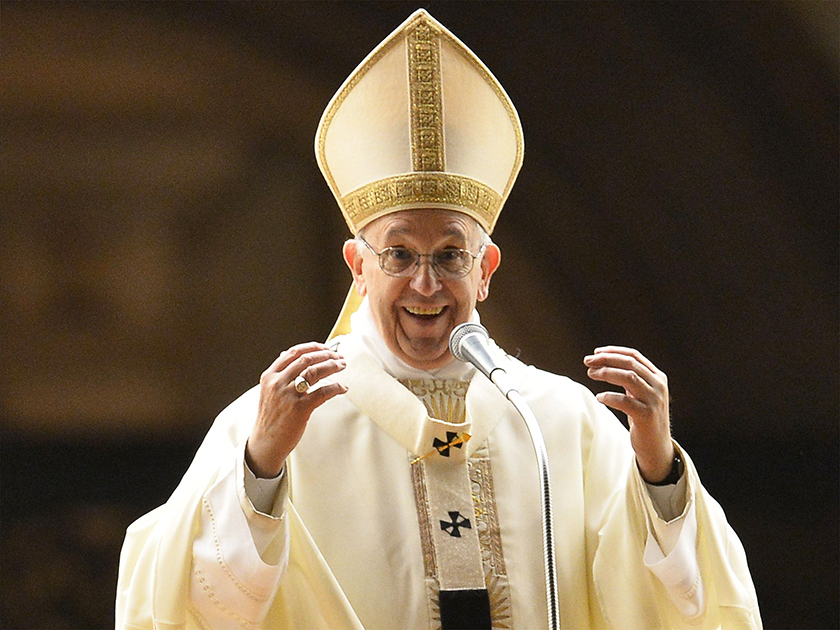
After joining the Jesuits in 1958, Bergoglio was ordained priest in 1969. In 1998, he became the Archbishop of Buenos Aires and was made cardinal in 2001 by Pope John Paul II. Upon his election to papacy, he chose the name of Francis, in honor of St. Francis of Assisi, the saint of poverty and simplicity. Humility, simplicity of style, and a concern for poor people and migrants, together with his exhortation to trust in God’s mercy were characteristic features of his pontificate from the very start. His greeting, “Buonasera,” addressing the huge crowd gathered in St. Peter’s Square on the evening of his election, made his first appearance as a Pope a memorable event. His Jesuit background led him to use simpler vestments and silver instead of gold for his Piscatory Ring, and he went on wearing the same pectoral cross he had used as a cardinal. He would ride along the streets of Rome on the back seat of an old Ford Focus, or on the passenger seat of his own Fiat 500, to visit a parish. On a couple of occasions he popped out of the Vatican just to have new lenses fitted to his glasses by his trusted optician in Via del Babuino, and he would insist on paying the bill.
Francis was the first pope who chose to live in a modest flat in the Vatican Domus Sanctae Marthae guesthouse instead of the grand Apostolic Palace. One of his first acts was to have a few rooms behind the right wing of Bernini’s colonnade converted to serve as public baths for migrants and the homeless.
During his papacy, Francis boldly preached the protection of the environment, and against consumerism. He asked all nations of the World that still practiced capital punishment to abolish the death penalty and strongly criticized racism and discrimination based on religion, race, sex, and sexual orientation. Francis also urged the Church to be more tolerant and inclusive toward homosexuality. Unions of people of the same sex could not be blessed, but individuals could, though not in liturgical contexts. He also ruled that women could be full members of dicasteries of the Roman Curia.
In the international context, he was instrumental in restoring diplomatic relations between America and Cuba and managed to limit the influence of the Chinese government in the appointment of bishops in China. In 2015, under his auspices, the Holy Seat signed a “Global Agreement” with the State of Palestine, a formal recognition of the rights of the Palestinian people. In 2023, Francis strongly condemned Israel’s military operation in Gaza and later in the West Bank. He was also the first pope to really apologize for the role played by the Church in the “cultural genocide” suffered by the indigenous peoples of Canada in residential schools.
After his election, allegations were made concerning Bergoglio’s relations with the Argentina’s military junta when he was the Archbishop of Buenos Aires. Bergoglio allegedly had not done enough to free two Jesuits arrested by the military and had on various occasions collaborated with the regime. However, no evidence was ever provided. On the contrary, it is well known that Bergoglio hid members of the opposition in churches and in Church properties to save them from being arrested and probably become “desaparecidos.”
A few fundamentalist Catholic priests and even some high prelates accused Bergoglio of being a heretic and a schismatic for his defense of indigenous peoples in the Amazon and their traditions. In Italy, at least, nobody seemed to heed this nonsense.
Pope Francis died on April 21, 2025.
Bergoglio was the first South American and the first Jesuit to be elected pope. His successor, Cardinal Robert Francis Prevost, Archbishop of Chiclayo (Peru) is the first North American pope and the first pope who belongs to the Order of Saint Augustine. Upon his election, he took the name of Leo in honor of Pope Leo XII, who has become known for his concern for workers and their welfare, a choice that seemed appropriate to many observers, with a new industrial revolution looming and the challenges of AI.
Born in Chicago, on December 14, 1955, he grew up in the suburb of Dalton and became a friar of the Order of Saint Augustine in 1977. He became a priest in 1982. He worked for years in Peruvian parishes, and also worked as a teacher and administrator in seminaries, and as Bishop of Chiclayo.
On his return to Rome, Pope Francis made him Cardinal and appointed him as prefect of the Dicastery of Bishops and president of the Pontifical Commission for South America. His election to papacy on May 8, 2025 was quite unexpected, since many Vatican experts considered the idea of a pope from the United States, a superpower, unrealistic. Some said that his election represented a “dignified middle of the road.”
Upon his election, he took the name of Leo in honor of Pope Leo XII, who has become known for his concern for workers and their welfare, a choice that seemed appropriate to many observers, with a new industrial revolution looming and the challenges of AI.
It is much too early to express any opinions on Pope Leo’s papacy. However, his work and commitment during his years in Peru as a priest, a teacher and administrator in seminaries, his concern for the poor in depressed areas of the country, his criticism of Peruvian dictator Alberto Fujimori’s actions and politics, and his denunciation of the violence of the Peruvian army against civilians, speak in his favor. As a missionary priest in Peru, he visited the poorest and most isolated communities on horseback and defended villagers against the violence of the “Sendero Luminoso” (Shining Path), a Marxist-Maoist guerilla movement. He strongly condemned, more than once, the October 7 attack by Hamas in 2023 against Israeli civilians and the indiscriminate bombing of Gaza by Israel, which has caused more than 60,000 deaths, including 20,000 children — a genocide according to many.
It will not be easy to steer the “barque of St. Peter” in the perilous seas of these modern times. At the moment, Leo XIV seems to follow a middle course between the currents of traditionalism and modernism. A voyage over the perennially troubled waters of the Roman Curia and the Catholic world in general.
I wish the new pope all the best luck. He will need it.