

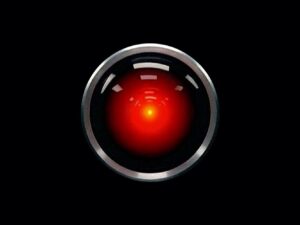
 HAL revisited: I was among the few who watched the 1968 premiere of Stanley Kubrick’s “2001: A Space Odyssey” in Cinerama, a short-lived but mesmerizing technique that used three projectors operating simultaneously to display the entire canvas of the film on an amphitheatrically shaped screen measuring some fifty feet, floor to ceiling. Cinerama, for all its magnificence, took second place to the film’s star, an artificially intelligent supercomputer named HAL 9000, its voice dubbed by the Canadian actor Douglas Rain in flat, eerie tones. HAL is the soul of a vessel sent into distant space to investigate a Tower of Babel–like monolith on Earth’s moon (and, previously, in Africa at the dawn of humanity) that appears to take orders from its Jupiter counterpart. Though hundreds of postwar films and books touched on the inevitability of AI, HAL 9000 was unique, in essence a hyperintelligent supplementary human with a glowing red eye. At the time, some critics viewed HAL as a high-tech caricature, the brilliant machine made in man’s image, which, given human nature, would eventually turn against him. Ultimately undone by data it cannot fathom, HAL kills one of the two astronauts on board, forcing the second one to “disarm” it, to use Pope Leo’s word. My memory of HAL, a traumatic one for a boy, comes as the head of the American AI firm Anthropic has openly said that some new AI systems may soon have the menacing capacity to elude human control, HAL finally come true. He all but begs other AI firms to construct what he calls a brake pedal. I doubt he will succeed for the same reason HAL was made omnipotent, because superintelligence is thrilling, but as futurist Arthur C. Clarke — author of the 2001 series — knew, an AI door left too ajar can be symbolically and literally murderous, like a hormonally homicidal teen with an AK-47. The message is simple: Disarm now before HAL and its 21st-Century masters will not allow it.