

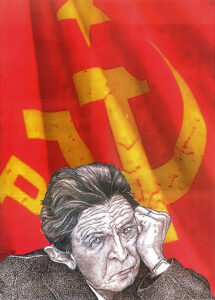
 Berlinguer in ’76: Early into its bicentennial year, the United States warned Italy, since World War II run by the Washington-friendly Christian Democratic Party, that if the rival Italian Communist Party (PCI) were to win hotly contested June national elections, it would have to review the steadfast relationship between the two NATO allies. The Italian Communist Party was the largest in Western Europe and the vanguard of the so-called Eurocommunist movement, also active in Spain and France. Though these communists maintained ties with Moscow, they had little interest in the Soviet Union as a ruling model. Instead, Enrico Berlinguer, who headed the PCI was more interested in worker rights and social welfare. He sought, he said, a more equitable Italy based on merit not on favoritism. The Christian Democrats, he repeated time and again, were unreliable, broken into at least a half-dozen factions, and prone to political deceit. In the end, the Christian Democrats won the election by slightly more than 4%, though the PCI surpassed the 30% threshold for the first time in its history, and for decades the storyline read that Italy had narrowly averted communist tyranny. But this story was wrong, as my friend, the gifted and astute writer Stephen S. Hall, has discovered by reading newly declassified diplomatic cables. The real fear, articulated privately by Secretary of State Henry Kissinger, was that Berlinguer, a son of Sardinian nobility, was an honest and capable politician who if he rose to power might push the Christian Democrats into fatal disarray. Washington was less interested in forestalling communism than preventing someone who might change Italy for the better from attaining a critical leadership role. Despite his efforts, Berlinguer’s communists never did come to power, fundamentally undermined by far-left terrorist organizations, most notably the Red Brigades, who worked to discredit a sturdy party led by an exceptional man, Berlinguer, who died in 1984. The man Washington wanted so badly to taint was thus undone by groups whose tactics and ideology he loathed. “Good guys,” baseball manager Leo Durocher once remarked, “finish last,” which in Berlinguer’s case meant finishing second.