When I found out about Pope Francis’ death on Monday, April 21, I had just dropped my daughter off from school and was at one of my coffee spots, “Karma Cream,” for the best macchiato in town. My heart fell reading the news: of course, I wasn’t surprised. Considering the pope’s health, it was only a matter of time. Nor can I claim to be anything other than a lapsed Catholic, or, similar to many Italians, a cultural one. But still: a force for good in the world, particularly our deeply troubled one, was gone. If lauded as a proponent of human rights and a defender of the marginalized, the pope and his legacy around other progressive issues, like gay marriage, was more opaque. But as far as popes go, he was indisputably known as “the people’s pope.”
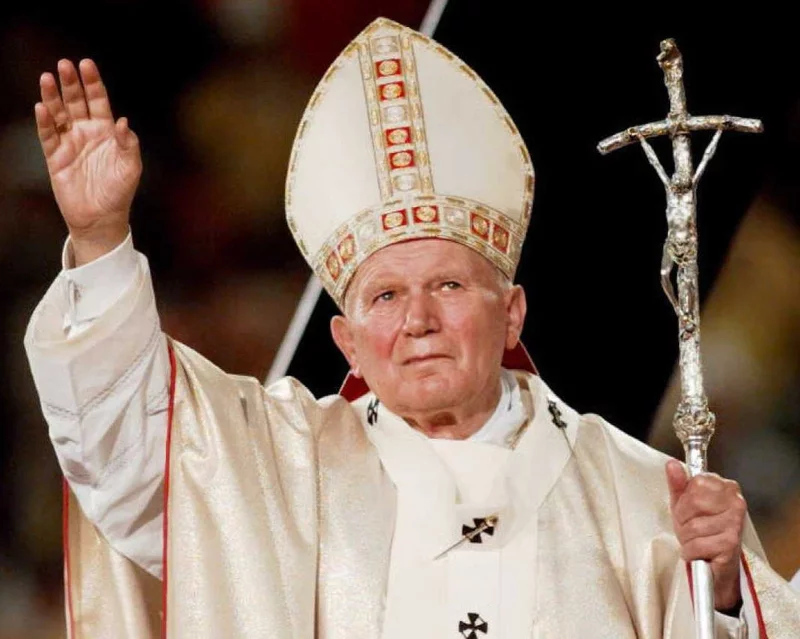
His death took me back to the passing of Pope John Paul II, in April 2005, which also came, curiously, around Easter time. I was a young reporter in Rome, and the papal transition was the first big story that I got to work on. Having earned some street cred as a freelancer on the Vatican, I was hired by the Wall Street Journal to help compile background on the pope. I was also tasked with writing the “reporters’ notebooks”: Basically, I got to wander around Rome, taking the pulse of a city that had lost its beloved Papa and would brace itself for his less congenial successor. I wrote pieces on a convent-turned hostel, the pope’s knowledge of Roman dialect, and a Boy Scout troop from Poland that came for the pope’s funeral.
This last one was my favorite because it was a found story — meaning, I literally stumbled upon it. I was leaving my office, heading down the Via del Corso, when I spotted hundreds of Boy Scouts holding Polish flags. I asked someone what they were doing, and he explained that they were going to camp out at Castel Sant’Angelo. I followed them there, through Rome’s Centro Storico neighborhood, where people came out of apartments and restaurants to wave and cheer on the Scouts. When we got to the open field beside the Castel Sant’Angelo, the Scouts pitched their tents and their parents made sandwiches for supper. Many of the boys were teenagers, who told me they wouldn’t have come this far for their favorite rock star, only their “Papa.”
I might have been a novice reporter, but I was in journalism for the words, and I’d crafted my own in the Scouts piece.
After a couple of hours, I walked all the way home, along the Tiber River, which seemed more lit up than usual, undoubtedly because of the excitement coursing through my own body. I knew I had a story, and the body is often its first messenger. When I got home, I sat down and wrote the story without pause. The next day, a senior correspondent wanted to cut it up for “string” for her own piece, which didn’t sit well with me. I might have been a novice reporter, but I was in journalism for the words, and I’d crafted my own in the Scouts piece. I then quietly sent it to my supervisor, telling him about the correspondent’s intentions. He quickly sent the story to editors in New York, who ran it nearly unedited.
When I tell this story to my students, I use it to illustrate the curiosity and conviction necessary to report and write. I told an abridged version to my daughter Julia the other night because it’s never too early to learn to follow your instincts and stand up for yourself. But she was far more interested in hearing about the otherworldly pageantry of the papal transition itself: the red-robed cardinals and their secretive voting, and the white smoke billowing in the skies of Rome, signaling the election of a new pope.
She’s right to hunger for these details: If journalism is the first draft of history, witnessing it is the first order of business, which brings me to another memorable moment: the day before John Paul II died, I followed a rumor that he was already dead. I literally ran down Via Vittorio Emanuele II toward the Vatican City, not wanting to miss the story, but also telling myself, “I have to get there so I can tell my kids about this someday.”