With the Paralympic Winter Games in full swing and the Olympics just concluded, I should be writing about ski jumping, downhill racing, figure skating, and bobsleighing (bobsledding to North American ears) on an icy rollercoaster. Unfortunately, I am not in the least interested in sports of any kind, apart from my stint in athletics in my high school days. In my teens, I unexpectedly discovered I could run faster and jump longer than any other boy at the teacher’s college I attended from 1964 to 1968. It was a real epiphany, which at the Student Provincial Games, over four successive years, got me golden medals in the 100-meter dash and in the long jump, a bronze medal in the 4×4 relay, and admiring looks from Anna, the classmate sitting next to me and whom I would marry nine years later.
The opera that premiered during the Games “is also a homage to the diversity and variety of Italy and its landscapes, cities, and people and particularly to its mountains, which have provided a breathtaking background for these Winter Olympics and Paralympics.”
Of course, I saw the grandiose opening ceremony of both the 2026 Milano Cortina Winter Olympics and, now, the Paralympics. Italian President Sergio Mattarella formally inaugurated the Games.
A prerecorded video depicted Mattarella’s arrival at the stadium riding an old trolley car, driven by nine-time Grand Prix motorcycle road racer, and current racing driver, Valentino Rossi.
The Italian television commentary, by the director of the Sports Department of RAI, was a disaster (for which he was fired in February 2026). The man got most names wrong, including that of International Olympic Committee President Kirsty Coventry, whom he mistook for President Mattarella’s daughter, as well as the name of the stadium. “Welcome to the Stadio Olimpico,” he emphatically announced to open the live television report. A pity the Stadio Olimpico was 576 kilometers south, in Rome! That was only the beginning and, for the love of my country, let’s draw a veil over the rest.
The Parade of Athletes from 92 countries took place in the San Siro stadium in Milan but also in three other venues, Cortina d’Ampezzo, Livigno, and Predazzo. Actually, this was the first time that the opening ceremony took place across four different locations of the host country. Two cauldrons were lit, one in Milan and the other in Cortina. The ceremony in February included a section highlighting the artistic achievements of Italy, with tributes to 18th-century sculptor Antonio Canova and to three of the most celebrated Italian composers, Gioacchino Rossini, Giacomo Puccini, and Giuseppe Verdi. World-renowned artists such as Mariah Carey, singer Laura Pausini, Andrea Bocelli, and United Nations Messenger of Peace Charlize Theron, among others, also spoke or performed. Italian rapper Ghali recited “Promemoria,” a poem against war by Italian poet Gianni Rodari. Ghali was the only artist not to be honored with a close-up during his performance, a retaliation, according to many, for his denunciation of the genocide in Gaza during his exhibition at the 2024 Sanremo Music Festival, and his criticism of the Italian government’s support of Israel.
To be honest, in my view, it seems at least debatable whether Israel should have been invited to take part in the Games. Russia had been excluded because of its invasion of Ukraine, but not Israel — notwithstanding the invasion and the complete flattening of Gaza, and the extermination of more than 70,000 Palestinians, civilians in their largest majority (as confirmed by IDF data), including about 20,000 children. So, one wonders, why not invite Russia, too? In ancient Greece, wars stopped during the Olympics and even states at war with each other took part in the games. Today, the Olympics are so politicized that some are invited and some are vetoed and even during the Games, as has already been the case for the Paralympics, people die under bombs dropped by a participating nation. What happened to the spirit of humanity, fraternity, and peace?
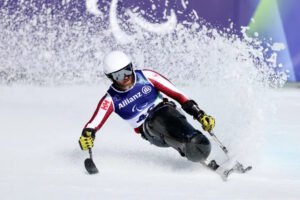
The Para Alpine Skiing Men’s Downhill Sitting Final slid into the Tofane Alpine Skiing Centre, with Team Canada’s Kurt Oatway of Team Canada seen here on the first day of the 2026 Paralympics.
Being impervious to sports, I feel that what struck me most was music, which certainly occupies an ample corner of my heart. Readers will forgive me if I confine myself to dealing mostly with music at the Olympic Games overall and at the XXV edition of the Winter Games.
In fact, the Olympics is not only sports. Music and arts have always played an important role in the event, and the harmonious combination of both elements adds to the fascination of athletic performances. Music is an essential element of figure skating and other artistic competitions, but it is also intended to motivate and inspire athletes. Music is played in all indoor games and often also outdoor. It has been connected to the Olympic Games since its beginnings in ancient Greece (from 776 B.C.E. until 393 C.E., when Emperor Theodosius, pressured by the Christian religious authorities of the time, banned them). In Olympia, where the games were held in a festival that blended religion and sports, hymns were sung in honor of the gods in their celebrated sanctuary. I visited Olympia several years ago and, swept away by nostalgia for yesteryear, ran the 212.54 meters of the track in the fifth-century stadium, next to the ruins of the temple dedicated to Zeus. I confess I ran a bit out of breath, but I made it up to the stone marking the end of the track.
When Baron Pierre de Coubertin resumed the Olympics in 1896, music and art in general were associated with sports. The Baron strongly believed that art and sport could contribute to promoting education and international harmony and peace. At the first edition of the modern Olympic Games in Athens, the Olympic Anthem (or Olympic Hymn), composed by Spýros Samáaras, with lyrics (in demotic Greek) by the poet Kostis Palamás, was sung, and it continues to be performed to today in the language of the host country. The five-rings logo was adopted in 1914 and first appeared after World War I (Antwerp 1920). The rings are blue, black, red, yellow, and green. At least one color appears in the flag of every country on Earth.
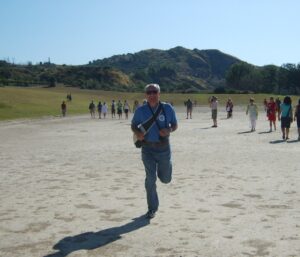
Aldo Magagnino jogs on an original Olympics track.
Besides the buffet of music and songs at the Olympics’ inaugural and closing ceremonies, during the various sports events and medals ceremonies, compositions by renowned musicians sometimes premiered. This tradition started with the Stockholm Games in 1912 and continued for several years before being discontinued. This year it was revived, and two compositions were commissioned and presented.
“Olympia,” a symphonic poem in four movements (The Future, Flames, Times, Final Celebration) by Roberto Cacciapaglia, is a musical journey for piano, orchestra, voice, and electronics, which accompanied the arrival, the passage, and the ascent of the Olympic flame up to the lighting of cauldrons and then the final celebration. “When I started to work at Olympia,” Maestro Cacciapaglia said, “I thought of a composition that could support the most important, celebrative, and symbolic moments of the 2026 Milano Cortina Olympics opening. In ancient times, [the] Olympics stopped wars, the so-called Olympic truce. In the dark and tragic times in which we are living, music and this ceremony may celebrate the highest gifts of human beings: the ability to listen, share, and walk united toward peace.” The symphonic poem was recorded by the Royal Philharmonic Orchestra directed by Roberto Cacciapaglia.
The other composition that premiered at the 2026 Winter Olympics is an opera, “I Giochi di Orobea” (The Games of Orobea), with music and libretto by Andrea Portera. The work stemmed from an idea of Maestro Lorenzo Passerini, the artistic director of the Valtellina (Province of Sondrio) Orchestra Antonio Vivaldi. “The Games of Orobea” deals with division, sacrifice, and redemption: five “champions” defy one other to pursue the sacred torch of the God Alpime (in Italian, ‘Dio Alpime,’ an anagram of Olimpiade). They are all bearers of diversity: age, gender, sexual orientation, ethnic group or religion, and disability, the last one being a clear hint to the just-begun Paralympics Games. “My reference points were the values inspiring the Milano Cortina Games,” Maestro Andrea Portera said. “The five Olympic rings allowed me to imagine a story and its development. In ancient Greece, [the] Olympics were a moment of peace and dialogue: In this case, the Olympic spirit has also a social meaning, because the five ‘champions’ are not champions at all, but they represent five discriminated-against categories.” The message conveyed is that diversity is strength and that the blending of diversities enriches humankind. It is also a homage to the diversity and variety of Italy and its landscapes, cities, and people and particularly to its mountains, which have provided a breathtaking background for these Winter Olympics and Paralympics.
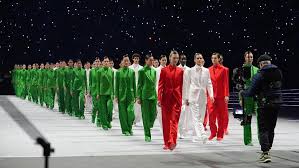
The opening ceremony for the 2026 Milan Cortina Winter Olympics was a visual coloratura mixing spectacle with athleticism against the beautiful backdrop of northern Italy and its alpine landscape.
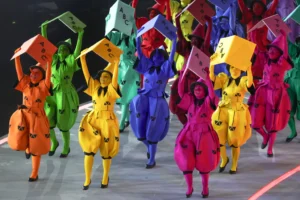
Italian literature even made a bold appearance at the Games’ opening.