Some years ago, I wrote a line that has recently re-emerged in my mind: Maybe I should go back to Rome in the guise of a nun. I was bemused: I knew I didn’t actually want to be a nun. Nor could I imagine raising my daughter in a nunnery. But I also knew what I longed for, at the time, besides a desire to be back in Italy (this was during the first Trump presidency, so you can only imagine how I feel now). I wanted solitude. The closure of the cloistered, contemplative life.
My daughter was a toddler at the time, and so, my longing for space was not an uncommon feeling for mothers, especially introspective ones. My mother said you always remember the first look on your child’s face. My older brother was smiling and laughing, and he became the social one. I studied my mom, like I was “already wondering what this was all about.” She dubbed me a thinker, and it stuck.
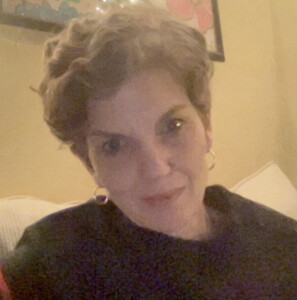
A portrait of the writer, Kristine Crane, in her meditating chair, with a new hairstyle and life lessons learned.
Over time, I’ve figured out, more or less, how to manage my mind with mothering. But the nun line came to me over winter break, after doing two, back-to-back silent meditation retreats that felt monastic. I wasn’t able to talk to anyone, not even my cats (though I once cheated). Although I’ve been doing these retreats twice a year for several years, I skipped them last year when I was working on my dissertation. So, I was nervous to jump in and sit silently with myself for several days — especially since I knew that during the retreat, I would likely process the dissertation research that I’d abandoned the moment it was done.
The topic was how relocation laws affect mothers — who are put in situations one scholar compared to “Sophie’s Choice” — forced to decide between leaving kids behind for a job or romance elsewhere or staying with their kids and passing up those opportunities. It’s a gendered burden that’s been buried under the guise of parental equality. I’d powered through it “like a ninja,” as a friend told me, donned in my objective academic armor, but the topic’s underlying emotional implications were bound to emerge.
And they did during the retreat, along with a bunch of other emotional stuff: My mother loss, my father’s dementia, relationship struggles. The theory behind the meditation practice is that by sitting with yourself, you burn through your burdens and come out lighter as a result. In a literal sense, this happened to me: I lost about seven pounds in four days. I felt fragile, but also a little freer, with some clarity on my career, creative life, and relationships. Private musings aside, I also ingested some valuable life lessons from the retreat lectures. Here are a few takeaways:
My mother said you always remember the first look on your child’s face.
“Don’t be a football of other peoples’ opinions”: In other words, don’t dwell on what others think of you. I experienced this first-hand in the fall, when I chopped my hair off during a trip to D.C. mid-semester. With three classes to teach and my daughter’s roster of activities, I knew my drastic haircut could not go unnoticed. My mind recorded each comment, from the sweet student who said, “Oh, I love your haircut. Your face looks so beautiful!” to the gymnastics mom who looked me squarely in the face and said, “Oh, I love your . . . earrings!”
“Accept situations and people for what they are”: Don’t passively accept bad situations, especially if you can change them, but if you can’t, don’t fight reality in search of an idealized reality. You may end up fighting yourself, which is never good. This relates to my research: The mothers most at peace with their lot were those who proactively strategized a way to not feel trapped — either by taking steps to leave or finding self-preservation in staying.
“The present moment is inevitable”: Being present is also a more peaceful, fun way to live. I realize that I like teaching because it demands that I be fully present. Ditto for creative activities like writing poems and taking pictures.
“Life is magnanimous”: Life is so much more than what meets the eye. I experienced this on New Years’ Eve, when my daughter and partner and I were taking an early evening walk. The clap-clap-clap of my partner’s flip-flops annoyed me. “It’s because they remind me of Florida,” I said. If there were a state shoe like there’s a state flower, flip-flops would belong to Florida. Flip-flops remind me that we live in a state that I don’t really like. But it has its virtues, like beautiful winter weather and wide-open skies. And on that night, Orion’s bright belt looked as close as a departing plane, and a planet we guessed was Venus twinkled in the seemingly bridgeable distance. “Julia, it’s already New Year’s in Italy!” I blurted out.
If we couldn’t be in Italy (not even, thankfully, in a nunnery), the next-best thing was knowing that the same sky stretches over us and Italy — and for that matter, everywhere else — and your imagination can take you anywhere in an instant. Maybe, I thought, understanding that is the actual best thing.