
The reason I chose to attend Columbia University more than five decades ago had little to do with the university’s stalwart reputation or its location, very much at the core of New York City, which at the time was broke and dilapidated. The allure was born of a different source: my love of subways. By 18 I knew those of Paris and London well — and had an uncannily sharp vision of the signs that appear under the windows of all French trains, Ne penchez pas dehors: “Don’t lean out.” Whether in trains or Metros, I always did . . . or tried, provoking ferocious rebukes from my mother, fellow passengers, and conductors, in more or less that order. When I was 12, my mother was fined some number of francs for my transgressions. She was furious, but I was proud.
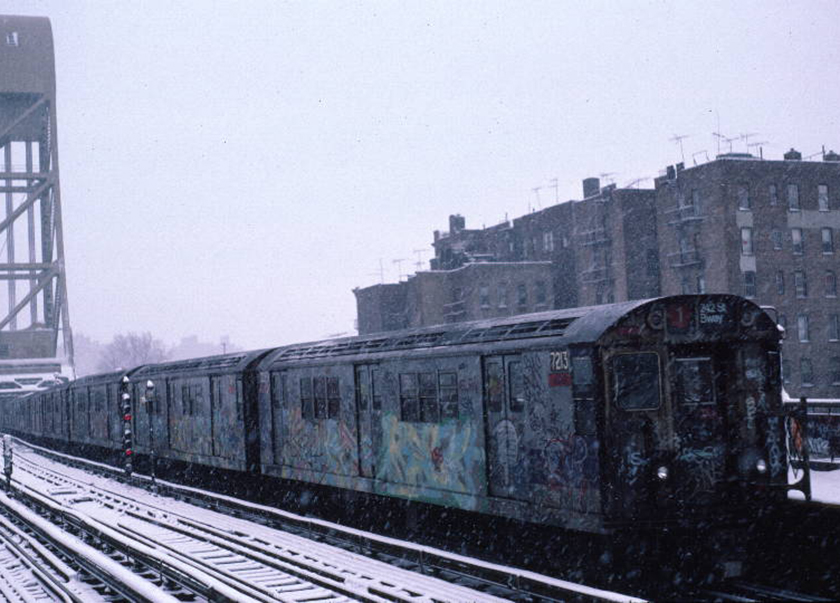
But Paris and London were fairly rigorously regulated, with most Metro and Tube windows not easily accessible to adolescent tinkering. Ah, but New York was different. A city on the brink of financial collapse, its tunnels and pre-air-conditioned subway cars in motley disrepair, it had no money to police what went on underground, short of violent crime. It adopted a live-and-let-live policy and let the chips fall where they may. And in 1971, the chips tended mostly to fall dirtily, and to stink.
The tunnel air, foul when the train was idle, assumed a completely different aroma at top speed, which to me was the scent of speed itself, unbridled and unkempt.
This suited me perfectly, and I spent the first few months of my freshman year not in classes (though I attended the important ones) but on the West Side IRT, both the local, number 1 (usually packed) and the express, number 2. I would studiously calculate where the first car would stop, at the far end of the platform, and anchor myself at the front window, just beside the driver’s locked compartment. If the window wasn’t already lowered, I’d pull it down myself and push my head as far as it would go into the darkness, so that when the train sped up, the metallic, dank air would blow back in my face and take me into a state I imagined as disembodied flying. My hair was long then, and at times it snapped like a small flag in a taut wind. The tunnel air, foul when the train was idle, assumed a completely different aroma at top speed, which to me was the scent of speed itself, unbridled and unkempt. At times the driver would open his door, often smoking, often bored, and strike up a brief conversation. Most drivers called me “kid,” and a few issued casual warnings, little more than “Stuff can blow into your eyes.” This was not Paris.
One driver, Marty, was an American born in Montreal who’d spent a year in Paris in the 1950s. “Wine was real cheap, and even the poor people seemed classy.” After a moment or two he’d disappear into his cabin. Another driver, a middle-aged black man named Carl, did the unthinkable: He drew me into his tiny compartment and let me watch him speed up and slow down the train, jostling toggles whose purpose he’d memorized. I was mesmerized. This, not the humanities, was to me the education I needed. Homer had no dominion in the tunnels. Stuck to these windows I met few passengers, although I did befriend a sleek Juilliard dancer with short red hair who, like me, enjoyed the thrill of speed and wind and rails. She’d been born outside Topeka in a rural area she’d always wanted to flee, but, maybe sensing my aloneness, she told me stories of large Thanksgiving dinners, which I imagined and envied. I was an only child who in essence came from everywhere and nowhere. I am that same boy now, perhaps more experienced but unchanged in my consummate loneliness, a trait that can turn into a life story.
This, not the humanities, was to me the education I needed. Homer had no dominion in the tunnels.
I so wanted to ask Lizzie, the Topeka girl, to have coffee with me, but the three times I saw her, I lacked the courage, and then I never saw her again. I met another tunnel traveler, a woman who went only by the name Pack Rat. “Up front is the only place where this fucker of a city makes sense, at least to me.” She dealt heroin, she said, and wandered car to car. Again, Homer, at least in his bookish Columbia guise, was nowhere to be found. Yet this was my odyssey, speed and friction felt first-hand among vagrants, drug pushers, dancers, and a multitude of New Yorkers who kept their faces carefully hidden behind newspapers.
“You really are a tunnel hound,” the driver Marty once told me. I was and would remain, if only the world had not over the years deepened its almost neurotic attention to security. These days, most train windows cannot even be opened. They are built shut and sealed. Slowly but surely, the illicit means to experience that bodiless flight — aside from sticking your head outside a car window — is evaporating. The world is back on its haunches. Ne penchez pas dehors, with no mother needed to silence the music of chance.
