
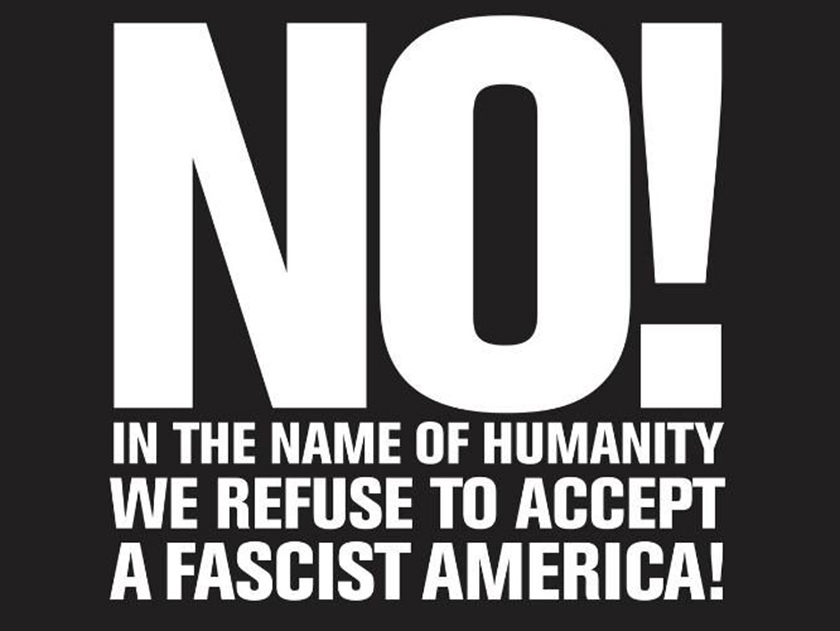
Fighting incessant wind, I hold my homemade sign high above my head as I yell into the highway, “Show me what democracy looks like! This is what democracy looks like!” over and over as my heart swells in my chest and my voice goes raspy. The majority of protesters around me chant at whatever volume their lungs allow.
“Silence is violence, when rooted in compliance!”
“Together, united, we’ll never be defeated!”
“Hey hey! Ho ho! Elon Musk has got to go!”
“Hey hey! Ho ho! The Trump regime has got to go!”
Angry white men in lifted trucks lay on their horns, flicking us off as they drive by. Older women in luxury SUVs shout at us from under bleach-dyed blowouts, fingers pointed in disdain. An occasional rogue driver will threaten running us down, swerving toward the sidewalks with pure, unadulterated hatred. Sometimes even children, following their parents’ example, yell at us from backseats. The sun beats down on us, unrelenting, but we are unrelenting too.
Though there are detractors, offensive gestures, and vitriol spewed our way out of passing car windows, mostly there are happy honks. Happy, smiling whoops, power fists thrown out in solidarity. The ones who are with us smile and yell and laugh with excitement. There is some kind of unexplainable energy exchange at gatherings like this that simply cannot be replicated or felt through a screen. It gives you hope like nothing else can.
There is a whole group of people who think the threat to democracy is not real and are completely apathetic, as if they can live in a blissfully ignorant bubble forever, in spite of all the turmoil we face under a plutocratic, oligarchic regime of techno-feudalism and corporate greed.
Our local Democratic organization gets permits from the county to hold protests and sign-waving events alongside our “main street” in the Outer Banks of North Carolina, which is really just a public park alongside a four-lane highway. We live in a distinctly American car-dependent place, a sprawling, glorified sandbar peppered almost exclusively with beach homes instead of hotels. This place still exists because of, and in spite of, tourism. It empties in the winters to become a ghost town where only major businesses remain open, with limited hours. Most of the full-time residents are either retired and well-off or young, seasonal service workers. I am the latter. Snowbirds with multiple homes come and go. Most of our audience are traveling motorists heading to rental homes on vacation from up north or out west.
I can’t help thinking each time we assemble how much our passersby don’t expect to see us — not here, not in this pristine spot to which they’ve come to escape the “world,” an escape that for them can be made only once a year, during paid time off. But that’s just the issue — there is a whole group of people who think the threat to democracy is not real and are completely apathetic, as if they can live in a blissfully ignorant bubble forever, in spite of all the turmoil we face under a plutocratic, oligarchic regime of techno-feudalism and corporate greed. As if it doesn’t already affect them. I like to believe these are people who are maybe too beaten down by economic stagnation to do anything but turn a blind eye and hope for the best, as if ignoring it will make it all go away.
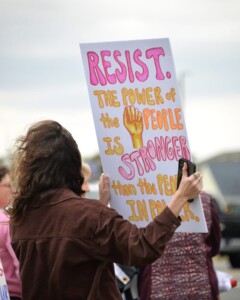
A photo of the author taken by fellow protestor and organizer Cyndi Goetcheus Sarfan.
I have protested many times over the years, from my hometown of Fredericksburg, Virginia, to Richmond, Virginia, and now, in Nags Head, North Carolina. I have protested for Black Lives Matter, Women’s Right to Choice, and now, democracy in the face of a plutocratic, techno-feudalist regime. I have protested with hundreds of people as things turned sour and police got involved; I have marched through the streets with thousands to obstruct “business as usual”; I have yelled with small handfuls of people alongside roadways. I have shown up alone or with friends, before or after work, whenever I could. I come from a family who think the American Dream exists, who think I am naively passionate, and who get all of their news from TikTok, talk radio hosts similar to Rush Limbaugh, and Fox News pundits. They will not read the books I suggest or the articles I send, nor will they watch the videos of our leading economists, Congress people, and experts on panels of international esteem. To them, I have been brainwashed by my “liberal” education.
At protests I get a little lump in my throat when I see mothers and daughters, inter-generational families turning out together. I wonder what it is like to have a default support system that seeks to understand you instead of the opposite, but I find support in my close-knit beach community, local town halls, and volunteer opportunities. We have to find and build our communities in person and on a regular basis. There is no other way to build momentum and crush the normalization of isolation in American culture; we have to get out there.
The easy thing to do is to fall into despair and check out, exactly what Gil Scott-Heron pointed out in the famously prescient song from 1971, “The Revolution Will Not Be Televised”:
"You will not be able to stay home, brother.

You will not be able to plug in, turn on and cop out.

…

The revolution will put you in the driver's seat.

The revolution will not be televised,

Will not be televised,

Will not be televised,

Will not be televised.

The revolution will be no re-run, brothers.

The revolution will be live.”
The revolution is alive in the streets of America, in us. We refuse to stand by as people are being kidnapped, detained, and deported without due process and as our president usurps powers that were never his to abuse.
So we must keep doing our part, while we still can. It is not in vain, and it is not unnoticed. If I find myself feeling small or powerless, I remind myself of what James Baldwin once said. “I never have been in despair about the world. I’ve been enraged by it. I don’t think I’m in despair. I can’t afford despair […] You can’t tell the children there’s no hope.”
We have to make good trouble. Even if it’s just 200 people, eighty percent of whom are over age 65. A threat to democracy here is a threat to democracy everywhere.
We can’t afford despair. We have to make good trouble. Even if it’s just 200 people, eighty percent of whom are over age 65, yelling into a highway as the police wait to usher us away our permitted time is up, we have to take to the streets. We have to organize. We have to show up. A threat to democracy here is a threat to democracy everywhere.
For the brief autumn I lived in Venice, Italy, trying — and failing — to pay my way through a Master’s degree that was still astronomically cheaper than anything in the United States, I had a hard time navigating my identity as an American. Fellow international students who found out I was American would almost always ask one of two questions: “What do you think of Donald Trump?” (or “Who are you voting for?”) and “Are there really that many guns?”
To me, this morbid curiosity about the dangerous spectacle America has become was not unwarranted. And so, I reiterate, a threat to democracy here is a threat to democracy everywhere. I will continue to stand up. Will you?
