
There is a scene in “It’s a Wonderful Life,” Frank Capra’s 1946 movie, in which the protagonist George Bailey jumps over his desk to keep customers from deserting his family-owned business in the middle of a bank run. “Wait a minute!” he stammers. “We can think this thing through.” Anytime I am tempted to get involved in something complex, or feel the urge to react to something I disagree with, I try to keep this line in mind.

Victor Hugo dons a keffiyeh.
There are so many tour groups near the Sorbonne’s entrance that they practically live on that street rent-free. Imagine the confusion of a completely uninformed tourist when, from the inside of the Sorbonne’s courtyard, he hears the chant of “Free, free Palestine.” That caught me off-guard too, not because I expected the situation in Palestine to have improved, far from it, but because the swift intervention of law enforcement and riot control usually deter the students from organizing any wide-scale campus occupation or sit-in.
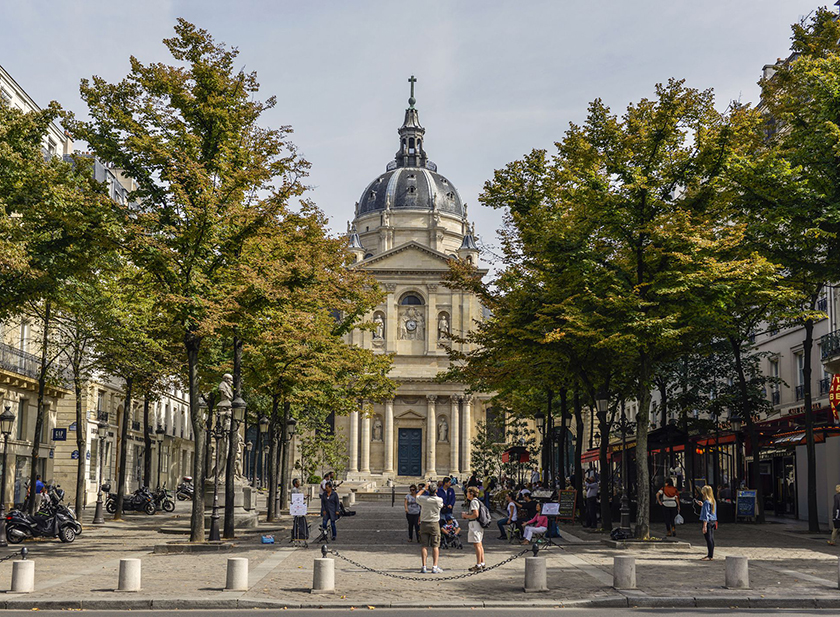
My first thought when I heard the chants in the megaphone at the end of my noon history lecture was, “Wow, they’re going for the heaviest symbolic statements possible.” I stepped out in the courtyard and saw that indeed, they were. Looking to my left, I saw a Palestinian keffiyeh draped over Victor Hugo’s bust while a student waved the red, white, black, and green flag. Up ahead, a dozen tents with the same colors had been set up on the courtyard’s cobblestones. I gathered, from the chitchat that had erupted around the scene, that this sit-in was meant to protest the so-called “Loi Yadan,” which is currently being debated in France’s National Assembly.
My first thought when I heard the chants in the megaphone at the end of my noon history lecture was, “Wow, they’re going for the heaviest symbolic statements possible.”
If passed, the Yadan bill, drafted with bipartisan support, would criminalize the public comparison of Israel’s current policy in Gaza to earlier crimes against humanity, such as those committed by the Nazis, and legally correlate the surge in antisemitic attacks across Europe and France with the strong anti-Israeli sentiment galvanized after October 7, 2023.
For many of the bill’s detractors, however, the bill’s rhetoric dangerously assimilates anti-Zionism with antisemitic hate speech. International organizations and nonprofits, the United Nations and the French Human Rights League among them, have already singled out the text as a possible impingement on free speech, and although the bill’s promoter, Caroline Yadan, is of French Jewish descent, the bill has also garnered criticism from anti-Zionist and nonpartisan Jewish organizations across France.
Cut back to the Sorbonne, where while the bill is being debated, students are outraged, megaphones are being taken out and the political situation has become a powder keg. My classes for the rest of the afternoon have been canceled and I am on my way out.
Out of the corner of my eye I notice, among the many flags flying, one bearing the hammer and sickle. I was only half-surprised; left-wing activism had been a part of the Sorbonne’s history for a long time. It made sense that this sit-in would be supported by the local Communist Party chapter.
Later, before watching in astonishment the footage of protesters being dragged away by the CRS (riot control squad), I saw that the hammer and sickle flag had been lifted above the Sorbonne’s entrance.
I did not choose to respond like a fanatic follower of Senator McCarthy from the 1950s, or like an elated Leninist from 1918. It was George Bailey’s words that sprang to mind. Hmm. Let’s think this thing through, together.
There are two reasons for which I wanted to mention this episode. Firstly, because it shows how quickly one cause can conflate with another, although in my first two years at Clignancourt, I had already had plenty of time to observe this. Secondly — and this is my main point — because it proves how seductive such symbols as the hammer and sickle remain for many of my peers today. Of course, Gen Z is far from the first to re-appropriate it in their political struggles; many singers on the American and British folk scene, like Pete Seeger and Ewan MacColl, had glorified Communist leaders from the “Third World” such as Fidel Castro and Ho Chi Minh back in the 1950s. The groundbreaking civil rights activist Paul Robeson was awarded the International Stalin Prize in 1952. Mao Zedong’s Red Book was mandatory reading for all new members of the Black Panther Party, alongside Marx, Lenin, and seminal works of anticolonial philosophy.

The hammer and sickle above the Sorbonne.
We may shudder at these references with our present hindsight, but in the mid-twentieth century, the atrocities committed by such régimes were not common knowledge in the West. Any such crimes were filtered out of the image that Communist or socialist-inspired leaders advertised to appeal to younger, increasingly politicized generations throughout the 1960s, in the years of the counterculture, the Cuban missile crisis and the Civil Rights movements.
Yet, it is precisely because such crimes committed under Communist régimes are known today, thanks to firsthand accounts and to tireless human rights advocacy, that the sight of the hammer and sickle banner above the Sorbonne’s entrance shocked me.
Was it not up to us, I mused, to weigh with detachment the importance of these symbols, to reflect on what they emerged from, and in this case, the abuses of human rights associated with them over time, whether in the Soviet Union or elsewhere? If indeed it was anybody’s duty, then surely it was not up to historians of the future to brandish such a symbol in front of a place of learning where many diverging viewpoints could, and should, be permitted?
What I decry is the fact that whenever a university campus is blockaded, that means that important dialogue is blockaded as well.
To anyone reading these lines who may disagree with me, allow me to state for the record that I am not trying to launch the Sorbonne 2026 edition of the “Red Scare.” I vigorously oppose any attempt to blacklist any member of the academic community on political grounds.
What I decry is the fact that whenever a university campus is blockaded, that means that important dialogue is blockaded as well. Any debating energy that students may have is channeled through incendiary, tribalistic WhatsApp group messages. Yet, if the default response of one of the most prestigious universities in the world to protesters who are peacefully sitting is to call riot control, then I cannot help but state that its administration is failing in a key part of its mission: to stimulate sound and constructive debate.
Because, as educators, historians, or writers, I feel it is vital to step back and take out or measuring scale. And a campus closure sets off the fine balance that we must try to strike.
The present state of history is like that run on the bank in the Bailey Savings & Loan. Whenever the rush picks up, I implore you, hop onto that desk. Be a George Bailey.
- The title of this article is inspired by a song that British-American experimental singer-songwriter Scott Walker recorded in 1969 to comment on the reinstatement of Soviet Communist Party rule in Czechoslovakia after the anti-Soviet “Prague Spring” uprising was brutally repressed.
