I turned fifty last week, and the next morning, I got a text from CVS advertising the shingles vaccine. “Happy birthday!” it might have said. “You’re old enough to get the shingles vaccine!”
In all honesty, I’d been thinking about the vaccine for a couple of years, ever since a friend who is a few years younger than me actually got shingles and was fairly miserable. On the radio, I often hear advertisements for both the shingles vaccine and pneumonia, which also requires you to be fifty. Many people probably dread these vaccines, but for me, the text felt strangely celebratory — at least it made me laugh.
After all, I’ve been dealing with a health issue that’s a lot more serious than shingles. On April 1, I was diagnosed with breast cancer. A few weeks ago, I had surgery to remove the small tumor, and in a couple weeks, I’ll undergo radiation. Fortunately, the prognosis is good: early stage, no node involvement, low recurrence risk. I’m so grateful for the early catch and excellent care that I’ve received.
But the whole thing has been a bit of an ordeal, and I was a little perturbed that cancer beat me to the fiftieth finish line. As a former health reporter and lifelong hypochondriac, in preparation for turning fifty, six months ago, I began rigorously examining every aspect of my body and health, starting with the easier stuff that usually doesn’t kill you, like teeth and hair. I chopped my hair off, invested in an electric tooth brush (that I’ve yet to use), got my hearing tested (confirming congenital hearing loss), got progressive lenses, and had a mole removed (which ended up benign). A few weeks ago, I had surgery to remove the small tumor, and in a couple weeks, I’ll undergo radiation. Fortunately, the prognosis is good: early stage, no node involvement, low recurrence risk.
In January, when I went in for my bi-annual mammogram (I’m monitored every six months because my mother died of breast cancer), I was holding my breath like I always do. But I was also more Zen-like, paying steadfast attention to the book I’d brought, The Art of the Interview. Interviewing was my favorite part of being a professional reporter, and listening to people’s stories still keeps me grounded in life. After my mammogram, I stopped off at the restroom and found, in my stall, a little prayer card that said “God Loves You.” I thought about leaving it there, to pay it forward, but I grabbed it at the last minute, tucking it inside my book.
My results arrived two days later, on my daughter’s eighth birthday. I had some suspicious calcifications that needed further testing. A biopsy two months later revealed a tumor nesting inside my dense breast tissue. Even before I got those results, I had a feeling it was cancer. I remember my mother telling me she “just felt it in her bones.” I felt it in my heart. Meaning: at a certain point during the biopsy, I heard hushed voices and the word “diagnostics.” My heart beat fast. I’m attentive to words: Diagnostics implies a diagnosis.
Still, I tried to put my suspicion out of mind. I even cracked a joke when I saw the tissue samples in a petri dish and blurted out, “Is that it?! It looks like pancetta. . . . But I’m so sorry to ruin carbonara for everyone.” The nurses and technicians laughed, which broke the ice. I asked one of the nurses, a two-time breast cancer survivor, how she felt about alcohol (she doesn’t drink), and she told me of her graduating class in Kentucky, 25% have had cancer.
When the results arrived in my health portal on April Fool’s Day, my heart thrummed in my chest. I asked my partner to open it, who, misreading the report, announced, “You’re fine.” This allowed me to relax enough to look myself and discover “carcinoma.” My behavior in the minutes and hours that followed reminded me of the way first responders act at the scene of an accident. I got up, made phone calls to relevant physicians, ordered genetic testing, and then went into work for my annual performance review.
I was surprisingly steely, but it was a surreal day, for another reason: My mother had been diagnosed with recurrent metastatic breast cancer on April 1. That was in 2005, when I was a young reporter in Rome, covering the demise and death of Pope John Paul II, who died the next day. I remember calling my mother from St. Peter’s Square when the announcement was made. A devout Catholic, she was following the live coverage; she didn’t mention her cancer, but I remember her voice sounding distant, which I had assumed was grief over the pope.
Despite this eerie coincidence, my disease outlook is better than my mother’s, partly owing to two decades of medical progress. Filling in the blanks on the pathology report, my doctor explained that my cancer was slow-growing and had favorable markers for treatment. I was so relieved hearing this that I told her about my pancetta remark, which prompted her to tell me about how in medical school, she announced that a certain bodily fluid looked like coffee — which got her a memorable scolding from an older physician, who loved coffee. I also discovered we shared a connection to Italy: her ex-husband was from Venice, and I had lived in Rome for ten years.
“Do you speak Italian?” she asked, a question that made me feel seen beyond the scope of my disease and literally squeezed the joy out of me “Yes!” I said, cracking a window onto one of my greatest pleasures in life.
Surrendering my fears led me to a state of grace, which has fed my creativity. “Write more, worry less,” is my new motto.
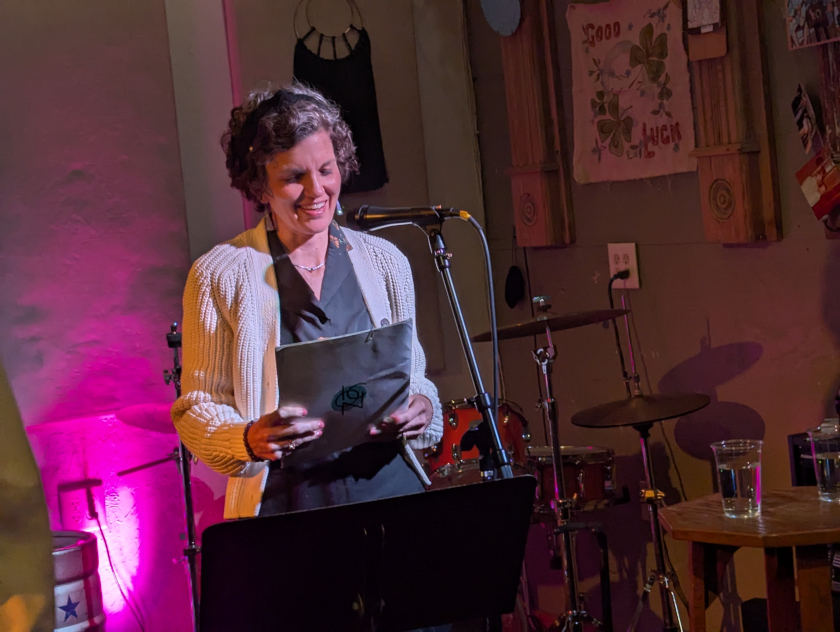
I’d been writing a lot of poetry in the past few years, and a few days after my diagnosis, I gave my first solo poetry reading. The day after surgery, I wrote three new poems. Surrendering my fears led me to a state of grace, which has fed my creativity. “Write more, worry less,” is my new motto.
I also know that I would be writing something very different if my prognosis were different. I once interviewed a young woman in her thirties with metastatic cancer. I asked her if she’d learned anything from the disease, and she said, “I haven’t learned anything that I wanted to know.” My own luck makes it much easier, even necessary, for me to view cancer as a wake-up call, even a gift, to unlocking the larger truths of my life.
Turning fifty amidst all this has been sobering. Many of my friends have thrown big parties, or gone to exotic places like the Galápagos Islands or Anguilla. I spent my birthday with a heating pad on one side of me and my notebook and two cats on the other — with beloved people, strong coffee, and good Indian food. And I guess I wouldn’t have had it any other way. Just like when I’m in the doctor’s waiting room, looking around, thinking about how no one really wants to be here. Yet, given the circumstances, there’s probably no place anyone would rather be. Life is like that: Even on a bad day, we just want more of it.