Emigrants convey their native culture to every far corner of the world where they move in their quest for jobs and better opportunities for themselves and their children. They carry with them the stories and traditions of their motherland, their family narratives, and the customs of their regions. Italians are no different in that regard. They keep celebrating Christmas and Easter as they used to do in their hometown, and, when it happens that the whole neighborhood is made up of their fellow countrymen, they join forces to honor their patron saints, decorating the street with lights and having processions, holding up the statue of whichever heavenly intercessor is being commemorated. All this with a brass band. What they certainly decant with them is the culinary heritage.
Emigrants coming from the south of Italy will make cauldrons of tomato sauce in July, to bottle and preserve, an indispensable staple for their consolatory plate of spaghetti in winter. On special occasions, they will feast on lasagna or polpette fritte (fried meatballs), or perhaps on polpette al sugo (said meatballs with sauce) served with homemade pasta, an apotheosis. An Italian housewife will make tiramisù using the same brand of coffee she used in her native village; if unavailable in her adopted country, she will have it sent from friends and relatives in her homeland, and she will try to smuggle in a supply on her return from a holiday in Italy. She will brew coffee in a Bialetti Moka Express, of course. In some places, peasants from the south of Italy introduced their neighbors to the delight of wild vegetables, which also grew locally, say, in England, but were sadly neglected by the natives, at least before Elizabeth David or Patience Gray published their illuminating books on Mediterranean cooking. They would amaze locals by just boiling the weeds, then pouring olive oil on top and eating them still hot accompanied with some homemade, possibly hard wheat, bread. They would also toss wild chicory in olive oil with onions or garlic, the latter anathema to the British until a few decades ago. In 1861, Isabella Mary Beeton, author of the hugely popular Mrs. Beeton’s Book of Household Management, described garlic as smelling “offensive.”
Italian expatriates would preferably buy an Italian car, with Fiat as a second choice if they could afford an Alfa Romeo (at least until Italian brands became wildly expensive compared with foreign vehicles of the same class).
An Italian man will hardly renounce his glass of wine on a Sunday lunch, but wine can be expensive abroad, so he will go to extremes to produce his own wine. Some friends of mine in England would buy a ton of grapes and spend a weekend squashing them and cranking the wine press to produce a few barrels of red nectar to share among them.
The stories behind emigration can sometimes be adventurous (I know of a couple of people from my village who reached Ellis Island traveling as stowaways, but that could be a story for another time). All of them have a touch of tenderness.
Both Pina and Gino were excellent cooks, and they nourished their children and their grandchildren with pasta, vegetables, fruit, and hearty integrations of meat and fish, which Pina brought to the table in a triumph of Salentino fragrance and taste.
Gino and Giuseppina (Pina as family and friends called her) came from Alezio, my native village in Salento. They were young and in love, just married, when they decided to seize an unexpected opportunity to migrate to England. Gino’s elder brother had met a British officer during the war in northern Italy. They became friends and when the war was over, before returning home, the officer offered him his assistance in case he might wish to immigrate to Britain and find a job there. Gino’s brother said he was grateful for the offer but that he could easily find a job in Italy, adding “Maybe my younger brother . . .”
A few years later, in the early fifties, Gino and Pina were waiting in line at the passport and custom control office in Dover. When their turn came, the officers looked at Pina, shook their heads, and denied her entry into Britain; Pina was visibly pregnant and at the time regulations prohibited access in Britain to pregnant women, probably to avoid an increase in the costs of welfare. During the war, the country had accumulated debts toward other countries amounting to several billion pounds. Rationing continued in Britain well into the fifties. The British army officer, let’s call him John, who was waiting for them behind the custom desks, managed to intervene and stand guarantor for the young couple. Gino and Pina were allowed to cross the border.
They faced the difficulties and the harshness that all emigrants have to tackle in a foreign land: prejudice, diffidence, nostalgia, the feeling of disorientation in a city apparently boundless, and, of course, the challenge of learning a different language, so strange to their ears used to Mediterranean sounds and the sweet cadence of the Salentino idiom.
Yet Gino was a resourceful young man, and he soon found a job in a tailor’s shop in Russell Lane, in north London. Later, he was hired as a pastry cook at the Friern Barnet Hospital, the largest mental institution of Britain, where he soon rose in rank to managing the food service and where he also continued to work until his retirement. Pina also found a job in the same hospital.

A picture of Pina and Gino, taken in the 1950s, in London, England.
Both Pina and Gino were excellent cooks, and they nourished their children and their grandchildren with pasta, vegetables, fruit, and hearty integrations of meat and fish, which Pina brought to the table in a triumph of Salentino fragrance and taste. And Gino was a master in all sorts of cakes, in addition to bread and Yorkshire pudding. During my spells in London, in the seventies and in the eighties, I was often the recipient of their generosity and their industriousness in the kitchen of their terraced house in New Southgate. On my first time in London, they even put me up for a few weeks, until I found a job and an accommodation of my own.
Today Gino and Pina rest together side by side in a north London cemetery, but their grandchildren have not forgotten the mouth-watering dishes served by Nonna and Nonno. A few weeks ago, I was presented with a booklet produced by one of their grandchildren, Christopher O’Gorman (of Salentino-Irish descent), whose title is slightly reminiscent of a Ian Fleming novel, “From Alezio with Love. Recipes and stories from Luigi and Giuseppina Gatto,” a small collection of some of the dishes most popular in the family. The thin volume, finely devised and privately printed, has been handed or sent to relatives and friends, a precious gift. However, a small publisher could be interested in a larger and commercial edition, maybe revised and expanded, as a first introduction to Salentino cooking for the benefit of all food lovers. Think about that, Chris!
Readers of this magazine might like to try the following irresistible recipe, published in “From Alezio with Love.”
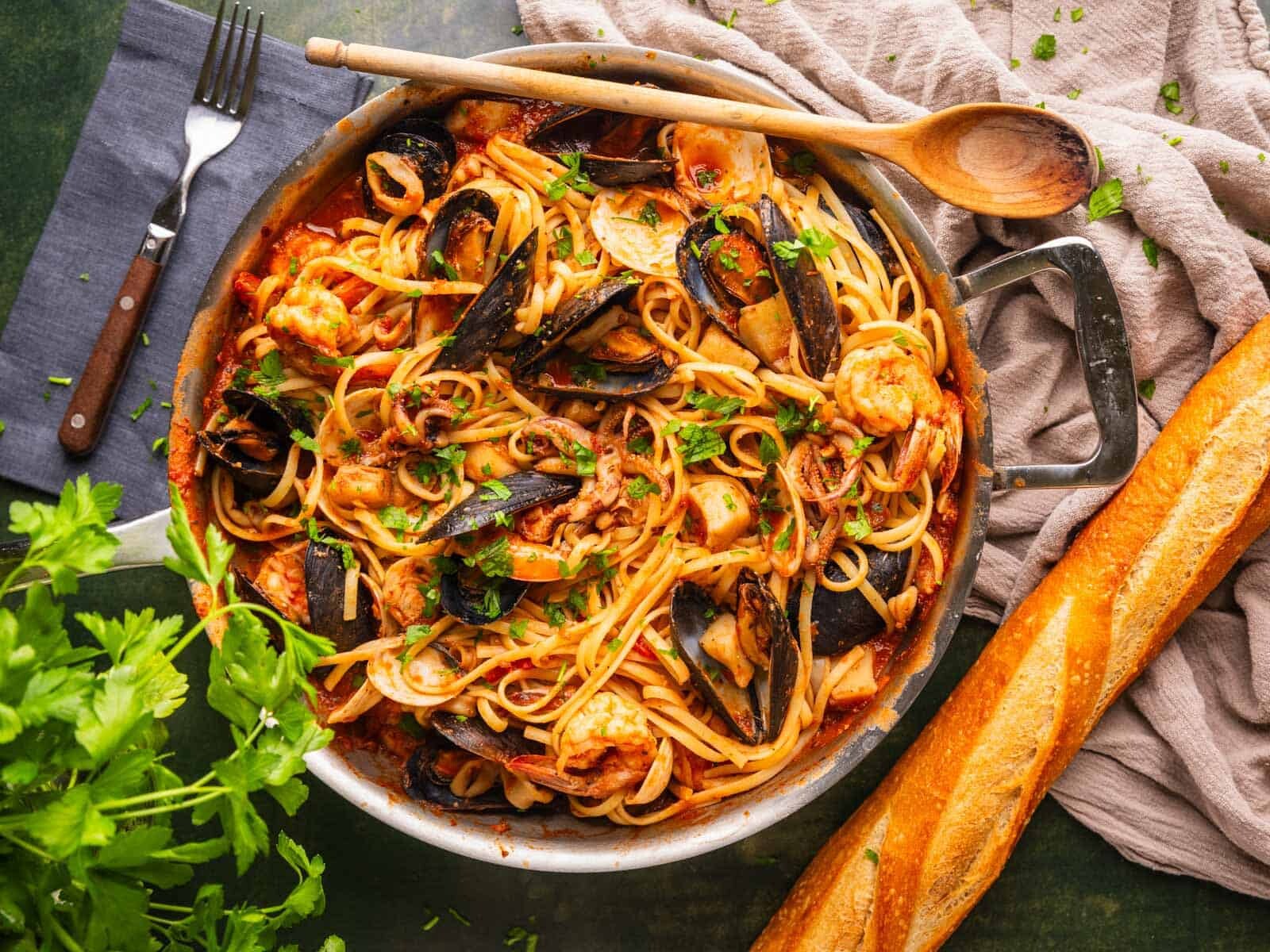
Linguine ai frutti di mare (linguine with fruit of the sea)
Ingredients:
- A tablespoon of olive oil
- 2 cloves of garlic, sliced
- Red pepper flakes
- ½ cup of dry white wine
- 12 Manila or littleneck clams
- 10 ounces of linguine
- 3 or 4 cups of tomato sauce
- 12 black mussels
- 8 shrimp, shelled, (tail intact) and deveined
- 4 sea scallops, quartered
- 5 ounces of calamari, cut into thin rings
- ¼ cup of fresh flat-leaf parsley, coarsely chopped
Method:
Boil water in a large pot while heating oil in a large sauté pan over medium heat to cook garlic until sizzling. Add red pepper flakes to taste, cook for one minute. Add wine and clams and cover the pan. Raise heat to medium-high and cook for five minutes. Add linguine to boiling water and cook them until they are “al dente.” Uncover sauté pan and let simmer one minute more. Add tomato sauce and season with salt and pepper. Add the rest of the seafood and cook, stirring until clams and mussels open, about three minutes. Toss with linguine, add parsley, and toss again. Divide among four bowls.*
Bon appétit!
*Many thanks to Christopher O’Gorman for permission to reproduce the previous recipe.