
Here is a letter I wrote in November of 1986 to Irwin Glusker, who was then art director for “Gourmet Magazine.” He died in August 2022, at the ripe old age of 98.
Dear Irwin,
The first thing to do upon arriving in Rome for a six-month stay (especially, if you’ve just had a 15 hour journey) is to drink a creamy espresso ristretto. The second thing is to buy a half-pound truffle from Pierluigi Manfroni, the dashing, dark-eyed owner of Ristorante Il Bersaglio in Cittá di Castello. Il Bersaglio specializes in local porcini, white and black truffles, and game, such as cinghiale, pheasant, quail, and all sorts of little birds that Italians insist on eating even though they are diminishing yearly (the birds, not the Italians).
Pierluigi could not have been more than thirty when we first met him, young for the padrone of such a large restaurant. I remember the meeting because his crazed dark eyes grew even darker as he talked with a kind of madness about how the whole purpose of his life was finding and cooking truffles.
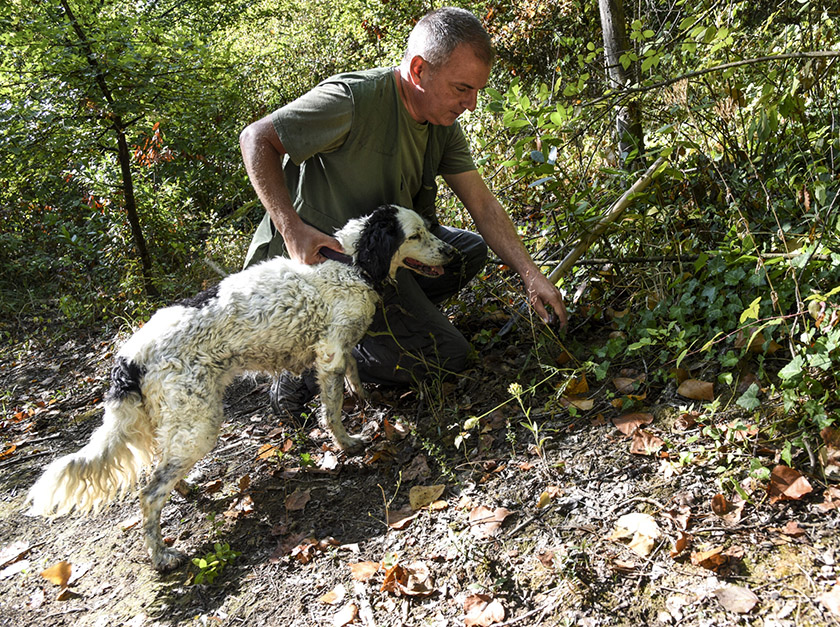
His fingertips are coffee-colored with something like tobacco stains, probably permanent stains from digging for truffles for over thirty years in the rich espresso-colored soil of Umbria.
He swears even today that the truffle is a magical food with rejuvenating powers, and if his looks at his present age are any indication as to the truth (or lack thereof) of such a statement, we should all be eating them daily along with our multivitamins. A truffle shaved upon four eggs in the morning, he says, will give one enough energy for the rest of the day, and he himself sleeps no more than four or five hours a night, kept awake, no doubt by the practically Machiavellian strategies that truffle hunters entertain in order to find their treasures. Sleep deprivation does not effect Pierluigi. His fingertips are coffee-colored with something like tobacco stains, probably permanent stains from digging for truffles for over thirty years in the rich espresso-colored soil of Umbria.
One of our first trips to Umbria was to see Alberto Burri, the Italian sculptor and artist, who lived and worked, in Cittá di Castello. The graceful Palazzo Albizzini was stripped to accommodate Burri’s enormous canvasses. It is a unique museum in that it was designed by one very good artist, Alberto Zanmatti, for another, and this in itself is worth the trip, whether one ends the day with truffle madness or not.
We found Burri that evening in his kitchen, part of another old palazzo, restructured to make wall space for a few of his private pieces. We sat and talked and drank the local red wine, although because of his illness, he abstained from rich food and too much sipping of sulphites and tannin. I remember an evening some years ago in Los Angeles during which he whipped up a grand spaghettata with garlic, oil, and hot peppers; he was a cook and a food lover, so it was difficult for him to give up cooking so many dishes. His wife Minsa was also an accomplished cook, and I am sure they must have given in many times to the temptations of the truffle, the grape, and the pungent porcini during their long life in Cittá di Castello. Now Burri is gone, leaving in his wake a collection of riches and fond memories of one who was fortunate to live among the tartuffi.
After what was to be, sadly, our last evening with Burri, we proceeded to our evening of truffles at Il Bersaglio. There were two or three large parties of men who had already begun on the six-course dinner. Waiters hurried by with enormous platters of tagliatelle over which were then shaved the precious white jewels, and fortunately for us, weighed rather haphazardly and whimsically at this restaurant rather than precisely to the gram as they are in Rome. By mistake a harried waiter brought us bowls of cream of porcini soup in addition to our all-truffle menu, and from that we worked our way through truffled pasta, truffled squab and pheasant, truffled salad, gelato di tartuffi, and an after-dinner amaro da tartuffo, essence of truffle in a bottle, guaranteed to be the perfect digestive for what has gone before.
We then had a shot of Fernet, just for insurance.
The following morning, Signore Manfroni helped us, with great care and attention, to chose our Romeward-bound truffle. We had three days to find and rent a kitchen in which to make risotto or tagliatelle, and so the half pound truffle rested in the refrigerator at the Hotel d’Inghilterra while we received dozens of tips from everyone on the care and feeding of fungi; some were of the aluminum foil school while others swore by the arborio rice preservation method, an added advantage being that a truffle-scented rice will then lie in wait for a perfect truffle-infused risotto. Whether the truffle should be shaved thick or thin, on pasta, rice, eggs, or polenta was a source of conversation for anyone with a nose; the truffle’s rather raunchy perfume had seeped through the fridge, through the hallways, and down into the lobby. No one could escape the heady odor of the large fungus we had indulged in, and we were still debating whether to transfer it from the foil (Pierluigi’s preference) to rice when, on the second day of searching, we found a villa in the Borghese gardens. The truffle was transported to the kitchen of our new home, but, before that, everyone gathered around, as though participating in some solemn religious ceremony, waving goodbye to the truffle. Rarely have I seen such tears.
The truffle had been bought in its infancy, if one can call a half-pound truffle an infant; its weight was solid, its color rather dark, as it had not yet been cleaned. Pierluigi had assured us that we had the pick of the litter, and that it would show its true colors as it ripened over three days in transit. Although we were skeptical that our tartuffo would retain every molecule of its integrity after three days, it certainly shone brighter than the store-bought ones that first have to be stockpiled until enough are found for market. They are then transported to Rome or Florence or Los Angeles where they are sold for prices similar to those paid for platinum and this after having lost much of their goodness along the way.
xxx
Our truffle was, as the Italians say, un sogno, a dream.
It sat upon its plate next to its brand-new cutter (a gift from Pierluigi), patiently awaiting its fate of being sliced down to a nubbin over various dishes during the evening. By coincidence, our guests were Marisela and Alberto Zanmatti, who began the dinner by showing us their favorite: truffle slices on fresh buffala mozzarella with a pinch of pepper and, if desired, a splash of olive oil. We then polished off about half of the enfant with a creamy risotto, using our perfumed storage rice, then shaved a bit on a crisp salad of puntarelle with anchovy sauce and finally sent the exhausted but still formidable child back to bed in rice for the next day’s feast. We managed one more lunch with truffle and fresh tagliatelle in cream and one plate of polenta, Parmigiano-Reggiano, and truffle trimmings for dinner, and then it was over.
Since there is a limit to the depths of our pockets, even for truffles just once a year, we may not be so foolhardy again, but I am hot on the trail of some puntarelle and chicoria that grow wild in the fields, and this takes all my attention right now. I will write you in the next letter about agretti, puntarelle, and cicoria selvatica and why I think they are the reason Italians stay healthy and glowing during the winter. Meanwhile, the truffle season is ending, and despite good intentions, we are driving back to visit Pierluigi in the morning.
Ciao from an uprooted Texan who has found nirvana in a bowl of noodles.
