
What’s not to like about this boisterous two-hour biopic about pop music legend Michael Jackson? It captures all the flamboyant superstar’s epic moments — the “Moonwalk” at the 1983 “Motown 25” special, eight seconds of a little-known dance move that shocked and thrilled onlookers worldwide, to the horrific burning of the singer during the filming of a 1984 Pepsi commercial, which left him with severe second- and third degree burns and led to his addiction to prescription medication. In fact, there isn’t much in Jackson’s public career between his start as the eight-year-old lead singer of the Jackson Five in 1966 to his “Bad” World Tour performances at Wembley Stadium in 1988 that is overlooked in this light, well-crafted film. If you didn’t really know who Jackson was and why he had become such a music icon while still a teenager, “Michael” will provide a compelling introduction to the man who came to be known as the “King of Pop.” There are other glaring omissions in the film, most notably Janet Jackson and other members of the Jackson clan who thrived in their own right, were instrumental in Michael’s life, and whose fame (especially Janet’s) arguably helped fuel his career.
But, truth be told, you won’t learn anything about “Jacko” in this film that isn’t already widely known. Hagiography is a term usually applied to works of history that cast their subject in the most favorable light, celebrating, or even exaggerating, their positive attributes to paint a portrait of heroic proportions. “Michael” doesn’t downplay the challenges Jackson faced growing up with an overbearing and abusive father, or the tremendous commercial pressures he faced from ravenous producers eager to exploit his stardom, but this is a story of unmitigated triumph and transcendence. Michael surmounts one obstacle after another and goes on to fulfill the destiny first foretold by his mother, shortly after his birth, when she sensed he was a “most special child.”
But that’s the problem. Jackson, we all know, was a complicated individual with a complex identity, seemingly trapped between an anguished childhood and an unfulfilled adulthood, and a more complete biopic would delve into his personal makeup not just to address the serious charges of sexual abuse he faced that nearly derailed his entire career, but to better explain the sometimes tortured evolution of his creative genius, as well as his love of animals that fueled a fierce humanitarianism. Jackson did triumph over the confining expectations of others, breaking free of his father’s early chokehold on his career and standing up to music executives to fulfill his creative vision, but he paid an extraordinary price. He surrounded himself with children, with animals, and with adoring fans and sought out special friendships in the celebrity world to create a zone of protection and nurturance, and yet it still took ever-increasing amounts of drugs to keep his frightened and fragile spirit intact. He shone, exuberantly, in the spotlight, but was often shy and reclusive off-stage, or in more private social settings. His death in 2009 came two decades after the end period covered in “Michael,” but the warning signs were apparent long before and powerfully shaped his personal life and professional career.
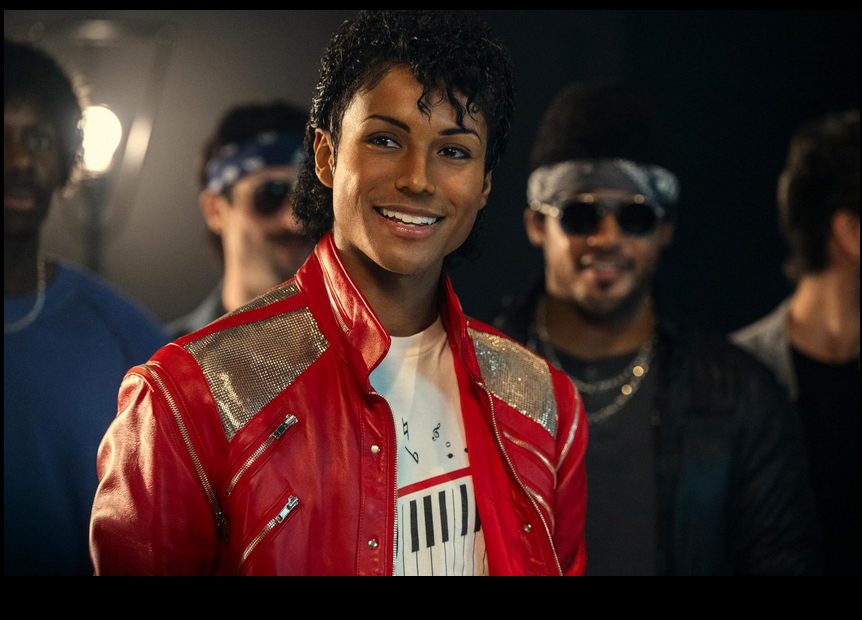
There are other glaring omissions in the film, most notably Janet Jackson and other members of the Jackson clan who thrived in their own right, were instrumental in Michael’s life, and whose fame (especially Janet’s) arguably helped fuel his career. Janet Jackson reportedly didn’t like the way the film portrayed the family, the way they talk, and even the mannerisms. Jackson’s own son, Prince, has also disowned the film several times online. Other family members have expressed the view that too much of the film was made up to suit the narrative, and they couldn’t endorse or participate in it, though they were invited to do so, as was Janet Jackson. Intriguingly, though, it was Jackson’s own nephew, Jaafar, the son of his brother Jermaine, who portrays him in “Michael.” And his resemblance to the pop legend is striking, lending some considerable authenticity to the production.
“Michael” seems to be part of a rapidly evolving movie industry trend. Cashing in on the powerful legacy of a great music star, with a heavy emphasis on the magic and majesty of their music. But unlike the recent Bob Dylan, Elton John, and Bruce Springsteen biopics, a portrayal of Jackson’s angst and inner turmoil is not mined to support potentially critical parts of the narrative. Jackson’s marital and relationship woes, the controversial cosmetic surgery on his face, especially his nose, and his near-death experience after being severely burned are noted only in passing, but they are never really explored. Audiences are invited to sit back and marvel at Jackson’s seemingly inevitable rise to superstardom, with few noticeable setbacks, at least in the early half of his prodigious four-decade career. Perhaps a sequel covering the final 20 years of Michael’s life will delve deeper into Jackson from the inside out. The potential to produce a sequel is clearly there, but don’t count on the industry or Michael’s family and estate to authorize it. “Michael” is just too pat and formulaic to be disturbed by the many dark and hidden dimensions of the singer’s later stages of life. And his tens of millions of worldwide fans — who’ve already looked beyond his foibles — probably don’t want to see it either.
