
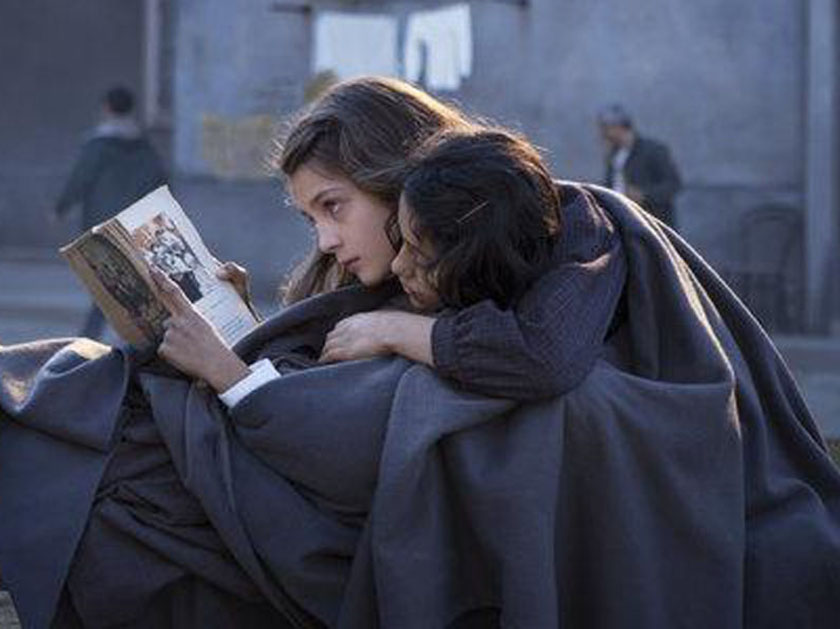
Recently ranked number one on the “The 100 Best Books of the 21st Century” by “The New York Times Book Review,” Elena Ferrante’s My Brilliant Friend, or, to give it its Italian title, L’amica geniale, has gained spirited recognition in the literary world since its publication in 2011, and its subsequent translation by Ann Goldstein in 2012.
The identity of its author, Elena Ferrante, who, since 1992, has published numerous books is a complete mystery, and therefore the subject of enormous speculation.
This particular book is the first of Ferrante’s Neapolitan novel quartet. The story is at once a tragic, coming-of-age-tale and an exploration the intense bond of friendship that exists between the two main characters. With the blunt force of harsh truths, class consciousness, and an unyielding patriarchal framework, Ferrante holds a flame up to the interior worlds of women, social expectations, and domestic violence during the fifties.
Ferrante writes, “I feel no nostalgia for our childhood: it was full of violence. Every sort of thing happened, at home and outside, every day, but I don’t recall having ever thought that the life we had there was particularly bad.
Ferrante writes, “I feel no nostalgia for our childhood: it was full of violence. Every sort of thing happened, at home and outside, every day, but I don’t recall having ever thought that the life we had there was particularly bad. Life was like that, that’s all, we grew up with the duty to make it difficult for others before they made it difficult for us.”
Told in the first person, from the perspective of Elena Greco, or Lenù as she is called, the only comfort, the only relation of warmth and mutual knowing, is between her and her best friend Lila, or Raffaella Cerullo.
Lenù muses, “No one understood us, only we two — I thought — understood one another.”
The story follows their connection from girlhood onward, from tales of youthful competition, shared dreams, puberty, the navigation of male conquest, all the way to the final act of a marriage. Because that is where the story traditionally ends, no?
The city of Naples is itself a character throughout the novel, shaping not only their limited view of the world within the confines of its evocative city boundaries, but the prospective radius that their working class lot would allow. It is a close-knit place of mutual struggle that generates family feuds, affairs, and crimes of passion.
“‘If you don’t try, nothing ever changes.’ What had to change, in her view, was always the same thing: poor, we had to become rich; having nothing, we had to reach a point where we had everything.”
The overall theme of agency — of bucking the sins, mistakes, and shortcomings of an inherited identity — casts an elusive shadow over both Lenù and Lila as they try, through intellectual and material pursuits, to achieve something for themselves. Lenù diligently strives to acquire a higher education that may afford her a brighter future, while Lila dreams of making a fashionable shoe brand out of her father’s existing shoe repair business. One definitively fails, another is left open-ended.
“‘The beauty of mind that Cerullo had from childhood didn’t find an outlet, Greco, and it has all ended up in her face, in her breasts, in her thighs, in her ass, places where it soon fades and it will be as if she had never had it.'”
The overall theme of agency — of bucking the sins, mistakes, and shortcomings of an inherited identity — casts an elusive shadow over both Lenù and Lila as they try, through intellectual and material pursuits, to achieve something for themselves.
What agency the pair strove for, yearned for, and worked passionately for, became a cross to bear, with expectation being that they would simply succumb to their role as women: to attract a man, marry, and make a family.
There is a famous quote by Sylvia Plath that gets at the root of this particular grievance: “What horrifies me most is the idea of being useless: well-educated, brilliantly promising, and fading out into an indifferent middle age.”
Ferrante fiercely portrays this loss, the various injustices and barriers that prevent socioeconomic mobility, doubling down on the fact that the patriarchy not only limited women, but also turned men against each other.
“Men returned home embittered by their losses, by alcohol, by debts, by deadlines, by beatings, and at the first inopportune word they beat their families, a chain of wrongs that generated wrongs.”
The inter-generational traumas and struggles portrayed by Ferrante are filtered through the minds of teenage girls who are forced to grow up quickly. The voice and tone is adolescent yet wise, honest, frustrated, and, at its root, innocent. It is peppered with dialect, Italian idioms, and a striving hope.
“My Brilliant Friend” is as much a coming-of-age Neapolitan vignette as it is a portrait of the loss of innocence.
“There are wars. There is poverty that makes us all cruel[…] Forget it, it was the Devil who invented the world, not the Father, the Son, and the Holy Spirit. Do you want to see the string of pearls that Stefano gave me?”
Though the pen name “Elena Ferrante” is a pseudonym, and this renowned work of literary art has yet to be assigned an authorial face or gender, the story speaks for itself as a masterful documentation of a time and place. It possesses an identity of its own. My Brilliant Friend is a rattling bildungsroman that evokes a candid portrait of Neapolitan life and a lament for lost potential.
Similar literary fiction novels with themes in common are: The Heart is a Lonely Hunter by Carson McCullers, Pachinko by Min Jin Lee, and The Woman Destroyed by Simone De Beauvoir.
