
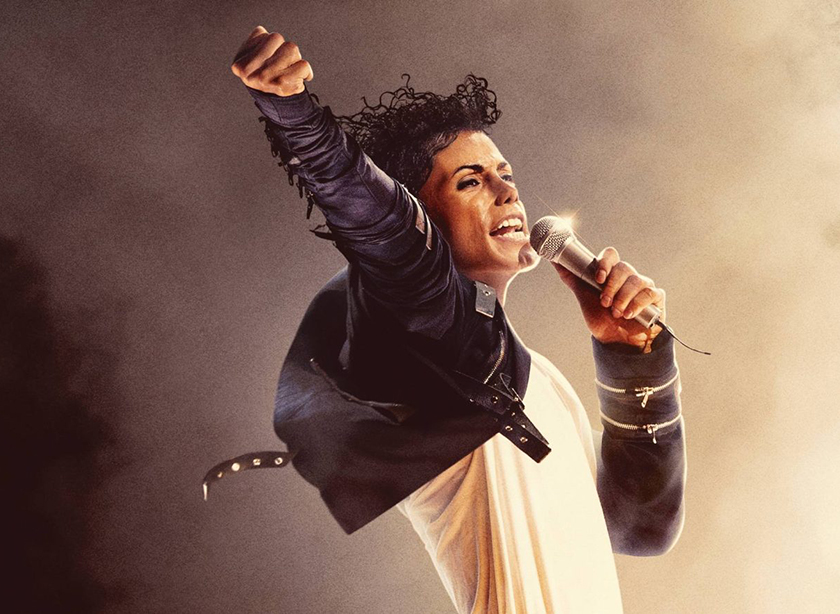
- I come to bury Caesar, not to praise him. – Mark Antony, from his monologue in Shakespeare’s “Julius Caesar”
For months I kept a watchful eye on the internet, scouring for every news item I could find on the topic. The words “Michael – 2026 movie” appeared in my search bar too many times to count.
I followed the making of the newly-released Michael Jackson biopic with quasi-religious regularity. I had listened and danced to his music any chance I got between the ages of ten and 13. But when the movie finally hit big screens throughout the world in April, I responded with a great deal more reserve than might have been expected from the diehard fan I used to be.
The sequined glove had definitely lost some of its glitter, but could that glitter be brought back?
Now, nearly a decade since the release of that documentary and close to twenty years since Jackson’s death, I cannot begin to formulate a clear answer on his innocence or guilt.
Of course I was impressed by the commitment that Michael Jackson’s nephew, Jaafar, put into playing his own uncle: he mastered every one of Jackson’s enigmatic mannerisms and managed to resurrect moves that even Gene Kelly had once called “electric.” Despite this, seeing the first trailer (which had a record-breaking 116.2 million YouTube views in the first 24 hours), left a strange taste in my mouth.
I was four in June, 2009, when Michael Jackson died, too young to be familiar with his work but receptive enough to feel a certain impact from the loss. After a period of staunchly rejecting practically any music made after the 1960s when I was eight or nine, I had an epiphany when my mom bought a Jackson greatest hits compilation for a long road trip. As soon as I heard Billie Jean’s drumbeat intro or the maniacal laugh of Vincent Price at the end of Thriller, I kicked myself for having sat upon such irresistible music for so long.
From the end of primary school right up to late middle school, I went about my life not minding in the least if somebody called me “Michael.” I learned the moonwalk; I was given a pair of faux glittering gloves for my 11th birthday; I would persuade anybody hosting a party, no matter the size, to fit Don’t Stop Til You Get Enough or Rock with You on their playlist just so I could show off my moves. And once I had dedicated myself to acting the part of the fan, I cried too, many years after his death, when I realized there was no bringing him back.
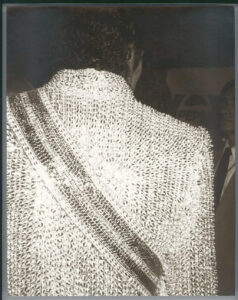
Michael Jackson seen from the back, portrait taken by Andy Warhol.
I must have been fourteen when the documentary Leaving Neverland was released, reinvigorating the child sexual abuse allegations that had dogged the last two decades of Jackson’s life. I can still recall classmates rushing up to me in the schoolyard before the bell rang, as if to ask my statement for the press. “William,” they felt it their duty to say, “your idol’s a pedophile.”
I covered my ears at the time. Was I right in doing so? I knew the names of Jackson’s accusers and knew enough to be disgusted by what they had revealed, even though an FBI investigation in 2005 had led to the superstar’s acquittal on all criminal charges against him.
As I continued my schooling, Michael Jackson’s music still held a special place in my heart even though my obsession had waned. I never stopped being haunted by those words I heard in middle school, however, and while I was generally in the habit of separating art from artist, I found this to be increasingly difficult with the King of Pop. I prided myself on being an independent spirit, a free thinker, but could not decide which version of the truth to believe. The sequined glove had definitely lost some of its glitter, but could that glitter be brought back?
Now, nearly a decade since the release of that documentary and close to twenty years since Jackson’s death, I cannot begin to formulate a clear answer on his innocence or guilt. This superstar’s case was my first exposure to a dilemma that anyone aspiring to be a journalist, historian, or educator must confront: that our admiration for any historical figure, living or dead, can severely overshadow our judgment if we let it, and that can happen very easily. If I do go to see the Michael picture, I will not find the basis for my decision there, no matter how authentic it claims to be. Even the best biopics are not free of bias; they are fundamentally reflections of the people who had a hand in their production, and in this case, the movie’s executive producer is entertainment lawyer John Branca, who is also the co-executor of the Jackson Estate.
Numerous critics – and I would probably join them, if it was my field – have decried the absence in the film of any reference to sexual misconduct in Jackson’s career, and though a sequel is in the works and much of the cast and crew has promised that the subject of the allegations would be tackled, the director Antoine Fuqua himself seemed dismissive of it. “Sometimes people do nasty things for money,” he was quoted as saying in an interview about Jackson’s accusers’ claims. That made me rather skeptical about the airplay that this part of the Jackson story will receive in any future installment.
A film such as this one, particularly when dealing with a subject as complex and as polarizing as Michael Jackson, should bring up more unanswered (and possibly unanswerable) questions than half-convincing conclusions.
In a very ideal world, anyone watching a biopic such as Michael should be placed in the position of a conflicted historian. A film such as this one, particularly when dealing with a subject as complex and as polarizing as Michael Jackson, should bring up more unanswered (and possibly unanswerable) questions than half-convincing conclusions. I expected – perhaps naïvely – that Michael would pick up on the spirit of Akira Kurosawa’s Rashomon or the historiography of Howard Zinn, delivering a polyphony of perspectives on one man, one phenomenon, and force the viewer to surrender their own vision or prejudices on the matter. But we are not in that ideal world, not all movies are Rashomon, and it can take decades for the public to accept the multifaceted, often contradictory, nature of one individual’s legacy. I have in no way reached that point yet, and in all good conscience, I cannot assume that Michael, for all its performances, its energy and the praise it has drawn from Jackson’s family members and fan base, will help us move in that direction.
I would like to end by describing the one visual document that, in my estimation, captures anything close to Michael Jackson’s essence. It is a “portrait” photograph taken by Andy Warhol – who isn’t best-known for his camera work – in the mid-1980s, just as the superstar is about to take the stage before a show on the Victory Tour. I put portrait in inverted commas because we do not see Michael’s face, only the back of his military-style jacket, sequins glistening. It stands perhaps as a prediction of what the self-proclaimed king would become: a will-o’-the-wisp, who tricked the spotlight whenever it tried to hold him in one place for too long.
