Ash Wednesday marks the beginning of Lent, the 40-day period of prayer and penitence in preparation for the feast of Easter. As a child, I remember my mother coming back home from church early in the morning, after the half-past-six Mass, with a pinch of ash standing out against her ebony hair. The day before Ash Wednesday is “Martedì Grasso,” Shrove Tuesday (or Mardi Gras, more in accordance with New Orleans tradition), which closes Carnival, a much more secular and goliardic time of year.
In my younger days, Carnival was a major event all over Italy, but particularly in towns and villages scattered in the southern countryside. People disguised themselves in fancy dresses as Harlequin, Punchinello, or some other stock comic character of the Italian tradition, more often simply using a mask and wearing grandparents’ or opposite-gender clothes and shoes, and would parade the streets at night, ringing bells at friends’ and relatives’ houses, challenging the dwellers to recognize them. They would offer confits, throw confetti and paper streamers, and the air reverberated with the sound of party blowers and whistles.
In my younger days, Carnival was a major event all over Italy, but particularly in towns and villages scattered in the southern countryside. People disguised themselves in fancy dresses as Harlequin, Punchinello, or some other stock comic character of the Italian tradition . . .
It is not entirely clear where this festive tradition stems from, but scholars generally agree that its origin dates to pre-Christian times; plus, it may be linked to Roman Saturnalia, a seven-day celebration that took place in December in honor of Saturn (who was also the god of sowing) and his wife Ops (the goddess of harvest). The Greek god Cronus, who kept watch over harvest, was celebrated in the Cronia feasts every year. In both festivals, the normal order of things was disrupted, work was suspended, and slaves had the freedom of saying and doing what they liked. Moral restrictions were loosened. Spring agricultural rites, celebrating death and resurrection in nature, were also held in ancient Babylonia and Egypt. These ancient rural traditions are also interpreted as a dramatization of the fight between death and life, winter and spring, with the triumph of the latter and the resurrection of nature. The Church used this symbolism and established the feast of Easter and the Resurrection of Christ to fall at the beginning of spring.
With the coming of Christianity, the Church permitted some pagan festivities to continue. The Saturnalia was purified of its pagan connotation and renamed Carnival, from the Latin carnem levare or carnelevarium, the Latin word for “meat” being carnem, while the verb levare means “to put aside,” a reference to the following Lent, a period of abstinence from meat (and from sexual activity!). During my teaching years in the north of the country, in Borgosesia (in the Province of Vercelli, Piedmont), I remember that some of the spirit of Carnival extended into Ash Wednesday. On that day, locally called “Mercu Scurot” (Dark Wednesday), starting early in the afternoon, people wearing old-fashioned 19th-century clothes and hats wander the streets, stopping at bars and knocking at doors, asking for wine to be poured into a small ladle (sometimes not so small) hanging from their necks. Then, they proceed to drink it, before moving forward. By early evening they are already obfuscated by alcohol, their brain and vision “darkened,” their pace wavering as they walk along arms linked, singing aloud drinking songs and shouting themselves hoarse.
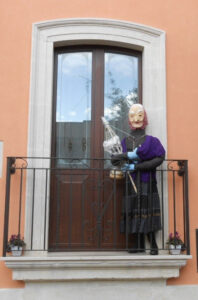
Carnival hag Caremma hangs out on a balcony in Gallipoli.
Today it is no longer so common to see masked people parading the streets and merrymaking, but celebrations are still held all over Italy during the last days of Carnival. In Gallipoli, a nearby town where I attended high school and years later taught English for more than three decades in the very same classrooms, Carnival is a long-established and still well alive tradition. It is in no way on par with the Venice or Viareggio celebrations, but nonetheless it is a major local event, with its masked pageant and parade of carnival floats attracting visitors from all over Apulia. According to some, the custom dates back to the Middle Ages. Like many Italian towns and cities, Gallipoli has its own stock character, “Titoru” (a corruption of Teodoro). As the legend goes, Titoru was a young man who, upon returning home from his military service, being too gluttonous and impatient, was choked to death by a meatball his mother had prepared, meatballs being the traditional Mardi Gras dish in Gallipoli. Masked groups stage fake funerals on the last days of Carnival, carrying around Titoru in an open coffin, surrounded by howling mourners, his face painted yellow and red (the colors of the town of Gallipoli). Titoru’s mother is “Caremma,” another stock character of Gallipoli. This grotesque character is represented as a hag, and her effigy appears on balconies and in the streets during Lent.
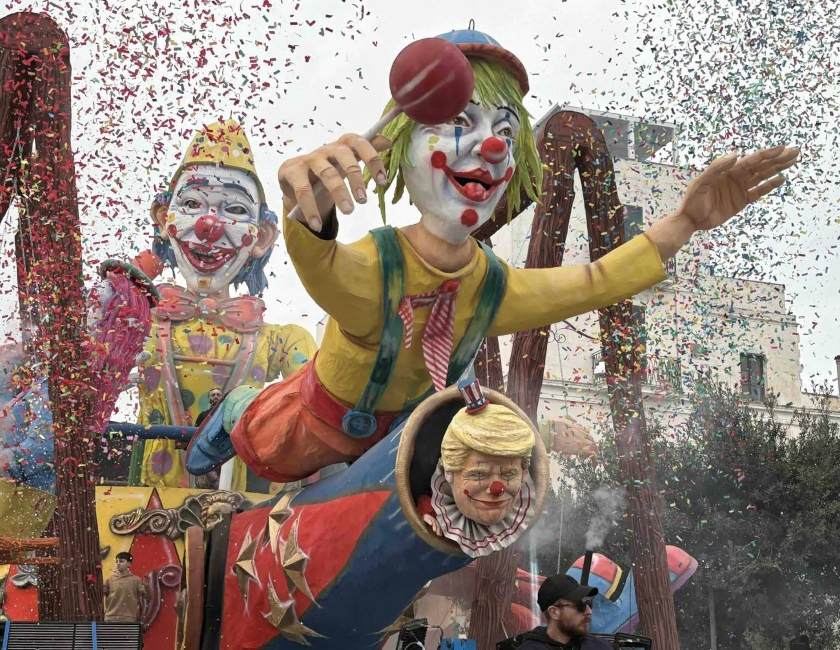
A parade of Carnival floats goes off along Corso Roma, the main street of Gallipoli, every year. Its first edition took place in 1941. Carpenters, mechanics, artists, and, most of all, papier mâché masters work for months in their spare time to create allegoric carnival floats topped with huge, grotesque characters whose movements are generated by complicated invisible mechanisms. The production of these short-lived masterpieces is carried out in hangars and is a most closely guarded secret. Nobody is allowed to see the works in progress. Only during the parade, on the last Carnival Sunday and on Shrove Tuesday, the fruit of long hours (and nights) of toil is offered to the admiration of the crowd thronged behind the barriers. The “carri allegorico-grotteschi” (grotesque allegorical floats), towed by tractors, file between people lined on either side and in front of the stand where a jury is sitting. Prizes are awarded to all floats in recognition of the skills and meticulous care of the creators. A special first prize is assigned to the winner of each year’s edition. Oreste Scorrano, a young man who years ago had attended my school, and his team won this 2026 edition presenting a grotesque float whose title was “Living like a Clown,” a satirical allegory, among other things, of the behavior of modern politicians at large. Donald Trump is depicted as being blown out of a cannon like the fat lady in a circus, and many have identified, rightly or wrongly, the clown sitting astride the cannon as an effigy of Italian Prime Minister Giorgia Meloni, epitomizing the convolutions of Italian political life.

“Mercu Scurot”(Dark Wednesday) revelers in Borgosesia, with their wine ladles. Photo by Paolo Brignone.
Scorrano explained to me that his float is an allegory of some quarters of contemporary society, where young people and adults live “like clowns,” with no responsibility, respect, and limits. Everything is ridiculed, evil is trivialized, and people play with violence and with the bodies and lives of their fellow creatures. The message is an exhortation to reflect on the premise that living without rules, empathy, and conscience is not freedom but a dangerous pretense.
Oreste Scorrano started working in the construction of the Carnival floats in his childhood and boyhood as a young apprentice. In time, he rose to become the leader of an 18-person team dedicating their free time to the production of a float for the yearly parade. “Various different skills and professionals cooperate to construct a float,” Scorrano said. “At least two blacksmiths, one carpenter, one electrician, and one expert in hydraulics, two modelers and sculptors, and about ten assistants to produce the papier mâché, paste it on the frames, and keep the hangar tidy.” He added that, “Carnival celebration was a more deeply felt tradition in the past. Younger generations are no longer fascinated by this ancient tradition. They certainly like merrymaking at Carnival and watching the floats parade, but they are not willing to come to work and learn how they are made.” Moreover, he lamented, “costs are skyrocketing, and the prize and the financial contribution of the Town Hall do not cover the expenses. We do it just for sheer passion and to preserve the tradition.”
Scorrano works as a manager in a bread-making factory, which incidentally reminded me of the title of a brilliant and hilarious book that an Australian friend of mine published years ago, “The Breadmaker’s Carnival” (Andrew Lindsay, 1998), a fitting tag for the winner of this year’s edition of the Carnevale di Gallipoli.