
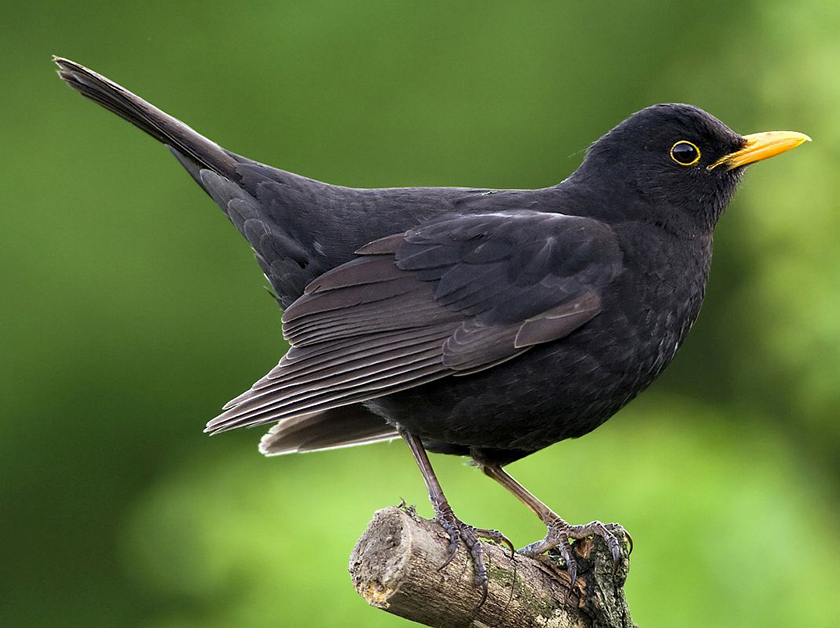
A shiny, blue-black merle is drinking from our terrace birdbath, throwing back his little orange beak, and enjoying the cool water on this very hot day at the end of May.
Friends who came yesterday to see the garden and have a glass of wine informed me that the French merle is called a blackbird, Turdus merula, in Canada, England, and God knows where else, but here in France, a merle is a merle, and they sing as if it is their only purpose in life besides pulling long, juicy worms from the base of the artichokes. Their singing is a delight. They never, ever sing the same song twice. Perhaps a good lesson for us. Try to change your tune from time to time.
Our garden has been honored by a pair of blackbirds (or merles, if you prefer) for almost two years now. In the beginning, I watched jealously as they swooped and sang in my neighbor’s garden, a magical piece of land that has been planted since his great-great-grandfather’s era.
I thought about how many times our merle has shown me his world through music, perhaps saying thank you for his daily breadcrumbs, his clean water supply, his fat earthworms that thrive on my compost, the straw from my mulch with which he builds his nests. And I thought, “Perhaps it’s a bit arrogant to try to sing with a merle, king of the garden, right up there with a nightingale. Perhaps this merle is really trying to help me learn yet another lesson.”
If I could have seen the raised eyebrow on our first merle (the nonexistent eyebrow), I might have known that he was casing the joint. Were we the right sort of audience for such an important member of spring’s orchestra? Did we have salivating cats or lurking dogs? Did we know that dried toast with seeds are preferable to those made from plain, white flour? And would we truly appreciate his skillful warbling in the way that our neighbor did? Our neighbor is a thoughtful man who once, after having found a poor little merle with a twisted beak, unable to forage for her dinner in the earth, dug the worms up himself and left them on the soil where they were instantly accessible. The little merle followed him through the garden, never leaving his side.
Listening to our talented merle, I thought to talk back, to imitate the crazy notes of his original songs, hoping to communicate, to make him know just how much he brightens my mornings and evenings. After every trill, I whistled back, following his notes as well as could be expected from a lowly human, and he continued to sing. Each song he produced was more complicated than the previous one, and I found myself trying harder and harder to follow his merle melodies, sort of like dueling banjos, only done with whistles.
After several minutes of what I thought was a lovely dialogue, he really let me have it — a song so rich with whistles, warbles, and trills that I finally surrendered to the master.
“Ok,” I said to our merle, “It’s all yours now; just go at it and show me what you can do.”
I thought about my propensity to interact with almost everything, even merles, to talk with everyone I meet when perhaps he or she might wish only to get on with a busy day, to offer solutions for friends’ complaints, when all they really want, and need, is an ear or a shoulder to take some of the weight off their troubles. I thought about how many times our merle has shown me his world through music, perhaps saying thank you for his daily breadcrumbs, his clean water supply, his fat earthworms that thrive on my compost, the straw from my mulch with which he builds his nests. And I thought, “Perhaps it’s a bit arrogant to try to sing with a merle, king of the garden, right up there with a nightingale. Perhaps this merle is really trying to help me learn yet another lesson.”
And so I did something different the next morning when his beautiful music began.
I just listened.
