Apulia’s land’s end, Italy’s south-easternmost tip, is known as Capo di Santa Maria di Leuca. It is a roughly triangular territory, about 16 miles long north to south and about 28 wide east to west. Over the last 22 years, I have been living here, “nel Capo” (in the Cape) as they say, in Presicce, one of a dozen or so villages scattered in the slightly undulated countryside.
According to some, the name Presicce might derive from the Latin word “praesidium,” a Roman military outpost. Anther hypothesis suggests the derivation from “Praesitium,” hinting at the Latin word “sĭtis” (thirst) and the tradition according to which Presicce was founded by the inhabitants of Pozzomauro, a medieval village on the eastern slope of the nearby sierra (remains of the settlement are still visible), who migrated to the plain in search of water. Water was easily available in the new site. Another village, less than a stone’s throw from Presicce, is called Acquarica del Capo, meaning, “rich in water.” The site of Acquarica del Capo seems to have been inhabited since Neolithic times and throughout the ages until present times, as testified by the archaeological finds, by the Celsorizzo tower and the medieval castle, whose original structure dates back to the XII century.
Until recent times, olive groves and vineyards almost completely covered the surrounding countryside.
In 2019, Presicce merged with nearby Acquarica del Capo, a logical, almost obvious decision, since the two villages were already so deeply interwoven that there was no longer any separation between the two built-up areas. On the other hand, they already shared the railway station and the cemetery. The result is the new town of Presicce-Acquarica. The old towns of both the original villages are a characteristic maze of alleys and common courtyards, with beautiful churches and ancient mansions overlooking fine little squares. Residences of the local gentry can be visited during a summer event between July and August (“Presicce in Mostra”). Presicce’s Palazzo Ducale, houses the Museo della Civiltà Contadina (Museum of Rural Civilization). The Museum of Rush (a plant of the marshes which once surrounded the settlement), whose leaves are still used for the production of baskets and fish pots, is located in the Castle of Acquarica.
Until recent times, olive groves and vineyards almost completely covered the surrounding countryside, which is punctuated by characteristic trullo-like dry stone structures, locally known as “pagghiari,” masterfully described by Edward Allen in “Stone Shelters” (1969). In the past, olives were processed in hypogeous olive mills, huge underground grottoes excavated in the calcareous bedrock. The oil produced was not for cooking, but for illumination. The old olive mills are now a museum. Modern olive presses yielding the rightly celebrated Salentino EVO oil have long supplanted the underground mills.
The hundred-years-old olive groves around Presicce-Acquarica, as in the rest of Salento, have been almost annihilated by the spread of Xilella fastidiosa, a disease that causes the rapid shriveling of the trees. Over the last few years, hundreds of thousands of new olive trees have started replacing the dead ones.
Several houses in the old towns of Presicce Acquarica are uninhabited and often in quite a dilapidated state, since a large share of the population migrated, over the decades, to northern Italy, or northern Europe, in quest of jobs. A number of these derelict houses have been recently restored and are now used as summer residences, or they have been turned into B&BS for the throngs of tourists that in summer flock here to enjoy the clear waters of the nearby Lido Marini, about five miles west on the Ionian Sea. To counteract the progressive (and seemingly irreversible) depopulation of the village, last year, the town council announced that a non-repayable contribution, up to 30,000 Euros, might be granted to foreigners who decide to buy a house in the old town of Presicce, restore it and settle there.
However, despite initiatives to revamp the old town, the commendable efforts of the town council (two new parks have been inaugurated recently), and although Presicce is included among the “Borghi più belli d’Italia” (Italy’s most beautiful villages), quite a few corners of the “centro storico” (the old town) still look utterly desolate. Things might be bound for some change, though. Three years ago, artist Marina Mancuso decided to revive some of the most dilapidated spots with her murals and paintings.
Born in Lecce in 1970, Marina Mancuso studied Fine Arts in her hometown and in L’Aquila. Later she started various collaborations with artists and famous brands, performing in Rome, Florence, Milan, Paris and London and exhibiting her works in Milan, L’Aquila and Lecce. She specializes in portraits, mural paintings, trompe l’oeil, generally oversized. Her works are now in art galleries (“Syart”, in Sorrento, and “Vernice Arte,” in Bari, to quote a couple), but are also displayed in offices, public institutions and private houses. Marina was also commissioned to fresco the extensive perimeter stone fences of some factories in the industrial areas at the outskirts of Salentino towns. She also produces illustrations for books and various handicraft. Particularly enticing are her painted canvas bags.
In 2010, Marina and her family moved to Presicce. They settled in the old town, in an early nineteenth century house, with wide working areas for both artists on the ground floor (her husband Silvano is also an artist). Marina says she “couldn’t bear the tumbledown conditions of several corners” of her neighborhood and decided to refurbish them a bit. “I try to bring beauty back to places that have been vandalized.” She set to work, brushes in hand, with her own idea of urban regeneration, sitting on the ground, surrounded by cans of paint, or perched on a ladder, intent on restoring ancient dignity and decency to the scruffiest back alleys. At the beginning, people watched her with a certain amount of diffidence, but soon Marina found passionate supporters and her creations were rapidly circulated via Facebook, Twitter, and Instagram. Local and national newspapers reported on her work.
As if by magic, images of angels’ wings, beautiful faces of children, baby angels, portraits of girls and women, leaning out of windows or deep in their work.
As if by magic, images of angels’ wings, beautiful faces of children, baby angels, portraits of girls and women, leaning out of windows or deep in their work, started to appear on washed out walls, on old doors that had long ago lost their paint , on shop windows, and on somber gray control cabinets, installed by the electricity and telephone companies and disseminated along the streets and in the squares of the old town. Marina also brought back to life an obliterated votive image of St. Anne inside a niche in a narrow alley.
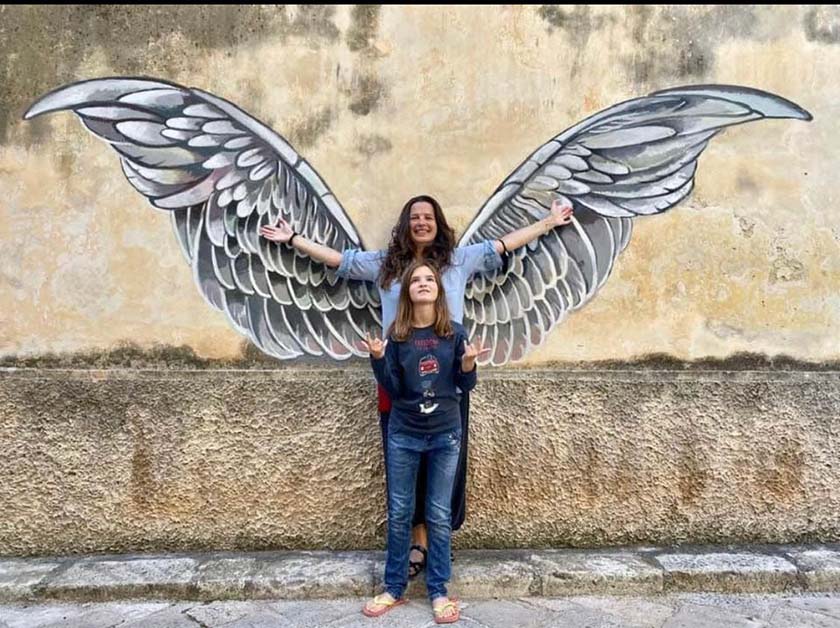
Her paintings exert a magnetic attraction on the tourists, who roam the alleys in search of them, in a kind of treasure hunt. Standing with outstretched arms, for a photo in front of the fully unfolded angelic wings that Marina painted on a white wall, has become an iconic must for visitors. The women she paints, with their daring faces and ruffled hair, seem to convey a message, almost a scream, denouncing the suffering, the sense of anguish and dismay of women in so many areas of the world, including this part of Italy, the “Terra del Rimorso” (Land of Remorse) as anthropologist Ernesto De Martino nicknamed Salento. De Martino was hinting at the bite (“morso”) of a local spider (the “Taranta”) which, according to the tradition, can be cured only by the dance (the “Pizzica”) stirred by the obsessive rhythm of the tambourines, but he was also alluding at the condition of women in the alienating and (especially sexually) repressive patriarchal Salentino society of old. Today, the Pizzica is part of the local lore. Marina likes to point out that even art has loon been a prerogative of men, and that women artists have invariably not received the recognition that male artists have, and that is something which must change. To this end, in addition to transforming Presicce-Acquarica into an open-air art gallery, Marina is generously giving her contribution. One can only hope that she may be leading the way for other young artists to follow.
“It’s comforting to notice,” she says, “that, so far, none of my murals have been defaced by acts of vandalism. Beauty is all around us along these ancient streets. All we need to do is to be aware of it, so we can preserve and renew it.”
For the near future, beside her professional engagements, Marina plans to continue her commitment to revive more corners of the old town (“if they let me do it”), before she and her family decide to move elsewhere.
Marina’s effort to make Presicce Acquarica a better place to live is an act of love, since she is not getting any money for it, but, as has been said, there’s more to life than bread.