
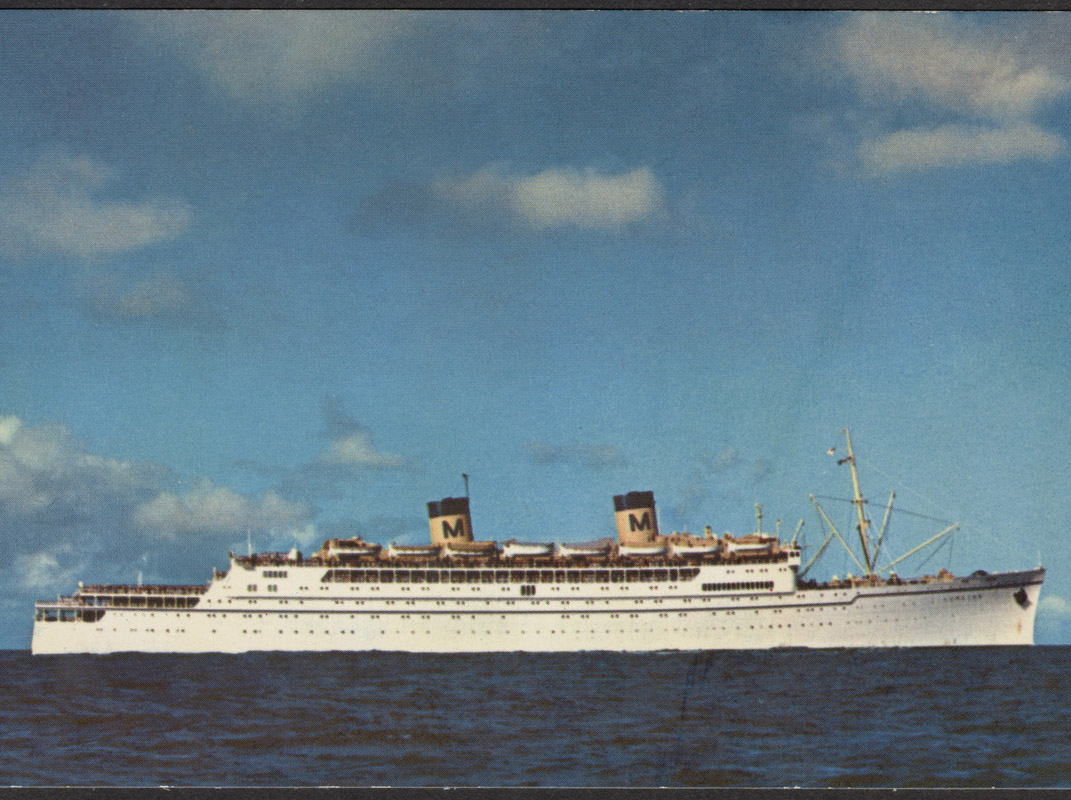
Christopher Winner’s recent “Boyhood Empire” series includes many tales of ocean liners. As San Franciscans, ships resonate with us, as we recall our own glory days of transpacific voyaging.
Matson Navigation, for example, has long had a presence in the Bay Area, dating back to the beginning of the twentieth century, and to this day it retains its place as one of the players in our regional commerce. And it’s one of the most prized tenants of the port of Oakland.
It was in the 1970s, with the increase in air travel, that Matson’s luxury fleet started to fall out of favor with travelers. Before that time, Matson liners had sailed all the way to the antipodes – to far-off Sydney, Australia, and to even farther Auckland, New Zealand. The liners’ more usual destination, however, was the city of its origin — Honolulu.
Among the company’s “White Ships” were the Lurline, the Mariposa, and the Monterey.
Though the romance of that era gave way to the pressure of globalized supply chains, commercial cargo shipping did remain a key part of Matson culture.
Though the romance of that era gave way to the pressure of globalized supply chains, commercial cargo shipping did remain a key part of Matson culture. Indeed, one can argue that this U.S. West Coast legend, being one of the leading U.S. flag carriers, helped to preserve a sacred national safeguard: the Jones Act.
The Jones Act prevents foreign-flagged ships from carrying cargo between the contiguous U.S. and certain noncontiguous parts of the U.S., such as Hawaii, Alaska, Guam, and Puerto Rico.
Foreign ships inbound with goods cannot stop at any of these four locations, offload goods, load contiguous-bound goods, and continue to U.S. contiguous ports, although these ships can offload cargo and proceed to the contiguous U.S. without picking up any additional cargo intended for delivery to another U.S. location.
The Merchant Marine Act of 1920 also ensures that “flags of convenience” are banned from the cabotage trade lanes, thereby ensuring that at least three-fourths of the crew members are U.S. citizens or permanent residents.
With Donald Trump’s return to the White House this January, all bets are off, however.
During his first term as President, he entertained a ten-year waiver of the Jones Act to appease the oil and gas industries, and he may yet revisit the idea if advisors embrace Project 2025 — a Heritage Foundation platform that proposes transferring the U.S. Maritime Administration to the Department of Homeland Security.
Jones Act advocates, meanwhile, continue to maintain that a waiver will have a profound impact on U.S. manufacturing and ship building, making the return to affordable luxury passenger voyages for the masses truly unlikely.
In other words, no “Boyhood Empire” for young adventurers in the future.
