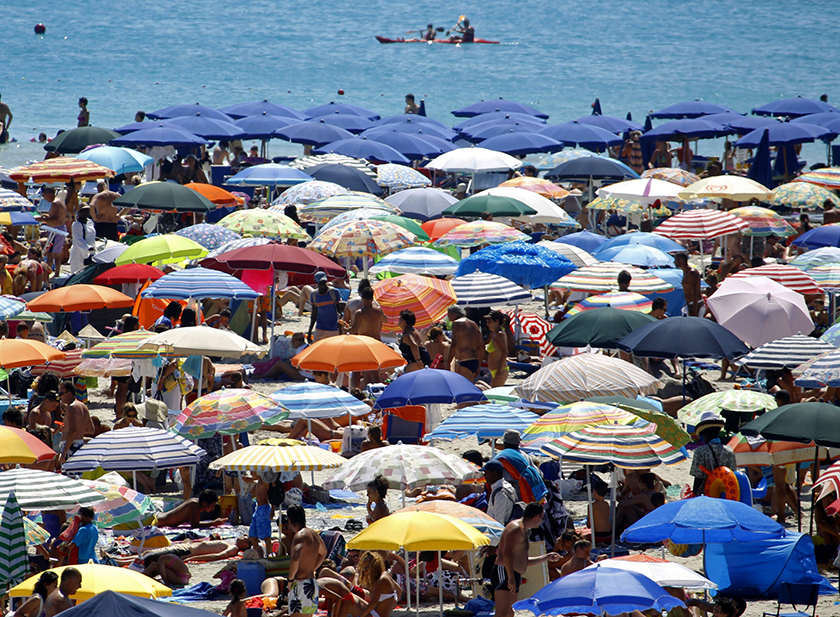
Summer is the season of scorching sunshine, of people flocking to seaside resorts, of sunbathing on golden beaches, of evenings under the moon, of pizza and ice cream in open-air cafés and pizzerias. It is also a time of “great chaos under heaven,” as Mao Zedong reputedly said, though, in this case, the situation is not exactly excellent, at least for residents in tourist stricken villages in Southern Italy.
In my small home town, Presicce, almost at the far end of the heel of the Italian boot, the quiet life of the villagers is disrupted by swarms of cars engulfing the streets. Shops and supermarkets are stormed by crowds of northerners, generally scantily dressed, pushing overflowing trolleys and leaving the shelves bereft. Your favorite brands disappear as soon as they are set out and you have to make the best of what is left. Country roads, and even motorways, suddenly become frightening as motorists rush along in oversized vehicles at racetrack speed.
Many of the elegant clothes and shoe shops have now given way to Chinese stores, pizzerias, rotisseries, Chinese, Indian or Pakistani restaurants, kebab shops, and fast food of all sorts, while two huge shopping arcades perpetually offering special sales, a few miles from the town center, lure shoppers.
Prices of food, especially fresh fish, fruit and vegetables, and beverages skyrocket much to the residents’ chagrin. A common opinion is that tourism is supposed to bring money and wealth to the small rural and seaside communities in southern Italy, and that was certainly true thirty or forty years ago. Foreigners would do their shopping in the small local shops and the money circulated and was invested locally. Then the moguls of the great supermarkets and megastores chains sniffed out business opportunities and shopping arcades sprang up like mushrooms after the autumn rain. So money is now mostly funneled out of town. It is true that they hire local people as clerks, cashiers, technicians, and security guards, but salaries are low, often too low (partly because our present government refuses to pass a law on minimum wage). Some traditional shops could not withstand competition and have closed. Even in a large town like Lecce, many of the elegant clothes and shoe shops have now given way to Chinese stores, pizzerias, rotisseries, Chinese, Indian or Pakistani restaurants, kebab shops, and fast food of all sorts, while two huge shopping arcades perpetually offering special sales, a few miles from the town center, lure shoppers. All summer long, at night, the old town is a global open-air restaurant, with hardly any room left for walking.
However, things gradually return to normality at the beginning of October, when the last waves of vacationers depart, suntanned and overweight, to their northern mists. In due course, prices of commodities will go down a bit. “Special offer” and “bargain” have already appeared on the shelves, with price tags invitingly red, to catch your attention.

A crowded alley in Lecce in the summer.
At home, Pina (my wife) and I are slowly recovering from the usual stream of summer visitors, relatives, and daughters with respective families. They all bring life and vivacity in a house normally inhabited by an elderly couple, and our first grandson, who was born last January, is a perennial source of joy. That also means that, between shopping, cooking and cleaning, driving to the seaside, long Salentino-style meals, exchanging amusing anecdotes and memories, going for an evening stroll for a “gelato” in the village square, there is no time left for other activities, be it just working a bit in the garden or watering plants and flowers.
So the first thing to do after the upheaval is to try to revive the garden. Then, go immediately on a low calorie diet after almost two months of Lucullean meals. As usual, at this time of the year, Pina exclaims, as soon as she steps on the bathroom scales, “Gosh! Vegetables! Don’t ask me to cook anything else for the coming weeks! Maybe, we can add some protein, but no fat. And NO CAKES AND NO PASTA!”
All kind of forgotten objects start to appear, a cardigan, a mobile charger, earphones, earrings, a watch, pills, bathing suits, all left behind by the visitors, and the kitchen table turns into a corner of a lost and found office.
“We’ll keep this for when they come next year or maybe at Christmas. This we must send, she might need it. No, not the watch, of course, too precious to send. I’m visiting them late in November, I’ll bring it …”
One of our married daughters, her husband and their baby boy camped in our bedroom, which is larger and can accommodate a cradle. My wife and I moved to the large room that I use as my study, since other guests occupied the other bedroom. For our own use, we had bought an inflatable rubber double bed that stood towering in front of my desk. Now it lies deflated on the floor, waiting to be neatly folded and stored for next year. My wife has dutifully cleaned and disinfected it with an alcohol, as she does with everything deserving to be preserved. That is why the smell of methylated spirits is always drifting in the air as into a speakeasy of old times.
I put away the old cookie tin in a cupboard in my study. It contains hundreds of mostly black and white or sepia photographs. After dinner, it sometimes pops up and the photos of grandparents, great-grandparents, uncles and aunts are passed around and shown to the kids who have never met many of them, since they were already dead long before they were born.
As usual, at this time of the year, Pina exclaims, as soon as she steps on the bathroom scales, “Gosh! Vegetables! Don’t ask me to cook anything else for the coming weeks! Maybe, we can add some protein, but no fat. And NO CAKES AND NO PASTA!”
It is also time to rewind the old Swiss cuckoo clock in the study where Pina and I slept for weeks. We had stopped it, to avoid being woken up every half hour during the night by the vociferous singing bird and the carillon.
We begin taking longer walks again with our dogs and I started writing something again and contemplating a project for a new translation. Notwithstanding all the good intentions, after a week of this strict diet, Pina is already experimenting with new recipes that she digs out of her computer. She promised to restrict succulent dishes to a couple per week, and in small doses. I am never worried, since everything she cooks, even the humblest weed, turns out delicious.
In the meantime, we both travelled to Rome in October for the launch of the latest book I translated, Dottoressa, an American doctor in Rome a volume of memoirs by Susan Levenstein. The book, published in 2019 by Paul Dry Books, now appears in Italian bookshops under the title of Dottoressa, un medico Americano a Roma. After that we felt we deserved a short holiday, so we went to visit relatives living in the Eternal City. A dinner in Piazza Navona was well worth the trip.
However, not soon after summer ended I caught my first autumnal cold, accompanied by shivers and cough. To make things worse, Pina and I already miss some of the summer excitement and, most of all, our grandson. In fact, though summer joys can be tiring, still they are joys. You appreciate them even more when nostalgia sets in.