

Local ferry commuters and tourist riders who anticipated The Golden State Valkyries‘ debut here this season as an expansion team were first intrigued by the jersey design unveiled by the Women’s National Basketball Association (WNBA) franchise.
For it features a sight familiar to anyone using waterborne craft: The San Francisco Bay Bridge from beneath the iconic structure.
This perspective provides a V-shaped angle for the logo designed by Cartwright, an agency that gave the LA Clippers a similar vantage point, with a sailing vessel for its branding.
According to the designers, they were aiming to symbolize the connection between San Francisco and Oakland, with the bridge cables doubling as wings and the tower doubling as a sword.
The thirteen lines from the sword represent the Valkyries as the thirteenth team in the league, and the wings split the space into five triangles to represent the ten players on the court.
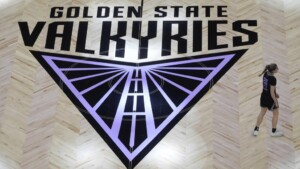
The Valkyries’ on-court logo
Meanwhile, sports fans may not be too well acquainted with the origins and development of the Valkyries in Germanic paganism and Norse mythology.
Most scholars believe Valkyries were originally viewed as “demons of the dead to whom warriors slain on the battlefield belonged,” and that a shift in interpretation may have occurred when the concept of Valhalla changed from a battlefield to a “warrior’s paradise.”
The German composer/conductor Richard Wagner first incorporated “Ride of the Valkyries” in his opera “Die Walküre” (“The Valkyries”), and San Francisco film director Francis Ford Coppola featured the music in “Apocalypse Now” for a scene where helicopter avenging angels exterminate soldiers and civilians in a jungle village in Vietnam.
Back at a Valks game, when the music comes blaring over the stadium’s sound system — the massive Chase Center jumbotron — it can be unnerving.
Opera, too, is a big deal in San Francisco. We have a world-class company dating back to Gold Rush days, led by Asian-American conductor Eun Sun Kim, the first woman to be named music director in the company’s history.
The fact that the Valkyries have an Asian-American coach — Natalie Nakase — is also a nice bit of synchronicity.
Another one for the highlight reel is that, in their first year, the Valks have been named the most valuable American professional women’s sports franchise (not just in the WNBA), worth $500M.
The fact that the Valkyries have an Asian-American coach — Natalie Nakase — is also a nice bit of synchronicity.
The status of women’s pro sports, including the WNBA, is rising, but the Valkyries are still working to develop the gravitas our opera has, so building an identity and fan base remains something of a struggle.
As a consequence, the team has coined the slogan “Put Your Vs Up,” which may or may not have sexual connotations.
The in-game hand gesture encourages fans to hold their index and middle fingers up together. According to the team, the phrase “put your Vs up” challenges the opponent to “bring it on.”
But, in another context, it clearly imitates the “V for Victory” popularized by Winston Churchill during the Second World War, and by the 1960s it was used by U.S. students protesting the Vietnam War as a peace symbol.
Even today the gesture can arouse anger in citizens of the UK, Australia, and New Zealand; if turned in the opposite direction, the V hand gesture, especially when paired with an upward motion, means “up yours.”
What Camille Paglia — the Italian-American academic and social critic — would make of this is anyone’s guess.
In her fourth essay collection, Provocations: Collected Essays on Art, Feminism, Politics, Sex, and Education, she observes that sports and celebrity are practices that actually harm the self-esteem of those who are not rich, famous, or attractive enough to belong to the group, while further defining women only by a very narrow, often sexualized, stereotype.
But from an operatic perspective, what have the Valkyries to do with these professional athletes?
On our way to a recent game via ferry, our informal focus group brainstormed mythic sports links, coming up with exotic V-named alternatives like “Vicunas,” “Vixens,” “Vespers,” and “Vestal Virgins.”
Finally, in keeping with the public perception of San Francisco being a lawless city, we suggest that “Vice” has a nice “Ring” to it.
Hojotoho! Hojotoho! as the battle cry in Wagner’s opera goes.
