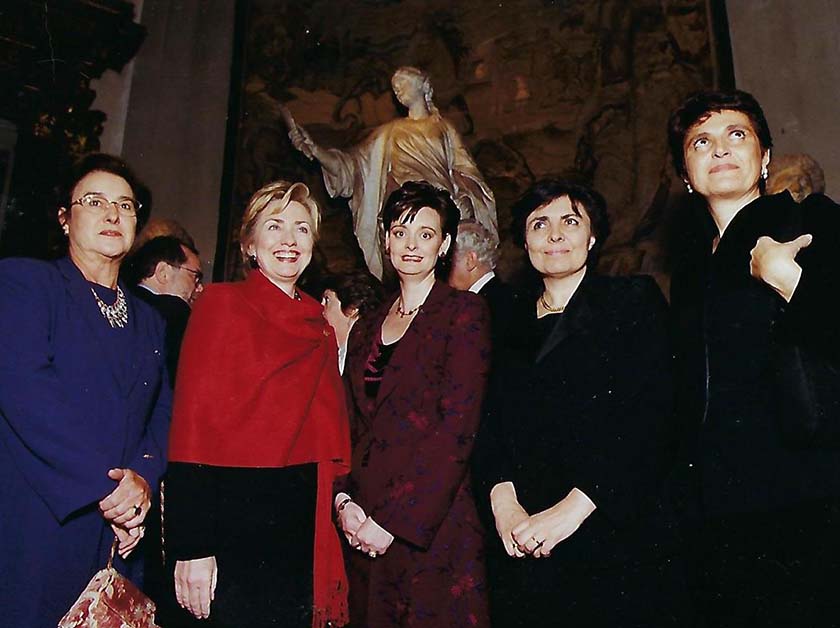
On the eve of President’s Day, I found a photo that’s as close as I’ve ever gotten to a U.S. president – his wife. Madame Clinton, otherwise known as Hillary. In the photo, she’s flanked by Cherie Blair, the wife of former UK Prime Minister Tony Blair, and wives of Italian politicians (the only one I recognize is the late Flavia Franzoni, wife of former Prime Minister Romano Prodi). Behind them is a large tapestry hanging on the wall, and a marble statue of a goddess.
The back of the photo is stamped “Official White House Photo, November, 1999.” I had been in Italy a couple of months at that point, and was probably working as a runner for one of the television networks for Bill Clinton’s presidential visit. Being a runner meant just that: running various errands for the correspondents who’d come to cover the visit. My role was hardly glamorous, but I fed off of the proximity to the famous. I don’t recall how the picture fell into my hands, but I’m sure that I snatched it up, since it featured Hillary, my high school heroine.
Bill Clinton became the forty-second president of the U.S. in 1993, my junior year of high school. Hillary entered the role of First Lady as a feminist icon, fighting for women’s rights all over the world. But her biggest selling point was that she had gone to Wellesley College, the school I had my heart set on attending.
I was immediately smitten. By the neo-gothic architecture, the dormitories with dormer windows, the huddles of young women in libraries with vaulted ceilings.
When Clinton took office, I was just starting my college search. Every day, glossy brochures arrived from colleges and universities around the country. When Wellesley’s arrived, I was immediately smitten. By the neo-gothic architecture, the dormitories with dormer windows, the huddles of young women in libraries with vaulted ceilings. Mostly, I was taken with promises that Wellesley formed strong, successful women, and shaped shy young women like me into assertive goddesses (they might not have used that word, but that was the feeling I got).
Wellesley really won me over when my best friend Sarah took a trip to tour the Seven Sisters, and while she chose Smith, she thought Wellesley was my perfect match. Besides my parents, Sarah knew me better than anyone. We listened to Beethoven’s Emperor’s Concerto together, confided our crushes to each other, and went to a summer arts camp where the poetry teacher told me I had a gift. She was privy to my heart and what mattered most to it.
But my parents quashed my dream. They thought Wellesley was too far, and too feminist. That latter reason made my blood boil. The whole reason I wanted to go to a women’s college was to be around feminists, since, in my mind, my mother wasn’t feminist enough. She hadn’t participated in the women’s movement, and she became a nurse, women’s work, which she later quit to raise her children. Never mind that she wore the pants in our house and was the first person in her family to attend college. A heady teenager, I overlooked nuance and embraced what I recently learned is called matrophobia, the fear of becoming one’s mother.
A heady teenager, I overlooked nuance and embraced what I recently learned is called matrophobia, the fear of becoming one’s mother.
The evening that I lost out to Wellesley, my mom and I were in the kitchen, and my mother gave me a hug and said, “I thought we were losing you.” Suffocating in her embrace, I thought, “At the expense of losing myself?”
Eventually, I found myself — in Italy. After freshman year at Northwestern, my mother’s pick for me, I dropped out to take a gap year, and went to Rome in the spring. As I’ve written elsewhere, Italy gave me both sensual discovery, from the language to the food, as well as intellectual purpose. It was there that I decided to become a journalist, which I came back to Italy to do after college.
During that journey, I learned a trade, a language, a way of life and a set of values that has stayed with me. I overcome my fear of becoming my mother, and confronted my even greater fear of losing her. These are things that I would catalogue in my own college-like coming-of-age brochure. It’s fair to say that Italy became my Wellesley.