

I saw a plaque across the street from a Starbucks, in the posh Parisian neighborhood of Saint-Philippe-du-Roule. The words on it read: Avenue Myron T. Herrick, 1854-1929. Ambassadeur des États-Unis en France. Citoyen de Paris.
Though there was not much information on the plaque, the little there was said a great deal. That Herrick had been the United States ambassador to France (for two non-consecutive terms, as I later learned) would have sufficed. He was also an honorary citizen of Paris, a rare, if largely symbolic, plaudit reserved mostly for a handful of dignitaries who defended French values. Recipients include Winston Churchill in 1944, Brazilian president Lula in 2020, and the publication Charlie Hebdo following the 2015 terrorist attacks.
These honorary citizens are all ingrained in our recent memory or in today’s geopolitics, and Herrick is far from the only American to be enshrined in a street name or other landmark in Paris. Yet, his is not a household name, which is why I earmarked him for further research. Perhaps his story would be an illuminating one in the history of Franco-American friendship, a friendship that now, in the era of President Trump, is strained.
Herrick, former Republican governor of Ohio, acted as ambassador from 1912 to 1914, then from 1921 to 1929. These two periods are close together in time, but, diplomatically speaking, worlds apart.
His first appointment was under fellow Ohio Republican, President William H. Taft. When Taft was renominated, prompting Theodore Roosevelt to abandon the Republican party (for the Progressives) in 1912, that was enough to secure the election of Democrat Woodrow Wilson. Herrick resigned from his ambassadorship 10 days prior to Wilson’s inauguration, as was the usual practice.
Wilson had built his campaign on a platform of neutrality, promising to be a “peace president” that could keep the United States out of the First World War. His decision to intervene militarily in the war in 1917 broke from the 1823 Monroe Doctrine, which forbade any European interference in American affairs, and from the doctrine’s extension in the Roosevelt Corollary of 1905. Well before American entry into the war, however, both Wilson’s and Herrick’s stances on the conflict had not been completely neutral. Herrick had seen his compatriots’ financial accounts frozen on the declaration of war and during the general mobilization in Paris in August 1914, and so he also began espousing an American “military preparedness” doctrine, in the early months of the war, to reinforce alliances with the still-forming Triple Entente (comprising of France, Great Britain, Italy and, until 1917, Russia).
Sometimes I try to cast my mind back to the first few months of the war, when families prayed harder and wept longer, as the naive dream of a “guerre fraîche et joyeuse” (“fresh, happy war”) faded away. This euphemism was used by certain soldiers and European dignitaries to convey the hope that the conflict would be over by Christmas of 1914. But Herrick, like many others, grew increasingly concerned as the war dragged on.
Smaller cities such as Reims did not forget the ambassador either. By the 1940s, Reims had unveiled its own Place Myron Herrick at the heart of town.
Herrick organized an American Volunteer Committee with the support of an expatriate group dubbed the “American Colony” to help Americans in France obtain funds for their return home. In August 1914, under the auspices of the American Hospital of Paris’s Board of Governors, Herrick allowed the French government access to all the center’s medical facilities. France, in return, offered the buildings of the nearby Lycée Pasteur to be reconverted as part of the hospital’s new extension, the Ambulance de l’Hôpital Américain. It was there that numerous American doctors, nurses, and ambulance drivers arrived to tend to wounded soldiers. Many of them saw this as a way of repaying the American debt to France, the country that had contributed the most to the Thirteen Colonies’ independence.
An ability for quick thinking was one of Herrick’s many talents. When notified that 1,000 injured French and British soldiers were stranded at Meaux, a northeastern suburb of Paris, and in need of medical care, Herrick telephoned everyone he knew who owned a car. Soon, motorists from all over the region were shuttling to and from the Meaux battleground, bringing soldiers to the hospital for medical care. This impromptu convoy, the American Volunteer Motor Ambulance, later became the American Field Service — a nonprofit organization that branched into youth exchange programs after the Second World War and still exists today.
Myron Herrick returned to the United States in 1914 and was shortlisted for nomination on the Republican Party’s 1916 presidential ticket. He was not acting under Wilson when the president visited Paris for the 1919 Peace Conference. Over the course of Wilson’s stay, the Treaty of Versailles was drafted, including the Fourteen Points that Wilson had formulated a year prior to advance international diplomacy and lay the groundwork for the League of Nations.
This moveable diplomat’s story, though, did not end there. As the 1920s began, Herrick, nearing age 67, was called back to power by Republican President Warren G. Harding. Incidentally, as lieutenant governor, Harding had been Herrick’s right-hand man when Herrick was governor of Ohio.
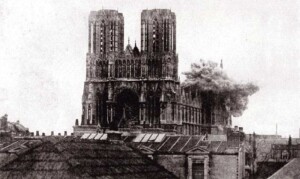
German shells crash into the famed Gothic cathedral Notre-Dame de Reims. Historic photo from Collier’s New Photographic History of the World’s War, 1918.
Throughout his second term, Herrick oversaw the reconstruction of cities such as Reims (in the Champagne-Ardenne region of northeastern France), pummeled by German bombardments during the war. This ambitious program allowed renovation work to begin on the largely razed Reims cathedral, and the city’s public library was rebuilt from the ground up in a unique Art Deco style thanks to funds provided by Andrew Carnegie. The Carnegie Library, now a listed historical monument, was completed in 1927. This was the year that Herrick, now representing President Calvin Coolidge, hosted a gala for Charles Lindbergh in Paris after his trans-Atlantic flight from New York. Herrick’s name was dropped in conversations among Paris-based anglophone writers like Ford Madox Ford and Ernest Hemingway, the latter of whom mentioned him in his posthumous 1964 memoir A Moveable Feast. The passage reads as follows:
“Is [the poet] Ezra [Pound] a gentleman?” I asked.
“Of course not,” Ford said. “He’s an American.”
“Can’t an American be a gentleman?”
“Perhaps . . . certain of your ambassadors.”
“Myron T. Herrick?”
“Possibly.”
Far from the polished decadence of Paris of the 1920s, smaller cities such as Reims did not forget the ambassador either. By the 1940s, Reims had unveiled its own Place Myron Herrick at the heart of town. Yet another Rue Myron Herrick can be found in the city of Tourcoing, near the Belgian border, which was occupied by the German army during the war.
Herrick, unfortunately, did not live to see these two dedications in person. He died at 74 in Paris on March 31, 1929, a few months before the U.S. stock market crash and the beginning of the Great Depression. In his official statement from that day, newly elected president Herbert Hoover declared that “few men in American public life have given . . . such unselfish and such valuable service to their country.” He concluded, “I grieve for the death of a friend and for the passing of a splendid public servant.”
After finishing my first draft, I look back over the trail that Herrick’s legacy dots across France and the United States, a worldly ghost oscillating from Ohio to Washington, D.C., to the Champs-Elysées. Once his story is told, there is little political commentary to add, and as an aspiring history teacher and journalist, I do not wish to moralize anybody. Rather, consider the case of Myron Herrick as a contrast to Mr. Trump, who uses angry messages in all caps on X as his diplomacy. He admittedly sees the world as a Monopoly board. His policy’s ruthlessness lies in its lack of empathy — a quality that he could perhaps learn from people like Mr. Herrick if he were open to it.
